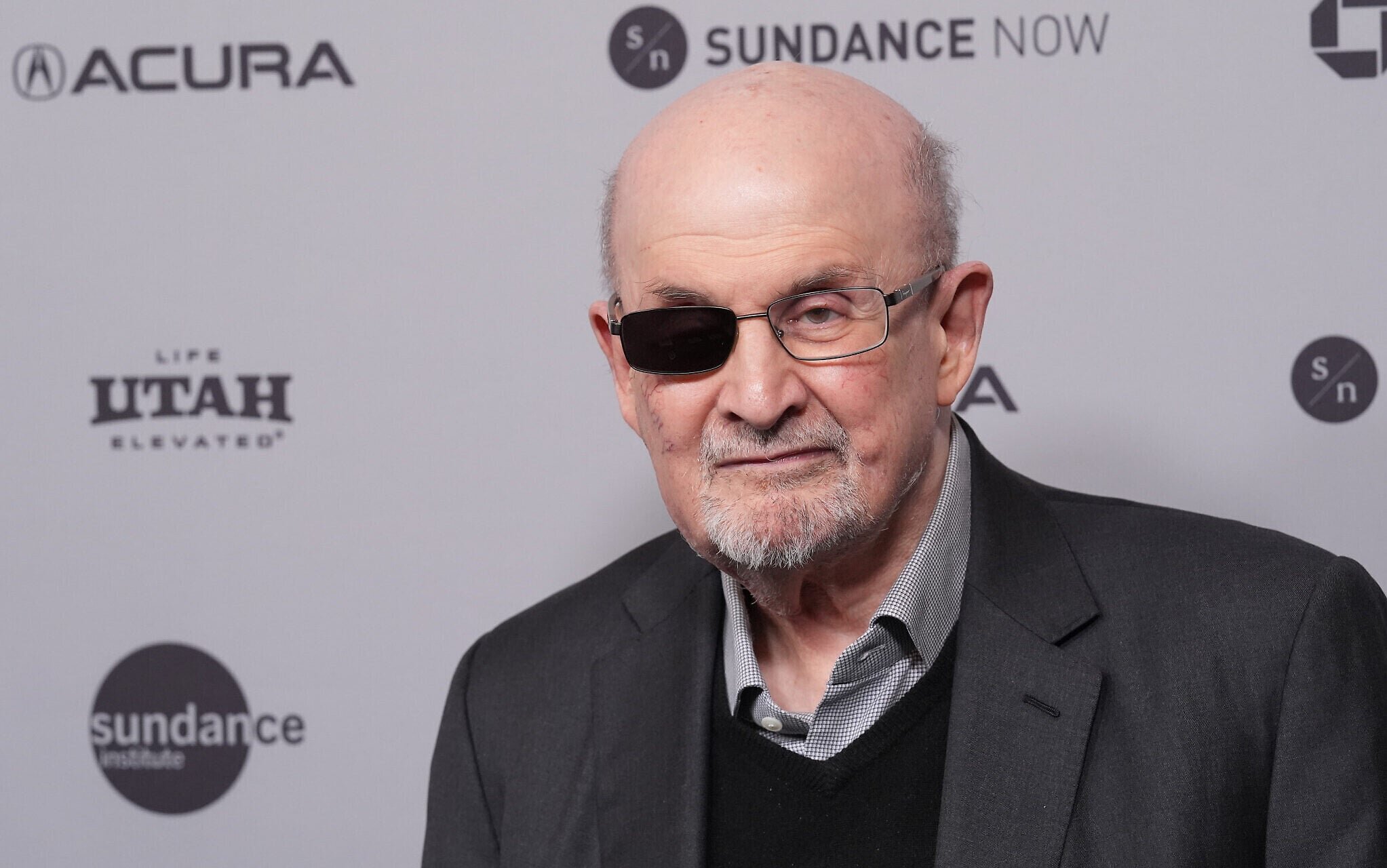
A man was convicted Wednesday of federal terrorism charges in the 2022 stabbing of Salman Rushdie, the author who has faced a decades-old death threat over his novel “The Satanic Verses.”
After just a couple of hours of deliberations, a jury found Hadi Matar guilty of all the charges against him, including engaging in an act of transnational terrorism.
Rushdie, who was about to speak on writers’ safety, was slashed 15 times on an amphitheater stage in 2022. He was gravely wounded and lost the sight in his right eye.
Prosecutors asserted that Matar was motivated by the late Iranian Supreme Leader Ayatollah Ruhollah Khomeini ’s 1989 call for Rushdie’s death because of “The Satanic Verses.”
“His brutal attack on Mr. Rushdie during a peaceful speaking event is a chilling reminder of the global reach of Iranian terrorism," Assistant Attorney General for National Security John Eisenberg said in a statement after the verdict, adding that “justice has been done.” Iran’s government has denied involvement in the attack.
Messages seeking comment on the verdict were sent to Matar's attorneys and Rushdie's assistant. During the trial, defense lawyer Nathaniel Barone said the government had no proof of what was in Matar’s head.
Matar himself declined to testify. Rushdie did, telling jurors: “I can’t say what his ambitions or his aim was, but the wounds were dispersed across my body.”
Matar, 28, is already serving a 25-year New York state prison sentence on an attempted murder conviction in the stabbing. His federal sentencing is set for November 3, when he faces a potential life term.
Rushdie won Britain’s prestigious Booker Prize for his 1981 novel “Midnight’s Children,” about his native India. “The Satanic Verses,” a novel of magical realism about the lives and dreams of two actors who survive a plane explosion, followed in 1988.
It drew critical acclaim in the United Kingdom but engendered protests around the Muslim world over what some believers saw as blasphemous suggestions about Islam’s Prophet Muhammad, particularly in a dream sequence. Over the ensuing years, at least 45 people were killed in riots over the book, a Japanese translator was stabbed to death, and an Italian translator and Norwegian publisher were attacked.
Rushdie, who was born into a Muslim family, has said the dream sequence was just that. But he went into hiding for years, gradually emerging after Iran’s government distanced itself in 1998 from Khomeini’s fatwa, or religious edict.
“For two decades or more, I led a public life without a hint of trouble,” Rushdie testified at the trial in Buffalo, New York.
Yet the fatwa was never rescinded; indeed, Khomenei’s successor, the late Ayatollah Ali Khamenei, indicated in 2017 that it remained in effect. An Iranian foundation has offered a more than $3 million bounty for killing Rushdie.
Matar broached the fatwa with contacts in messaging apps in 2021 and 2022, according to exhibits shown in court. The messages showed Matar fuming that he felt Rushdie had attacked Islam and, by surviving, emboldened others to insult the faith. Matar alluded to a 2006 comment along those lines by the late Hezbollah terrorist group leader Hassan Nasrallah, the messages showed.
Born in the US, Matar also holds citizenship in Lebanon, where Hezbollah is based. Prosecutors said that photos in Matar’s New Jersey bedroom and on his computer indicated his support for Hezbollah.
Matar “spent months planning and preparing to carry out what he hoped would be the execution of Salman Rushdie,” US Attorney Michael DiGiacomo said in a statement Wednesday.
The messages showed Matar initially talked about wanting to “expose” Rushdie, then about taking his life. In a private note to himself, he wrote: “We need to kill him ASAP,” Assistant US Attorney Timothy Lynch said in an opening statement on July 22. The prosecutor said Matar framed the planned killing as part of what he considered a jihad, or holy war.
As Rushdie was being introduced, his attacker climbed on stage behind him, then stabbed him as the audience gasped. Spectators and another speaker, Henry Reese, scrambled to aid Rushdie. Law enforcement officers, assigned to the event, arrested the attacker — soon identified as Matar — after civilians restrained him.
Rushdie published a 2024 memoir about the attack, then returned to fiction with last year’s “The Eleventh Hour.” The author, who was knighted by Britain’s late Queen Elizabeth II, received a Dayton Literary Peace Prize lifetime achievement award in November.
The war with Iran has been draining for all of us in Israel. But when I heard about a high casualty incident – ballistic missile impacts in Arad and Dimona that left nearly 200 people wounded – I drank a cup of coffee, packed a bag, and headed south.
There, I spoke with Shilgit, the head of an after-school program for underprivileged youth. Standing outside her destroyed center, Shilgit said it was a miracle that no children were hurt and spoke about the community coming together in the hours since.
As a Times of Israel reporter, I’m committed to telling stories of resilience like Shilgit’s. But my colleagues and I can't do this alone. If you value work like this, please consider joining our reader support group, The Times of Israel Community. Your financial support is essential to keep real human reporting like this going.
We’re really pleased that you’ve read X Times of Israel articles in the past month.
That’s why we started the Times of Israel - to provide discerning readers like you with must-read coverage of Israel and the Jewish world.
So now we have a request. Unlike other news outlets, we haven’t put up a paywall. But as the journalism we do is costly, we invite readers for whom The Times of Israel has become important to help support our work by joining The Times of Israel Community.
For as little as $6 a month you can help support our quality journalism while enjoying The Times of Israel AD-FREE , as well as ...