This is one outlet's own report from Deutsche Welle — the article as it was filed. Other outlets are covering the same event; open the full story to compare every source side by side.
Iran rules out US talks as Hormuz Strait remains closed
Iran has not asked to resume talks with the US, Foreign Ministry spokesperson Esmaeil Baghaei said. He added that the Strait of Hormuz remains closed and that messages are being relayed through mediators. DW has more.
https://p.dw.com/p/5HoWR Advertisement Skip next section What you need to know What you need to know Iran says it has not sought to resume talks with the US Tehran and Washington are not currently holding talks, but mediators remain active The Strait of Hormuz remains closed, according to Iran Oil prices lower on Monday as the US-Iran strikes pause Here are the latest developments concerning the Iran war and the wider Middle East on Monday, July 27.
Tired of missing our real-time updates? Click here to add us as a Preferred Source on Google. Then tap the "Star" or "Preferred" to keep DW News at the top of your feed.
07/27/2026 July 27, 2026 Is the US-Iran conflict entering a less volatile phase? US media reports suggest concerns about military resources, rising energy prices and the risk of a broader regional conflict may be influencing President Donald Trump's calculations.
In this DW interview, former US diplomat Alan Eyre, who helped negotiate the 2015 Iran nuclear deal , explains the factors shaping Washington's strategy, assesses the prospects for de-escalation and discusses what could come next in the US-Iran conflict .
Why the US wants to bring Iran back to the negotiating table To view this video please enable JavaScript, and consider upgrading to a web browser that supports HTML5 video
07/27/2026 July 27, 2026 Iran warns of 'unforeseen' consequences after alleged Ukrainian attack Iran warned on Monday of "unforeseen" consequences after Ukraine said it had carried out long-range strikes against vessels in the Caspian Sea over the weekend.
Foreign Ministry spokesperson Esmaeil Baghaei condemned the attack as illegal and unjustified, saying it violated the UN Charter and would not go unanswered by Tehran.
Ukrainian President Volodymyr Zelenskyy said on Saturday that Kyiv had targeted vessels transporting military cargo linked to Iran. Iran said one of its ships exploded in the attack, killing a sailor and injuring several others.
Baghaei said Ukraine's actions amounted to a "dangerous act of adventurism" and warned that the consequences would be unpredictable. Tehran has vowed to respond to the incident, which marks a significant escalation involving Iran and Ukraine.
07/27/2026 July 27, 2026 US strikes damage water infrastructure in southern Iran, affecting 120,000 Recent US strikes have caused significant damage to water infrastructure in southern Iran , disrupting supplies for around 120,000 people, according to Iranian authorities.
The Iranian news agency Fars, citing an official in Hormozgan province, reported that 18 facilities, including seawater desalination plants, were damaged in the attacks. Ten of the facilities were said to have been completely destroyed.
Among the sites hit was a desalination plant on Qeshm Island, which was reportedly knocked out of service at the beginning of the latest escalation in early July. Authorities said the damage has affected water supplies for more than 120,000 residents.
The disruption could have a severe impact on civilians in southern Iran, where extreme summer heat and long-standing drought conditions already place pressure on water resources. Daytime temperatures in the region regularly exceed 40 degrees Celsius (104 Fahrenheit).
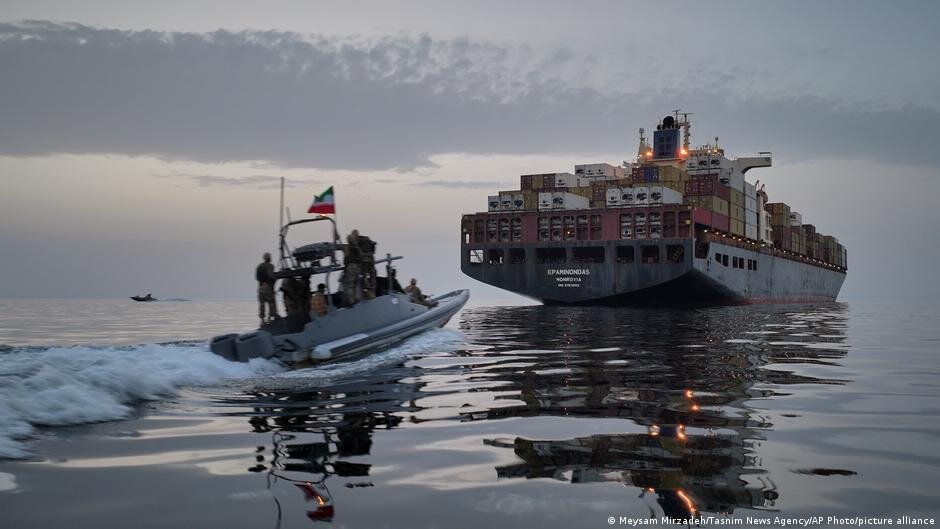
According to a state TV correspondent, the vessels were intercepted overnight after trying to use routes outside those designated by Iran. The report said the IRGC Navy fired warning shots before turning the vessels back.
Earlier, state television reported an unspecified "incident" involving one vessel but provided no further details.
The latest action follows a similar episode on Saturday, when the Revolutionary Guards said they stopped four vessels attempting to transit the southern part of the strait after firing warning shots.
US-Iran war: Will it ever end? To view this video please enable JavaScript, and consider upgrading to a web browser that supports HTML5 video
07/27/2026 July 27, 2026 Oil prices fall as US-Iran pause raises hopes for renewed talks Oil prices fell sharply on Monday after a pause in hostilities between the United States and Iran boosted hopes for a return to ceasefire efforts and negotiations over the Strait of Hormuz.
Brent crude dropped more than 7% at one point, briefly falling below $90 (€79) a barrel, as investors welcomed signs of de-escalation after nearly two weeks of exchanges between Washington and Tehran.
The US refrained from launching further strikes over the weekend, while Iran said it would halt retaliatory attacks against regional neighbors. The moves eased concerns over disruptions to shipping routes and global energy supplies.
Meanwhile, Iran said discussions with Oman had made progress on managing the Strait of Hormuz , a critical global oil transit route. Foreign Ministry spokesperson Esmaeil Baghaei said the talks focused on ensuring safe shipping passage while respecting the sovereignty of the countries involved.
The recent conflict had pushed oil prices above $100 a barrel for the first time since May, as concerns grew over threats to shipping in the Strait of Hormuz and the Red Sea .
07/27/2026 July 27, 2026 Welcome to our coverage Ramisha Ali | Dmytro Hubenko Editor Iran's Foreign Ministry spokesperson Esmaeil Baghaei said Tehran has not sought to resume talks with Washington and does not currently hold direct talks with the US.
While mediators continue to pass on messages, Baghaei said the situation in the Strait of Hormuz remains unchanged and the waterway is still closed. He also said some Gulf countries had been involved in the US war on Iran, without providing further details.
AIPROPX is an independent multi-source news index — we track, compare, and connect coverage from across the web into one place you won't find anywhere else.