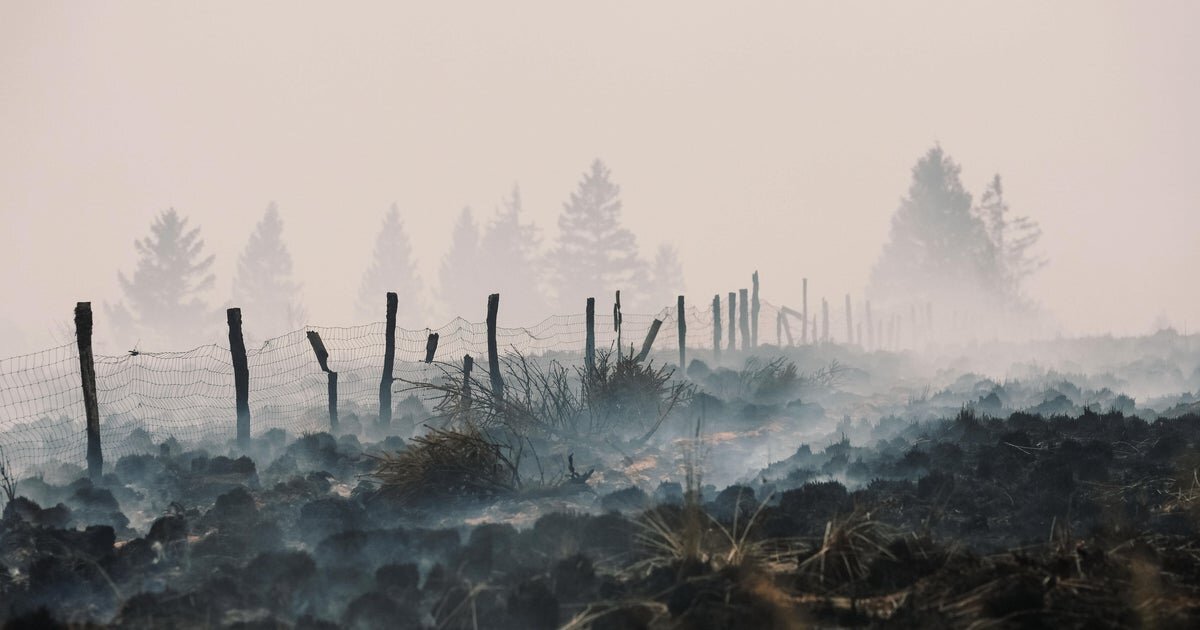
The wildfires burning across Europe this summer have exposed a potentially deadly threat lurking beneath the blackened landscape: rusty bombs and mines from World War I and II that threaten crews responding to the flames.Some of the weapons have exploded in the intense heat. Blasts have been reported in France, Belgium, Germany and the Netherlands, where a bomb-disposal team was dispatched to check a forest threatened by flames near a site of fierce fighting in the Limburg province in 1944.Steady temperatures and predictable rainfall once ensured that most buried weapons\u00a0stayed dormant. But this wildfire season was supercharged by heavy rains in January that spurred vegetation growth, which became kindling when the\u00a0summer heat arrived. Those temperatures, combined with drought conditions, low humidity and stiff winds, offered an ideal environment for fire, according to a study issued last month by the World Weather Attribution group. The blazes have led to mass evacuations.The current situation shows that Europe\u0027s "climatic luck" is running out, said Sarah Njeri, a peace and conflict scholar at London\u0027s School of Oriental and African Studies.\u00a0"Climate change is now doing the work of unburying and reactivating what was previously stable," Njeri said.\u00a0"You are not sure where the explosives are"In the eastern Belgian province of Liege, Gov. Herv\u00e9 Jamar said "a few sporadic detonations" were recently heard and that emergency services were adapting to account for munitions buried in a fire area. He said no fire crews were in danger, but local media published photos of a firefighter handling a rusted bomb.During World War II, booby traps, bombs and mines were scattered throughout the province\u0027s dense peat-bog forest known as the High Fens, which stretches across Belgium\u0027s border with Germany and was the site of key conflicts, including the bloody Battle of the Bulge. Now, a huge blaze is smoldering in the area.\u00a0Bernard Collard, a local historian who is authorized to scan the former battlefields with a metal detector, said that in an environment like this, "you are not sure where the explosives are." \u00a0He said he has found mortar shells, machine guns, helmets, cigarette cases, and once, a human skeleton. His father once detonated a found bomb in a quarry.\u00a0"You never know what you might come across, and you shouldn\u0027t take it lightly," Collard said while standing in a field that was once a blood-soaked site. Nearby, blueberry bushes cover old foxholes, trenches and deep craters from artillery fire.\u00a0He frequently works with the Belgian demining squad. "It\u0027s part of our history. We live with it," Collard said.\u00a0"The sound of war"\u00a0In a forest in tinder-dry France, a massive wildfire outside the southwestern city of Bordeaux uncovered a cache of what is believed to be World War II-era ammunition. Around 400 shells and pieces of ammunition were recovered in the village of Le Porge earlier in August. The munitions, both German and French, consist mainly of mortar shells, along with some high-explosive anti-tank shells.Fire commander Thomas Mimiague said blasts heard during the blaze may have been shells exploding. Mayor Martial Zaninetti told French news outlet\u00a0France Info\u00a0the blasts were similar to "the sound of war."\u00a0"There were ammunition depots buried in land within our municipality, but we didn\u0027t know it, and they exploded," Zaninetti told France Info, adding that one of the munitions "went through a house."\u00a0Over 180 homes were destroyed by the fire, local authorities said. Residents returned to the village earlier in August, after the flames were extinguished.\u00a0"Reliving the legacies of war"Finding unexploded ordnance in Europe isn\u0027t unusual. A 1,000-pound aerial bomb used by Allied forces during World War II was removed from a construction site in Belgrade, Serbia, in December. In September 2025, researchers found unexploded Nazi bombs sitting at the bottom of a German bay had become a home for marine life.\u00a0Sometimes the discoveries, like the fires, spark mass evacuations. Thousands had to leave their homes in Dresden, Germany, after an unexploded bomb was found in the southern city in August 2025. Traffic at France\u0027s bustling Gare du Nord train station had to be halted in March 2025 after an unexploded bomb was found near tracks.\u00a0Every year across the nation, Belgium\u0027s Explosive Ordnance Disposal and Destruction Service responds to more than 3,000 calls and disposes of 200 to 250 tons of munitions left over from both world wars. In Ypres, a town infamous for harrowing trench warfare in World War I, some farmers call the annual tilling of the soil "the iron harvest" because it turns up so many war remnants.Typically, the bombs are carefully handled and either defused or intentionally, precisely detonated. But wildfire heat can trigger the explosives, removing control from the equation.\u00a0Wildfire also isn\u0027t the only weather phenomenon revealing old weaponry. Drought has shrunk Europe\u0027s rivers and lakes to reveal munitions that were once invisible.\u00a0In Slovakia, the Danube River fell and exposed two naval mines that police pulled out of the water and buried in a trench for a controlled demolition. Authorities in Hungary closed Budapest\u0027s Margaret Bridge after a bomb dating from World War II emerged at its base in receding water. As the Rhine dried up, German authorities also found a WWII-era bomb.Christina Greene, a researcher at the University of Arizona who, with Njeri, wrote an article on Europe\u0027s wildfires and unexploded ordnance risk, said "the legacy of war keeps creeping up" because of climate change."It\u0027s reliving the legacies of war and conflict in a way that we haven\u0027t had to deal with in a while in certain places," Greene said.\u00a0