Ben Sales is a news editor at The Times of Israel
At the time, the catastrophe was unimaginable.
The numbers themselves told a horror story: 16 killed, 130 injured. Eight children among the dead. Five members of a single family. Another of the victims was a woman pregnant with her first child, visiting from New Jersey.
And yet, somehow, while those gruesome figures conveyed the worst of the nightmare that was the Sbarro terror attack, they didn't convey its entirety.
Sbarro was the center of Jerusalem, the expansive curved storefront dominating one of the capital’s busiest intersections. For Israelis, it was a place to meet up. For tourists, especially religious ones, it was an enticing example of an American fast food chain made kosher in the Jewish state.
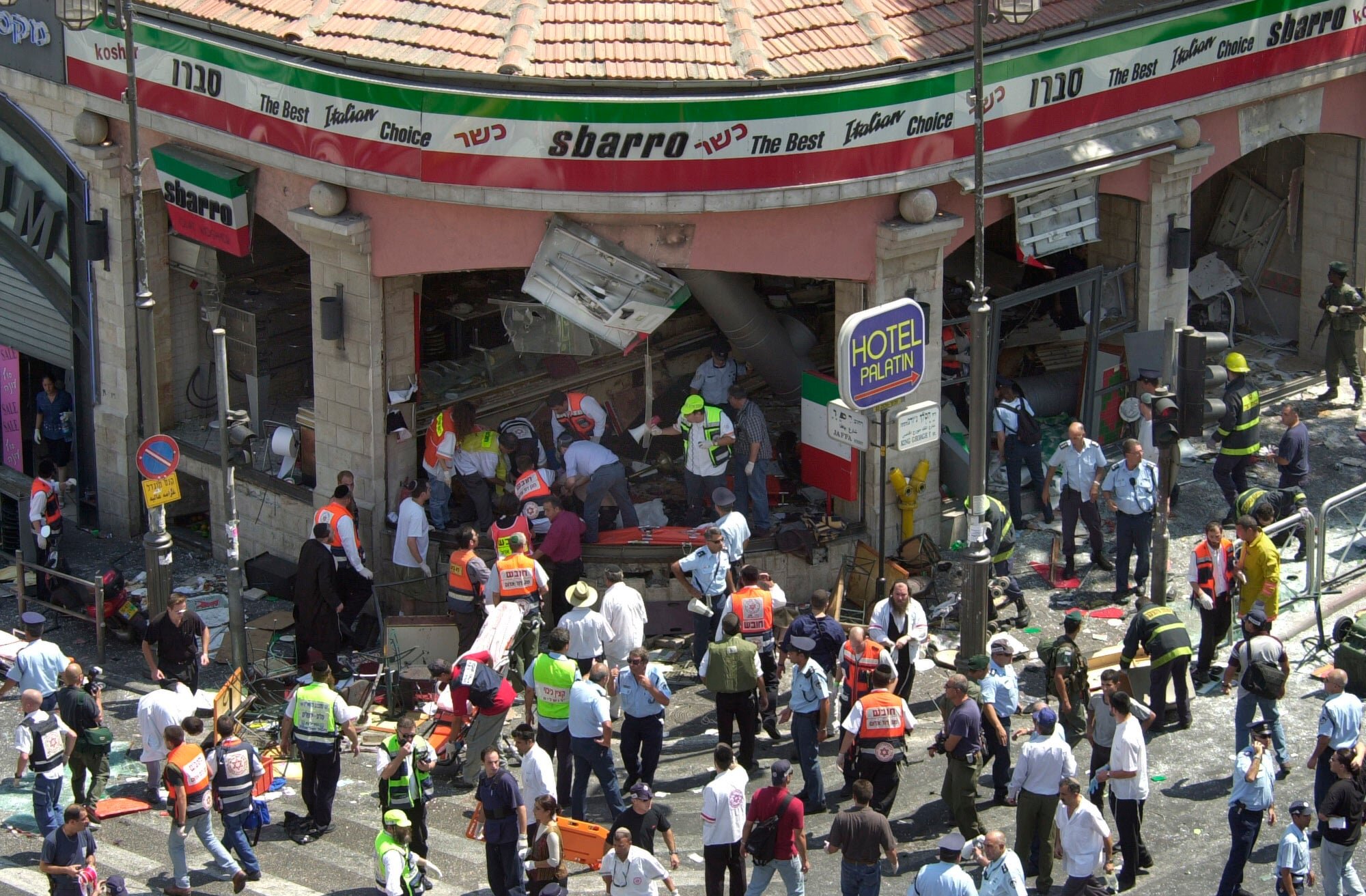
Twenty-five years ago, the crowded pizzeria became a hellscape.
If you’re old enough, you remember the photos: A bombed-out storefront. Debris everywhere. Medics and first responders scrambling in their vests to tend to the wounded. The terrorist who detonated the bomb had packed it with nuts and bolts and nails to cause maximum pain to the adults and children he was about to kill and maim. It worked.
A quarter-century later, who still thinks about this terrible attack? It was not the deadliest suicide bombing of the Second Intifada, or even of 2001. Globally, it was overshadowed 33 days later when terrorists flew two planes into the World Trade Center in New York City and another into the Pentagon, killing exponentially more people. More than two decades after that, the same Hamas terror group that killed 16 at Sbarro would kill 1,200 in southern Israel.
But of course, 25 years after it happened, there are those who still think about it: The parents, children, siblings and other loved ones of the 16 victims who walked into a pizzeria on that Thursday afternoon and never came out. At least one of those parents has never stopped thinking about it, because for him, 25 years later, it isn’t really over.
“The only reason I'm involved in this is because my daughter was murdered and the murderer has been free all these years,” Arnold Roth, whose daughter Malki was killed in the Sbarro attack, told The Times of Israel in an interview last week. “It's unthinkable to me that we're still fighting for justice for a child who was murdered in broad daylight.”
One of the terrorists who committed the attack killed himself along with the 16 victims. But another, Ahlam Tamimi, walked away and has lived free in Jordan for more than a decade. Roth and his wife have dedicated the past 15 years of their lives to making her face justice , so far without success.
And in recent years, that struggle has become harder. Because losing Malki is not the Roths’ most recent bereavement: They lost a son-in-law in Gaza, shortly after Hamas’s October 7, 2023, attack.
“Losing a son-in-law along the way to the very same enemy that this savage barbarian represents has not been easy,” Roth said. “It's a replay of having to address the need of keeping my loved ones safe and unharmed by the grief.”
The Roth family’s grief, and its ongoing fight for justice, also raises a set of questions that Israel has faced since its earliest days: How do we keep the memory of previous tragedies alive when new ones keep coming? And as the country struggles to heal from its freshest wounds, who will still be there to help right the wrongs of the past?
When Roth describes the past quarter-century, he speaks of “an eviscerating sense of bitterness at the failure.” He’s not talking about his own failure. He’s talking about the failure of those who are meant to support him — who have pledged to support him — to do what is in his mind the most important and unimpeachable thing one can do: bring his daughter’s killer to justice.
Tamimi, who orchestrated the attack and accompanied the bomber, walked out of Sbarro that day, was arrested shortly thereafter, and was released in the 2011 exchange for Israeli soldier Gilad Shalit in which more than 1,000 Palestinian terrorists went free. She lives in Jordan now. The Roths have invested 15 years of effort into having her extradited to the United States, where she could stand trial for killing American citizens, including Malki, and is on the FBI’s Most Wanted list . But despite a criminal indictment against her, she has not been brought to the US and still lives across the border, in Jordan, unconstrained and wholly unrepentant.
Roth blames presidents of both parties for being too timid to extract a known criminal from the territory of an ally that receives a huge amount of US foreign aid. And he blames Jewish organizations (though he was reluctant to name names) for not putting this on their priority list and not pushing their own governments to pursue this proud, murderous antisemite.
“I don't understand why there hasn't been a coming together of fury over this case,” he said. He added later, “It's not going to bring her back and it's not going to improve anything in our lives at all. But the idea that the woman who did it is dancing on Malki's grave — and that's the way I always look at it and always think about it — is unbearable to me. Unbearable in every sense of those words.”
Roth is aware of why Tamimi hasn’t been extradited, and why people who have devoted themselves to fighting antisemitism and terrorism have shied away from the case: Jordan is an ally of the United States, has diplomatic relations with Israel, and shares a long border with Israel and the West Bank. Although Jordan signed an extradition treaty with the US, officials don’t think it’s worth the risk of antagonizing Jordan’s monarchy to arrest someone who committed a terror attack 25 years ago, and who is regarded by many in that country as a hero.
Roth summarizes those concerns as “Don’t piss off the king.” And he thinks it’s nonsense.
“Who says that bringing this woman, as the treaty requires, to the airport to hand her over to the FBI agents is going to...