This is one outlet's own report from Gothamist — the article as it was filed. Other outlets are covering the same event; open the full story to compare every source side by side.
A non-profit newsroom, powered by WNYC. Gothamist Listen Live Donate News Perfect storm: More frequent severe weather leads to uptick in fallen NYC trees By Catalina Gonella Published Aug 12, 2026 at 6:00 a.m. ET
Twitter Reddit Email Never miss a story Email address By submitting your information, you're agreeing to receive communications from New York Public Radio in accordance with our Terms . By Catalina Gonella Published Aug 12, 2026 at 6:00 a.m. ET
Twitter Reddit Email We rely on your support to make local news available to all Make your contribution now and help Gothamist thrive in 2026. Donate today
Gothamist is funded by sponsors and member donations
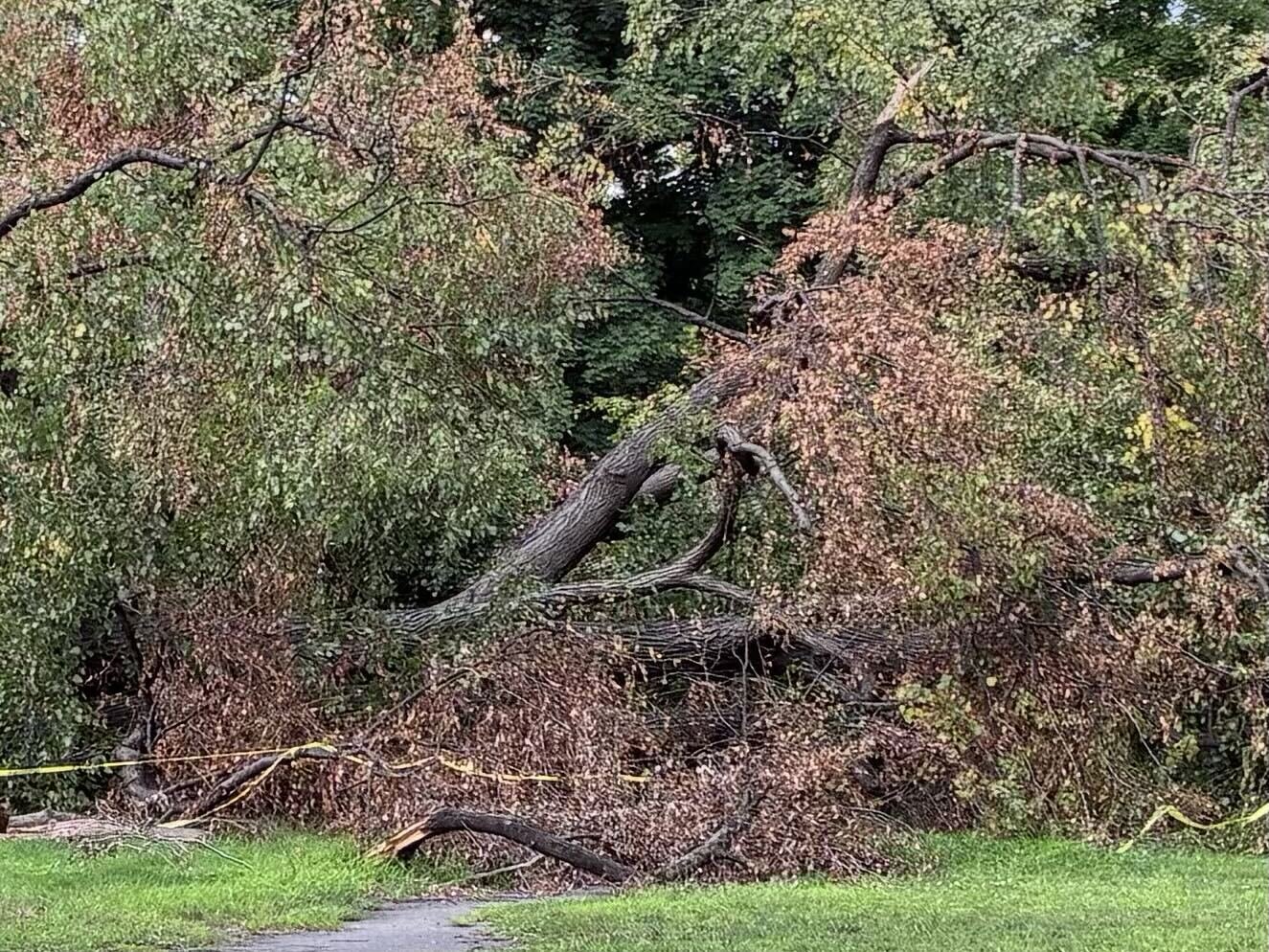
An increase in the number — and strength — of storms this year has led to a sharp spike in the number of damaged or fallen trees that need to be removed, according to the city Parks Department.
In the first seven months of the year, Parks Department crews completed 11,020 work orders for damaged or fallen trees. That’s compared to an average of 5,437 such work orders completed during the same period in each of the previous three years, according to the Parks Department.
So far this year, there have been three severe weather events that generated more than 1,000 tree-related service requests — on Feb. 22, June 6 and July 3 — compared to an average of just one per year over the past decade, the Parks Department said.
As chief of forestry operations for the Parks Department, Adriana Jacykewycz oversees the crews tasked with inspecting and maintaining trees and removing them as needed. She said severe weather, especially high winds, places increased loads on trees and their parts, which can cause them to snap if the forces are strong enough. Heavy rain can also saturate the soil, causing roots to become destabilized.
“That is why we do routine tree maintenance as a component of risk mitigation so that we can address concerning defects that might fail during a storm,” she said. “But at a certain point, high enough winds can take down even a perfectly healthy tree.”
The Parks Department relies on New Yorkers to report tree damage by calling 311 or using the department’s online service request system . Crews are then sent out to inspect reported trees to determine what work and equipment are needed, prioritizing those blocking streets, trees that have fallen on buildings and trees affecting power restoration, Jacykewycz said. Once those are taken care of, crews assess other reported trees and prioritize them based on the hazard they pose.
“ Over time we're gonna see how that plays out over decades worth. But we are seeing more frequent severe storms resulting in greater damage to our canopy and along with that we're also seeing rising temperatures and that affects the species that we choose,” she said.
The city is aiming to increase tree canopy coverage from the current 23.4% to 30% by 2040, according to its Urban Forest Plan.
Trees growing in an urban environment face many challenges on top of severe weather, such as pollution, drought, heat, pests and diseases, poor soils and physical impacts, including limited growing space above and below ground and construction impacts, Jacykewycz said. But New Yorkers can help beyond just reporting damaged trees to 311.
“ New Yorkers can help so much, just starting with the trees outside of their residences,” she said. “Basic watering, weeding, and mulching of the tree beds, just taking care of the tree pits and watering their trees, particularly during a dry period, once a week, a deep watering, can really help trees get established, especially the new trees. They really need it, but even the more mature trees can benefit from being watered. That's the number one thing.”
Local private tree care companies, which can be hired by residents to prune street trees that aren’t safety risks or trees in their backyards, have also felt the spike. Elizabeth Arce, an arborist with Arborpolitan, said the company had an especially busy winter due to the February storm that dumped more than a foot of snow on the city.
“ The winter season is very slow for us. We went from 0 to 100 in, like, that week. It was wild,” she said. “These two weeks of really cold extreme weather preceding a big blizzard with a lot of wind, and I think the trees were already sort of in this brittle state, and they just kinda snapped.”
The Nassau executive trails Gov. Kathy Hochul by 10 points statewide in a new Siena poll.
The Venezuelan immigrant reported back to work at his City Council analyst job on Monday.
Catch up on the most important headlines with a roundup of essential NYC stories, delivered to your inbox daily.
Gothamist is a website about New York City news, arts, events and food, brought to you by New York Public Radio.
AIPROPX is an independent multi-source news index — we track, compare, and connect coverage from across the web into one place you won't find anywhere else.