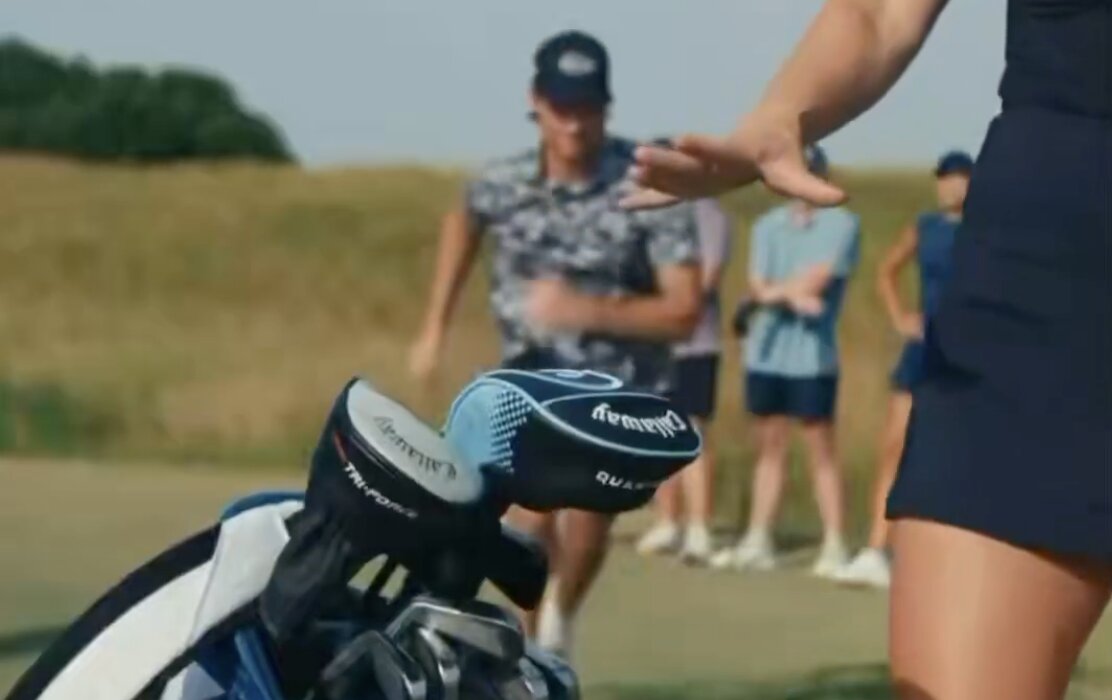
Credit: Callaway
Good Good Golf was once the poster child for the YouTube golf craze. One 15-second commercial sent their empire crumbling in less than a week.
Now , Good Good is the poster child for how not to handle a PR crisis, with a downfall that should serve as a warning to every other influencer, creator, and sports brand in existence.
It all started last week when Good Good and Callaway released an ad for their new driver. The commercial featured Good Good star Garrett Clark tackling a female golfer to the ground for attempting to pull the new driver from her bag. The point seems to be that this is a driver SO GOOD (good?) that its mere presence motivates someone to commit acts of violence against their partners or friends.
Ah man, someone must have accidentally deleted the post. Don’t worry Good Good, I’ll reupload your @CallawayGolf ad! pic.twitter.com/I4GwzBmUOJ
— Jay Don Takes (@Skulledwedge) August 22, 2026
The ad was remarkably tone deaf, misguided, and just plain ignorant. It wasn’t funny, ironic, or relatable in any way. Say what you want about the golf bro era and the YouTube universe as a whole, but it’s hard to fathom how this would appeal to any demographic. How it climbed through every level of approval at both companies is completely inexcusable.
But was it something that should ruin a company with millions of subscribers, a Golf Channel show, and even a sponsorship of a PGA Tour event? And how did Good Good end up taking the fall?
This is 2026. We are not living in Woke 1.0 anymore. Do you know just how difficult it is to get canceled during the second Trump administration? And this is golf we are talking about, not exactly a beacon of progressivism and inclusion.
So why did Callaway, the PGA Tour, Golf Galaxy, and Golf Channel all decide to back away? It wasn’t just the ad; it was how Good Good handled the fallout.
Last Saturday, as the ad began to catch heat on social media, Good Good posted a brief apology. However, the statement was unsigned, talked about their brand values, and offered no details on how it was made or any human touch. It was insular and out of touch. Callaway and the PGA Tour released their own statements, but it did little to calm the storm.
A YouTube golf channel talking about their brand values when some of their most recent videos are titled “ We pranked our friend with a fake $25,000 golf tournament ” and “ How many tacos can we eat in 9 holes of golf? ” is hilarious irony.
If this was their first attempt to move past the controversy, they hooked it out of bounds and had to take a mulligan.
Our statement on the recent driver ad that we decided to remove: pic.twitter.com/oFxO3eFZV1
— Good Good Golf (@goodgood_golf) August 22, 2026
By that time, major retailers were pulling Good Good merch from their shelves. On Tuesday, PGA Commissioner Brian Rolapp expressed his disapproval of the way Good Good and Callaway failed to meet the moment in their apologies. By this time, Good Good had to make good or suffer the ultimate consequences.
Again, the company fell short.
On Wednesday, Garrett Clark posted an eight-minute social media video apologizing again for the ad . But instead of offering a clear and unequivocal message, he tried to explain it away, threw his marketing team under the bus, and even shared outtakes from the controversial spot. He also tried to cover his own tracks by saying he knew it was “the worst ad known to man” before he even saw the backlash.
Again, the response to the apology was near-universal disbelief at how ill-advised this message was. While Clark appeared sincere and heartfelt, it was a masterclass in passing the buck, with no one at Good Good stepping up to take responsibility.
So is someone in marketing getting fired?
“Good Good marketing team reached out to us and they said we have this idea to essentially recreate or do a spinoff of the move Obsession. … Looking back, super dumb ad concept. Terrible ad in general. Not the greatest idea.” https://t.co/IXV4c2TB6s
— David Rumsey (@_DavidRumsey) August 27, 2026
The next day, everything fell apart. On Thursday, Callaway severed ties with Good Good and announced a $1 million donation to charities working to prevent violence against women. Good Good then dropped their PGA Tour fall event sponsorship . Finally, Golf Channel canceled the new season of Big Break , which offered an entry into the Good Good PGA Tour event as the prize.
The relationship between the professional golf world and YouTube golf is very interesting. They really operate in two different universes, with Bryson DeChambeau being the rare personality with one foot in both. While the PGA Tour is focused on the best golf in the world at an elite level, the YouTube realm is a creative sandbox filled with personalities who, for lack of a better phrase, make the sport look fun and cool.
Amid all the YouTube golf channels, Good Good seemed to be the one that cracked the code and built a bridge to the professional landscape. Major sponsorships, a Golf Channel show, and a PGA Tour event don’t come around for everybody. The fact that Good Good threw it all away in a week is a staggering and completely self-inflicted collapse.
It’s like Tin Cup ending with Roy McAvoy not holing out on his final ball, but dumping that in the pond as well and then storming off the course never to swing a club again.
Of course, there is a natural ebb and flow, and it’s fair to question whether the punishment fits the crime for Good Good. Did they truly deserve to lose all of the fruits of their labors like this? Or did the established golf world see an opportunity to teach the YouTubers a lesson and send a message that they need to shape up and fall in line if they want to be welcomed back in the inner circle?
If there were any doubts about those decisions, Good Good CEO Matt Kendrick put them to rest in an early-morning social media post in which he slammed Callaway, blamed a “co...