I know I can be stubborn. First of all, don't tell my wife. She already "knows" this, but I'll never say it out loud (and I still haven't!). I'll come up with an idea or learn a theory, see proof of concept one (1) time and latch onto the notion. Anyway, second, I'd like to believe it's part of human nature.
You couldn't change my mind about the Bengals outlook in 2021. Joe Burrow's shortened rookie campaign was enough. And they added his best friend and phenom to run alongside Tee Higgins? Just tell me when they schedule the parade in Cincinnati. And yet, each year, we have the same discussions regarding their claim to a postseason slot.
Post-hype sleepers command similar discourse in fantasy circles. They're players we know have played well or showed enough flashes, but flopped once the collective community took interest. A few hit their low point in 2025. But let's see if they're worth a click in drafts this year.
Join or create a Yahoo Fantasy Football league for the 2026 NFL season
Let's Set Expectations
Much to my own chagrin, let's expand on my Bengals analogy.
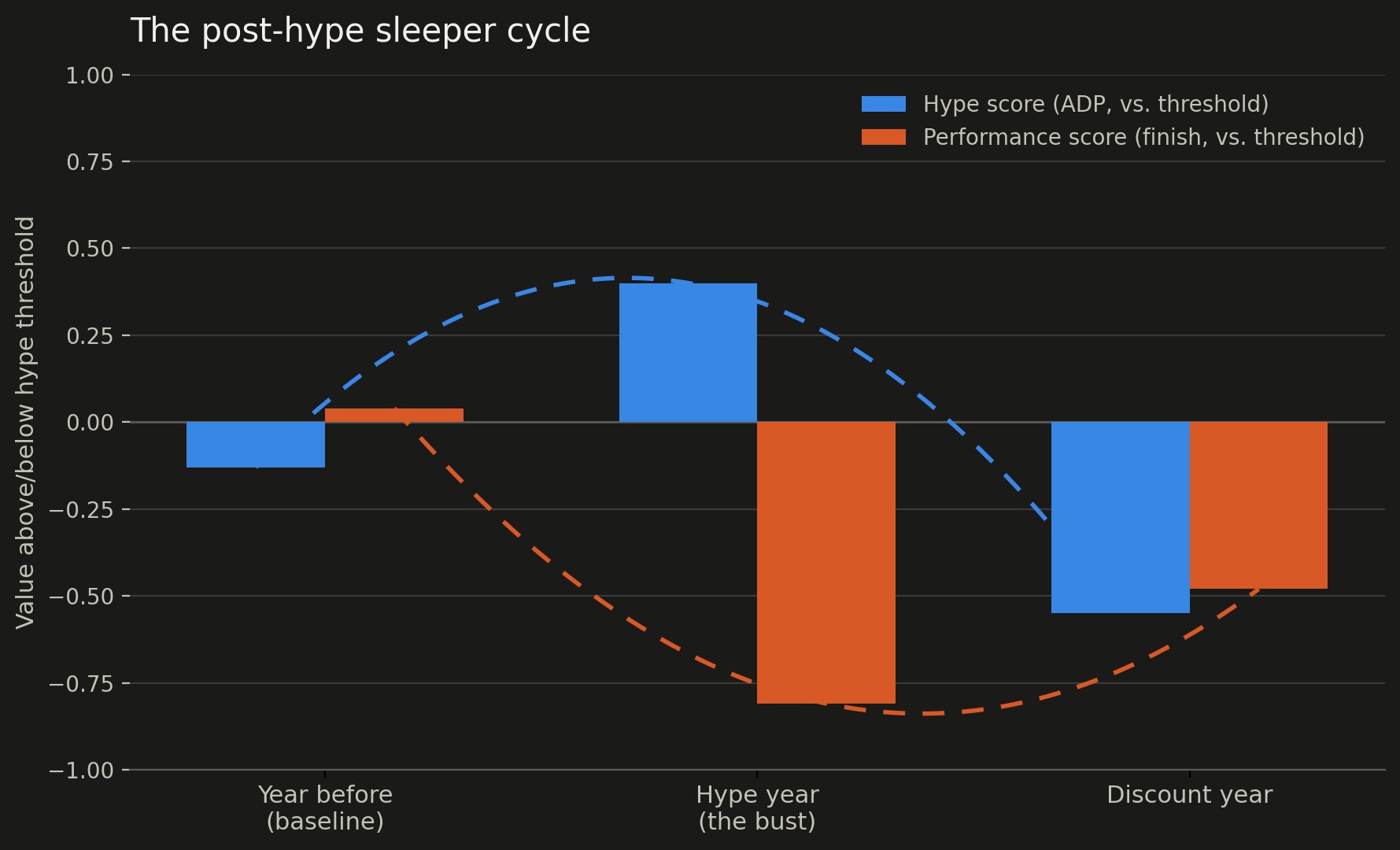
Typically, post-hype sleepers operate on a three-year cycle. The market values them (slightly) below their original ADP. For rookies, we've got historical benchmarks on collegiate production and draft capital to guide us. Vets can follow a different arc, but we'll get to them. In either case, the value, even the slightest edge in results relative to cost, is enough for us to push their draft price ahead the following season.
But that doesn't always equate to an equal rise in generated points.
Here's a look at the post-hype sleeper cycle in fantasy football. Chris Allen
I went through the last 10 years of data to isolate post-hype sleepers in fantasy. It was like walking down Memory Lane of my worst decisions. Regardless, a couple of takeaways here.
First, when things went bad for players, they were catastrophic for fantasy managers. The median drop between ADP and end-of-season ranks was 24 spots across all positions. WRs took the brunt of the collapse (average drop of 44.2). Quarterbacks had the mildest decline (14.7). The impact would pull your team out of playoff contention without an in-season roster adjustment. But the larger point lies in the two bars over the "Discount Year."
Does the post-hype discount pay off in the end? Chris Allen
Even when we find the guys with the (past) talent to outkick their ADP, us being right is only a minor win. In other words, the hype pulls us out a bit too far over our skis. Think about the Malik Nabers' buildup going on now. If healthy, he'd be a first-round pick after an electric rookie year. Accordingly, you can almost hear his price creep up with every positive piece of news.
But again, our evaluation of his situation (i.e., health) doesn't mean Nabers will be a WR1 again. And that's been the case for RBs and TEs, too. However, we've been able to make successful bets in the past.
Here's a look at the hit rate of post-hype sleepers since 2021. Chris Allen
The hit rate on post-hype sleepers for three of the four skill positions sits at about a coin flip. So, despite the potential for a slight loss in value, there's upside in targeting the guys we think the market has left behind.
Admittedly, RBs have a tougher draw. But in most cases, we can see the outcome before opening kickoff. Only 9.1% of the running backs over 26 years old with post-hype sleeper appeal exceeded their draft cost. On the flip side, this data point gives us a partial framework to dig into this year's candidates.
Speaking of, let's kick things off with a passer carrying some uncertainty into 2026.
The Talent Never Left, Just the Health Bar
I'll be upfront. I have no dog in the "J.J. McCarthy should be QB1" fight. HC Kevin O'Connell made his decision to make Kyler Murray the starter. But at QB16, gamers have to figure out if there's any juice to squeeze out of the cost. I say, yes.
Kyler Murray floats it to Jauan Jennings. (Via Vikings IG) pic.twitter.com/7Cz7RX8HXj
— VikingzFanPage (@vikingzfanpage) August 20, 2026
Now, one pass in a joint preseason practice has as much relevance to the regular season as this article. But we've been able to catch glimpses of Murray connecting with his ancillary pass-catchers . He's also started reinforcing the idea that Justin Jefferson could be back in the WR1 discussion by season's end. Regardless, Vikings fans (and fantasy managers) are expecting an upgrade from 2025. And based on history, we're right to demand more from the offense.
EPA per Dropback: 0.05 (Murray, career), -0.14 (McCarthy, 2025)
Passing Success Rate: 47.2%, 40.4%
Sack Rate: 6.2%, 10.0%
Three stats don't define a QB, but we can start the conversation here. While Murray hasn't been the most efficient thrower, his ability to avoid catastrophic plays (e.g., sacks, turnovers) puts him ahead of his current competition in Minnesota. And let's keep in context that the Cardinals' offensive line was deteriorating to a similar state as the Vikings. Murray was up to a 34.5% pressure rate in 2025. But unlike McCarthy, Murray brings some mobility to the position.
2022: 14.2% (rushing rate), 7th (among all QBs, min. 200 dropbacks)
2023: 13.3%, 9th
2024: 11.6%, 11th
2025: 14.4%, 8th
Even during injury-riddled years, Murray's rushing rate (combination of scrambles and designed runs) has been inside the top 12. Now, he's piloting an offense with a playcaller who's historically integrated high-pace, play-action concepts and pre-snap motion (easy buttons for QBs) at or above the league average since joining the Vikings. While quarterback may seem deep once you get into the middle and late rounds, if I'm looking for upside, Murray fits the archetype of a passer that can finish a...