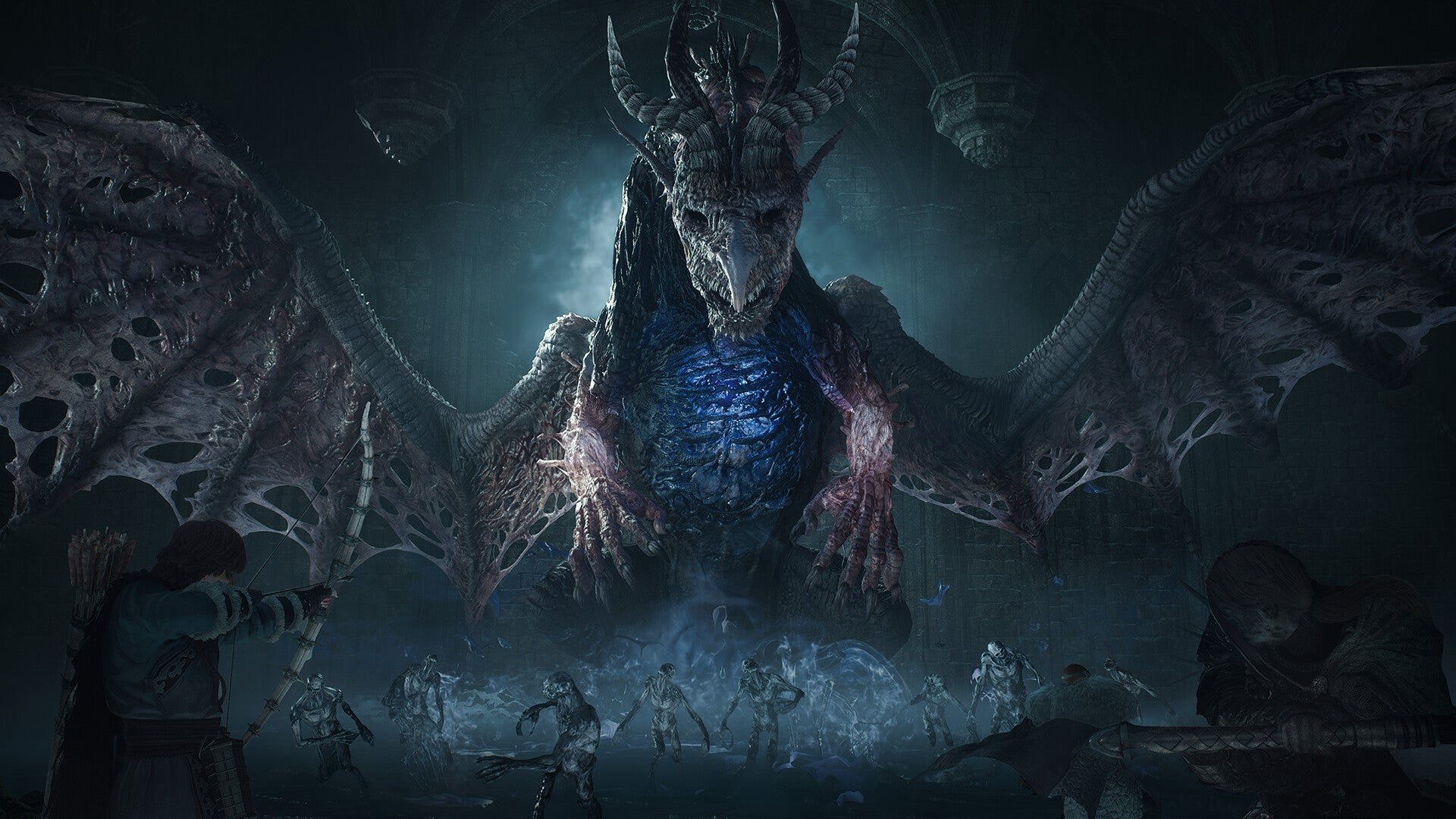
There are plenty of fantastical creatures to fight in Dragon’s Dogma 2, but nowhere in the base game will you find a dragon that vomits zombies. You will find such a beast in its upcoming Dark Arisen expansion, though, and this winged atrocity marked the final challenge of a 90-minute hands-on demo I played just ahead of gamescom 2026.
The undead barfer easily ranks among Dragon’s Dogma 2’s most hideous foes – a scaly titan with an unsightly face, torn wings, and decaying flesh. At multiple points throughout the battle, it rears back its head to belch a plume of sinister smoke from its rotting maw, out of which skitters a gang of pallid corpses. It’s a creative and horrific way to introduce additional mobs to a boss fight, and for a moment I’m distracted from my project of hacking the dragon’s legs off to perform a series of spinning sword attacks, cutting down the newly-birthed fodder three at a time.
Such a beast awaits you in Norgan, the new “Forsaken Dominion” that Dark Arisen adds to the north of the base game’s map. While designed for advanced players, it’s not an “end game” zone; instead, it’s recommended for characters around level 40, and can be accessed from relatively early in the campaign. The region’s icy conditions and bitter snowstorms create several new and unique challenges, and outfitting yourself to survive such sub-zero temperatures is first on the agenda. The demo opens with a blacksmith offering to craft me some armour with better thermal properties, and a short fetch quest later I’m outfitted in furs fit for a Stark. While the demo didn’t allow me the chance to fully explore why warmer armour is so important – does the cold inflict damage over time, like in the modern Zelda games? Or does thermal clothing provide better defense against icy attacks? – my short trek into the frigid north still highlighted a number of ways the region’s climate poses dangers distinct from those we’ve faced in more southern lands.
While battling against the yeti-like Norgan giant, I was frozen solid by the beast’s arctic breath. Later, midway through the fight, an unexpected avalanche knocked me off my feet, disrupting my chain of attacks. As ever, your AI companion Pawns chatter away, and their dialogue hints to such avalanches being triggered by both large beasts and your own weapon strikes. Other tactics suggested by my party include rolling a boulder towards an enemy, which would grow larger as it gathered up the snow in its path, and shattering hanging icicles so they would rain down like glass on our foes.
“I definitely didn't want the cold, snowy region to purely be a visual effect,” Dark Arisen’s director, Kenta Kinoshita, tells me. “If a snowstorm has blown in and is obscuring your visibility and the wind is working against you, then you're going to have to come up with a way to get around it. But the wind can also be used to your advantage; if you're trying to jump over a gap in a crevice and you're able to orient yourself towards the direction the wind's blowing, it can blow you further. The wind could even be a help in getting you on top of huge enemies if you orient yourself right.”
I wanted the cold theme to provide friction that's really interesting to strategize how to overcome. The base game encouraged you to use the world around you as a tool and a weapon, a philosophy Dark Arisen is expanding upon further. Kinoshita describes how enemies will cross frozen lakes in pursuit of you, and so you can break the ice to plunge them into the water below (it’s here where it's worth remembering that Dragon’s Dogma 2’s water is plagued by The Brine, the red tentacled mass which swallows up any living thing.)
“There could be an enemy that steals your relics and runs away,” Kinoshita adds. “How do you find where it's gone? Well, follow the footprints in the snow and maybe you'll trace it back to its nest and find the relics that it's stolen from you and more besides. At every different level of encounter design, I wanted the cold theme to [provide] a level of friction that's really interesting for the player to discover and then strategize on how to overcome.”
Unknown Treasures
By relics, Kinoshita doesn’t just mean any old piece of equipment you’ve found. Relics are part of Dark Arisen’s new loot system that sees you collect mystery spoils from across Norgan and bring them back to camp to be “appraised” by Jiera, the local wise woman. When acquired, relics are listed in your inventory with vague descriptions – this one is a helm, this is a light weapon – and are utterly useless to you. Throw Jiera a few rift crystals, though, and she’ll reveal their true nature, turning them into gear you can carry into battle. Compared to the equipment discovered in the base game, relics are more likely to have interesting properties that you could build a strategy around, such as substantial stat modifiers or abilities.
One of the demo’s early quests paired me up with Freki, a huge direwolf with a taste for hare and a nose for relics. Following your first scripted adventure, you can feed Freki meat whenever you want to trigger his hunt for buried relics – simply follow him to acquire new treasures.
This new system intrigues me because it encourages a very particular gameplay loop, one reminiscent of the loot grinds in games like Destiny. Many Diablo-esque ARPGs and looter shooters use randomised rewards that must be “decoded” as a way of establishing a compelling cycle of explore, collect, decipher, equip, repeat. The bait, of course, is the possibility of finding that one piece of gear that will elevate your character build and unlock the ability to complete the cycle in even more dangerous parts of the world, which in turn rewards even greater weapons and armour.
Kinoshita agrees that this more organic style of play is a focus for Dark Arisen, beyond the traditional framework of a fantasy RPG. “There are, of course, quests. You'll un...