I love spicy foods. Maybe it’s my Japanese heritage. I’ve been a Bengals fan for over 25 years, so I’m already a glutton for punishment. But unfortunately for me, my wife and sons avoid the heat. Of course, I’ve tried to convert my wife to a “heat-onist.” We’ve been down south a number of times (NOLA, ‘Bama, ATL, etc.). And I try to throw a bit of “culture” into every dish I make. All to no avail.
But recently, my soon-to-be teenager has shown an interest in going to Flavortown.
Join or create a Yahoo Fantasy Football league for the 2026 NFL season
At first, I was shocked. I assumed the preference for the subtle tastes in life would be a constant. Don’t get me wrong, I was happy about the shift. But the adjustment had me reeling.
That’s where we find ourselves with the RB Dead Zone. An idea that Ben Gretch (I watched him throw a 50-yard pass in Canton last month) posited back in 2019. And still, we scour the early rounds for potential letdowns. However, as the league has changed, so should our approach to early-round RBs.
What Is The RB Dead Zone?
Think about how we evaluate and draft QBs.
We know what to expect from the high-end options. Guys like Josh Allen and Lamar Jackson offer not only passing efficiency that rivals most of their peers, but rushing, too. The potential for high-scoring weeks makes their draft cost worth the similarly high investment. And then we start to play games with all of the QBs that follow.
From projections to coachspeak to training camp clips, our collective knowledge teases us with dreams of ceiling outcomes. Yes, this IS Joe Burrow’s season to be in the MVP conversation (please, let this be true). Of course, Justin Herbert with Mike McDaniel will be a problem for the rest of the league. And while we push players farther up our draft board, the risk of failure increases. And when the bill comes, our fantasy teams are left struggling. Let’s apply this thought process to RBs using an example from last year.
Kenneth Gainwell gets the goal line carry over Kaleb Johnson with Jaylen Warren out 👀 pic.twitter.com/wzS3xee95B
— Yahoo Fantasy Sports (@YahooFantasy) September 28, 2025
Kaleb Johnson earned Day 2 draft capital from the Steelers. With Najee Harris out of the picture, we (and I’ll use the royal ‘we’ here) all bought what Pittsburgh’s front office was selling. They drafted Johnson to be their RB1. However, even after reports of him struggling in training camp, we dismissed Kenneth Gainwell’s $1.8 million contract. And Jaylen Warren had always been the RB2. No other scenario made sense other than Johnson having the lead role. And, unsurprisingly, we’ve done this with other RBs before.
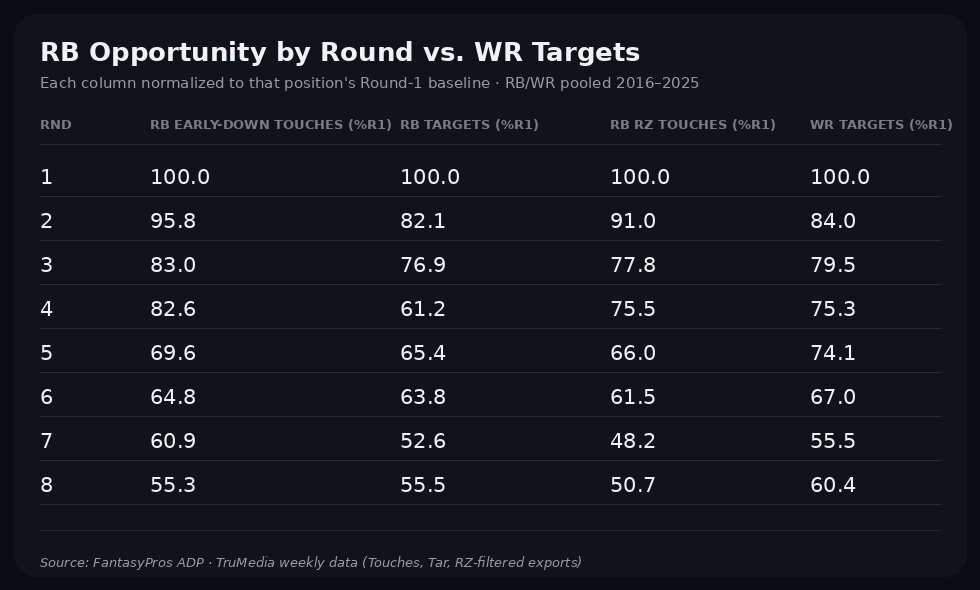
Here's a look at RB opportunity by round vs. WR targets. FantasyPros
I took the last 10 seasons of data and normalized the workloads for RBs and WRs by round. I’m not breaking any ground by saying players drafted later don’t see as much usage. But there are two key takeaways from the table.
First, look at how quickly things decline for rushers. Target shares are down by almost 40% by the fourth round. Touches when their teams are in scoring position cut in half by the middle rounds. The situations or scenarios we anticipated occurring broke a different way. Plus, what’s worse is that the better solution was right there in front of us.
Targets for WRs drop but at a softer pace. Again, this is a 10-year sample, so zooming into a single year might shift the effect somewhat, but the overall indication is the same. The receivers offer more stability. Betting on an RB becomes more tenuous. However, the projected responsibilities for these rushers make them hard to avoid as we build our teams.
So, when you hear the term “Dead Zone RB,” it’s not to say the player doesn’t have any talent. How well (or poorly) an RB performs at their position is one facet of the term. It’s the combination of their situation-based role (e.g., goal-line carries, pass-game involvement) and team outlook that we have to consider. And if our case for them to exceed their draft cost doesn’t outweigh a non-injury-related loss of work, then you’ve found yourself in the Dead Zone.
Does It Still Exist?
In short, yes. However, it’s not as simple as pointing to a cluster of draft picks and proclaiming them as the place RB value goes to die. Let’s start with what drives the phenomenon.
Here's a look at simple correlation with PPG by touch type. FantasyPros
My good friend Dwain McFarland popularized the concept of contextualized usage. Essentially, not all touches hold the same value. Of course, volume is king. But some situations are more conducive to fantasy points than others. So, using the same data set, I measured the correlation between specific scenarios and the results. The usual suspects rose to the top. Being involved in a team’s passing game and on potential scoring plays matters. However, as we’ve decomposed RB profiles over the years to understand their components, our draft strategies have adjusted to the increased understanding.
Here's a look at the worst round for RB value by season since 2021. FantasyPros
I calculated the points above replacement (PAR) for RBs by round over the last five seasons. I used the RB30 as the bar since we require at least two starters and some wind up in the FLEX. Anyway, I looked for where PAR bottomed out as a sign of the location of the Dead Zone.
Seeing the sixth round as where RB value hit its minimum back in ’21 made sense. We were in the throes of “avoid this area of the draft” analysis. But as we got smarter and both teams and backfields evolved, the timing slid to the right. And it’s been dithering around the R7-10 since. Even better, the market has started to reflect our judgment in committees.
Here's a look at RB targets and red zone touches by round. FantasyPros
Targets and red-zone touches for rushers typically taken in the Dead Zone are up. Now, not every case warrants us taking an RB ove...