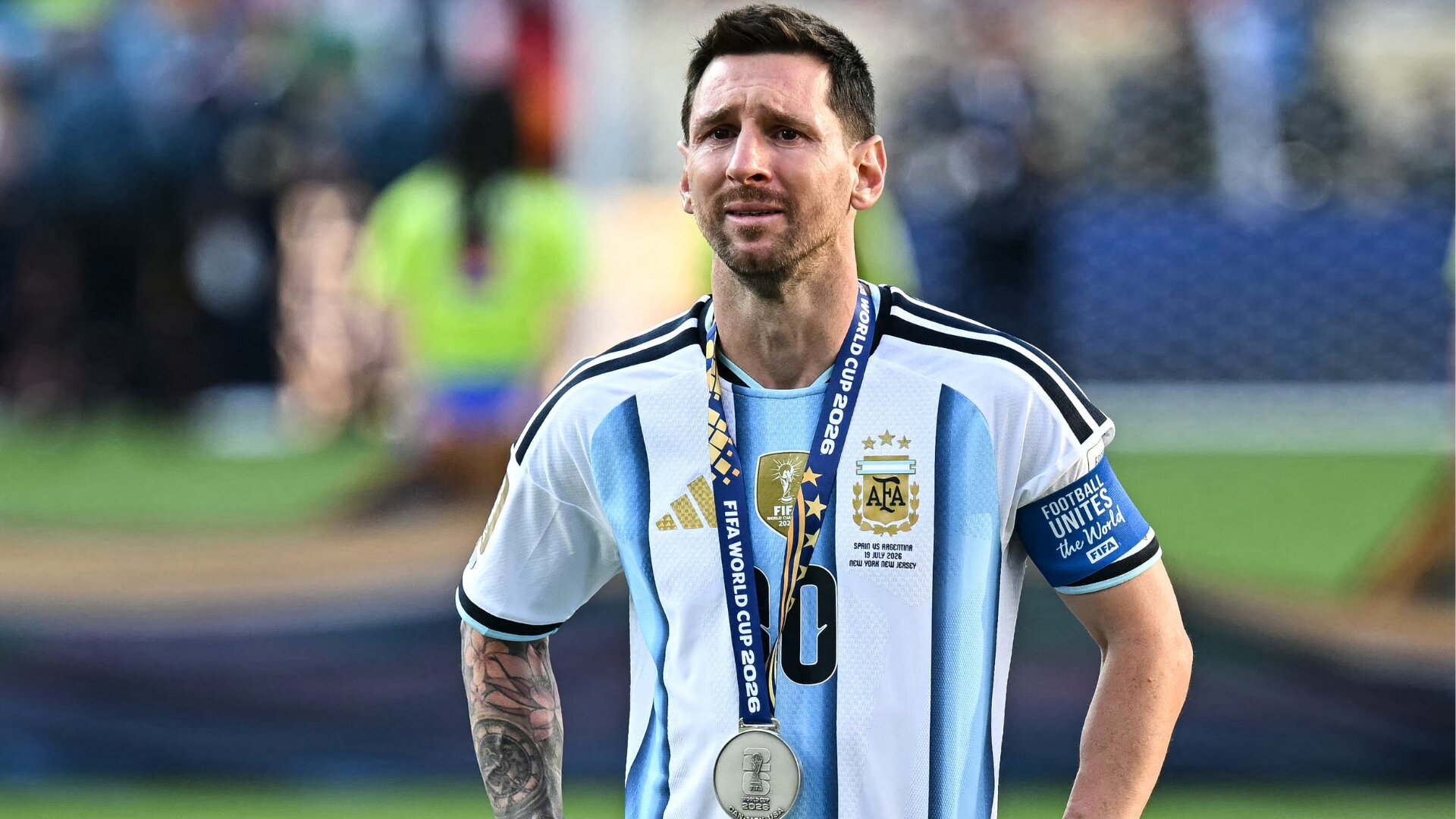
Lionel Messi officially announced his retirement from the Argentina national team on Monday, closing the book on one of the greatest international careers in soccer history. The announcement, posted on his social media accounts, comes roughly six weeks after Argentina's heartbreaking 1-0 extra-time loss to Spain in the 2026 World Cup final, and just over three weeks after his father and agent, Jorge Messi, passed away .
Messi, long criticized for his inability to win anything with the national team, guided the team to a historic run over the last five years, which includes winning the 2022 FIFA World Cup, sandwiched between winning two Copa America titles and then a second-place finish at last summer's 2026 World Cup.
For nearly two decades, Messi's genius was undisputed at the club level but questioned on the international stage. Messi's journey with the Argentina national team was one of frustration, redemption, and ultimately glory, and it will forever stand as one of the great narrative arcs in sports history.
Here's what Messi posted on social media:
"After all this time since the final, and after thinking about it a lot, I want to tell everyone that I'm retiring from the national team. It was a decision that hurt and still hurts deep inside, but I understand that this is the right moment. I swear I always gave everything, not only in these last few years when we won everything, but before that too. I always fought and gave everything for this shirt, to bring you happiness and make you feel proud to be Argentine through football. There isn't much time left, and different chapters are coming to an end. This is one that hurts me a lot. I love, I loved, and I will always love being part of the national team. I gave everything I had, and I don't have anything more to give. Also, there are great young players coming through who deserve to be here. Thank you for all the love during these 20 years. I'm going to miss hearing you from the inside. Now I'll be one of you, always supporting from the outside, in the good times and even more in the bad ones. Thank you to my family for always being there and for being with me throughout this beautiful but difficult journey. Thank you to every coach, teammate and director I had the chance to share it with. I take with me unforgettable memories and moments.I leave with peace and pride, knowing that together with my teammates we gave you moments we once dreamed of. It was crazy to experience all of this with you. I love you! Thank you God for making me Argentine. Vamos Argentina!"
He then added, "I wrote these words on July 21, two days after the final. Today, after what happened with my dad, I'm even more convinced of this decision than before."
When Messi made his senior Argentina debut in 2005, the nation hadn't lifted a trophy since the 1993 Copa America, a drought stretching back to when Messi was still just in elementary school. And for how his career started, things weren't looking all that good. Sure, there was an incredible buzz around a player who had fans dreaming of a Diego Maradona-like impact, but his friendly debut against Hungary lasted just 43 seconds after receiving a red card.
Soon after, how special of a player he would become was evident for all who watched him as he grew into the best player on the planet at Barcelona, though the burden of ending Argentina's drought fell squarely on his shoulders. It took 17 years, and it very nearly broke him.
Messi lost Copa America finals in 2007, 2015, and 2016, along with the 2014 World Cup final to Germany. The 2016 defeat, decided on penalties against Chile, pushed him to his breaking point. Devastated, Messi announced his retirement from international football on the spot, declaring his time with the national team over in an emotional interview in East Rutherford, N.J.
The retirement didn't stick. Weeks later, after an outpouring from fans and a personal appeal, Messi reversed course, saying he loved the shirt and country too much to walk away.
The payoff finally came in 2021. Amid the COVID-19 pandemic, Messi captained Argentina to the Copa America, defeating host nation Brazil 1-0 in the Maracana, the same stadium where Argentina had suffered painful losses before. Angel Di Maria scored the lone goal, and Messi wept on the field afterward, finally a champion in Argentina colors and cementing his legacy with long-awaited continental glory, one that had fallen through his fingers many times.
Simply put, 2022 was the coronation. Messi led Argentina to the World Cup title in Qatar, delivering one of the greatest individual tournament performances ever seen, capped by a classic final against France that Argentina won on penalties after a 3-3 draw. The triumph ended a 36-year World Cup drought and, in the eyes of many, cemented Messi as the greatest player of all time, closing the last gap in a resume that already included seven Ballon d'Or awards, four Champions League titles, and 10 La Liga crowns won during his transformative career at Barcelona, where he rose through La Masia to become the club's all-time leading scorer and one of the most decorated players in football history.
It didn't start off all that well, though, with a shock loss to Saudi Arabia. But then, Argentina wouldn't trail the rest of the tournament, beating Mexico, Poland, Australia, the Netherlands, Croatia and France to reach the summit of international soccer.
In 2023, Messi stunned the soccer world by choosing Inter Miami over lucrative offers from Saudi Arabia, joining MLS in a move that reshaped American soccer's profile. He delivered immediately, winning the Leagues Cup in his first weeks and later an MLS Cup, while drawing record crowds and global attention to the league.
He added a second consecutive Copa America in 2024 and led Argentina back to the World Cup final in 2026, extending a career defined by persistence, one that turned 17 years of near-misses and a retirement scare into a legacy th...