This is one outlet's own report from Forbes — the article as it was filed.
AIPROPX ReportForbes · 2h ago
US Navy’s Forward-Deployed Carrier Now In Waters Claimed By Beijing
Aerospace & Defense US Navy’s Forward-Deployed Carrier Now In Waters Claimed By Beijing By Peter Suciu ,
Forbes contributors publish independent expert analyses and insights. Peter Suciu covers trends in the world of aerospace and defense. Follow Author Jul 28, 2026, 09:57am EDT Summary The USS George Washington, the U.S. Navy's forward-deployed nuclear-powered aircraft carrier, is now operating in the South China Sea after transiting the Luzon Strait. Its presence, leading a strike group with advanced capabilities, aims to uphold freedom of navigation and challenge excessive maritime claims. This deployment comes amid escalating tensions between China and the Philippines, following recent clashes involving Chinese Coast Guard aggression against Philippine vessels and personnel. The U.S. has condemned China's actions, reaffirming strong support for its treaty allies in the region. Meanwhile, the USS Theodore Roosevelt is concluding RIMPAC exercises and is expected to remain in the Indo-Pacific, potentially bolstering the American maritime presence as the Navy seeks to avoid record-long deployments for its carriers.
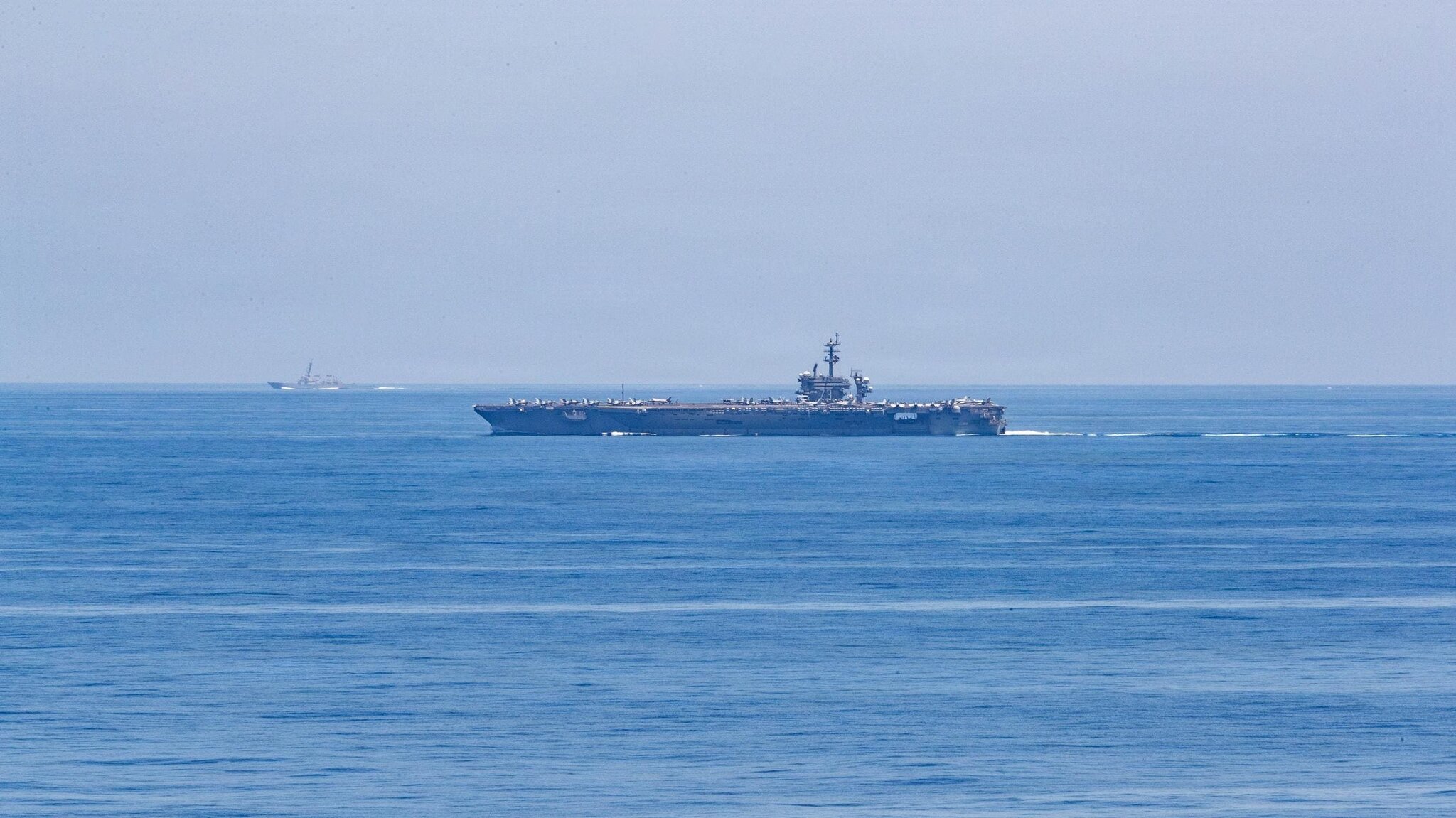
The United States Navy’s only forward-deployed nuclear-powered aircraft carrier, the USS George Washington (CVN-73), transited the Luzon Strait last week and is now operating in the South China Sea. The sixth Nimitz -class supercarrier had previously been deployed to the Philippine Sea and participated in the Valiant Shield joint exercises with the Japan Maritime Self-Defense Force in June.
CVN-73 began its 2026 deployment on May 10, 2026, when it departed from its homeport at Yokosuka Naval Base, Japan. The patrol is expected to last around six months, similar in length to the time the carrier spent at sea in 2025, its first deployment since returning to Yokosuka after completing its midlife refueling and complex overhaul.
The USS George Washington Carrier Strike Group, led by the nuclear-powered aircraft carrier with the embarked Carrier Air Wing 5 (CVW-5), also includes the Ticonderoga -class guided-missile cruiser USS Robert Smalls (CG-62) and the Arleigh Burke -class AEGIS guided-missile destroyers USS Benfold (DDG-65) and USS Shoup (DDG-86).
“The USS George Washington Carrier Strike Group’s advanced capabilities, including the F-35, are upholding FREEDOM of Navigation and Overflight in the South China Sea. We challenge excessive maritime claims around the world,” wrote U.S. Ambassador to the Philippines Lee Lipton in a post on X on Sunday.
CVN-73 is the first U.S. Navy supercarrier to be deployed to the South China Sea since the USS Abraham Lincoln (CVN-72) conducted routine operations in the waters in January, which included live-fire exercises and a replenishment-at-sea. CVN-72 was dispatched to the Middle East, leaving the U.S. without a carrier strike group in the Western Pacific until the USS George Washington began its patrol in May.
The U.S. Navy regularly deploys warships to the neutral waters of the South China Sea, even as Beijing maintains it as its sovereign territory.
The arrival of CVN-73 to the region comes as there have been heightened tensions between China and the Philippines, which have overlapping claims. That included a July 20 clash on the Second Thomas Shoal involving Chinese Coast Guard officers physically striking a Philippine Navy SEAL on the head with a wooden baton, which necessitated a medical evacuation of the injured sailor, USNI News reported .
Just days later, the Chinese Coast Guard reportedly attacked the Philippine Coast Guard and Bureau of Fisheries and Aquatic Resources vessels with water cannons near the Scarborough Shoal. Videos of the incident, recorded by the Philippine Coast Guard, have also been shared on social media.
The U.S. has publicly condemned China’s actions.
“We’re committed to supporting our treaty partners, and obviously we’ve already done quite a bit,” U.S. Secretary of State Marco Rubio said during an address to the ASEAN Foreign Ministerial Meeting in the Philippines last week.
“In fact, there was a U.S. Coast Guard vessel in the region at the time that this happened and actually helped stand between the two sides and allowed the individual who was injured to be rescued and brought back for medical treatment,” Rubio added. “We’re already here, we’re already present, we have a role, and we’re not going to abandon our allies. We’ve made that abundantly clear.”
Multiple U.S. Coast Guard Sentinel -class cutters had previously been deployed to the Middle East, but are now operating in Southeast Asia.
Another United States Navy Nimitz -class aircraft carrier, the USS Theodore Roosevelt (CVN-71), has been leading this month’s Rim of the Pacific 2026 joint exercises near Hawaii, which kicked off in late June . CVN-71 departed its homeport of San Diego on June 15, 2026. The carrier arrived in Hawaii on June 23, in advance of RIMPAC maritime exercises, which will conclude on Friday.
The United States Navy typically doesn’t give advanced warning or insight into where its aircraft carriers could be deployed. However, following the conclusion of the RIMPAC 2026 exercises in late July, the USS Theodore Roosevelt is expected to continue its scheduled deployment in the Western Pacific and the broader Indo-Pacific, operating in either the U.S. 3rd or 7th Fleet areas of operation.
Given the recent flare-up in the South China Sea, the Department of Defense may intentionally maintain CVN-71’s operational focus in the Pacific region in an effort to bolster American maritime presence, rather than dispatching another nuclear-powered supercarrier to the Middle East.
Currently, two other U.S. Navy Nimitz -class aircraft carriers are deployed to the U.S. 5th Fleet and U.S. Central Command’s area of responsibility, including the USS Abraham Lincoln and USS George H.W. Bush (CVN-77).
However, CVN-72 has now spent 249 days deployed since the carrier departed from Naval Base San Diego on November 21, 2025. What is also not...
AIPROPX is an independent multi-source news index — we track, compare, and connect coverage from across the web into one place you won't find anywhere else.