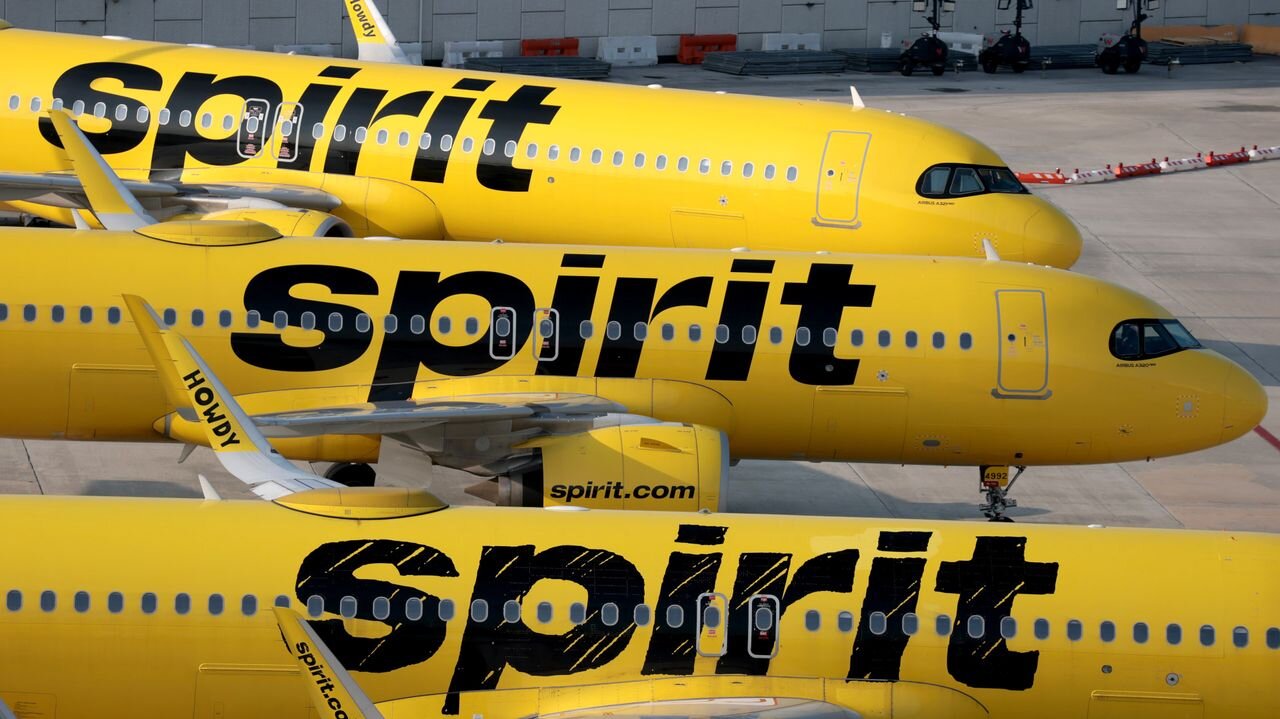
Google won a bankruptcy auction for Spirit Airlines' internal business data for $10 million
The package runs to roughly 100 million emails, 500 million Teams items, decades of payroll and crew records, and about 30 million lines of code, with customer and loyalty data excluded
However the sale has stalled as a flight attendants' union says the privacy terms protect customers rather than employees, and a rival bidder has since offered $12.5 million
Google has successfully bid $10 million for what a court notice calls the 'Deidentified Data' of Spirit Airlines' parent company - but its bid to use the data to train AI models has run into a privacy debate.
The cache is massive: it contains roughly 100 million emails and 80,000 email accounts, and lists 17,082,644 OneDrive items, 20,577,677 SharePoint items, and 500 million Teams items, along with the Microsoft 365 environment that they were stored in.
It includes 1,092,000 time card records going back to December 2012, 175,658 employee records going back to August 1986, 3,426,618 payroll records, 148,018 employee tax forms, 5,014,676 crew pairings, applicant tracking documents, litigation case files, and employment contracts - and Bloomberg Law also notes it contains around 30 million lines of code , plus revenue, aircraft operations, and audit data.
A deal with plenty of naysayers and competitors?
Spirit Airlines was one of America's most prolific low-cost providers, and as a result, it has what one could term a treasure trove of documents that Google could leverage to train its AI models at a time when experts and subject-matter experts are increasingly in short supply on an internet that has sidelined many of them in favor of AI-generated answers.
The move, if it closes, subject to a September 9 hearing, makes sense for Google on two fronts; the AI training aspect is the most obvious one.
Google is also already a dominant surface for travel search , and it is buying one carrier's booking curves, fare behavior, and competitor pricing history out of a liquidation could give it a staggering amount of insight here on how to track, predict and parse data publically made available by other low-cost airlines thanks to a near-naked view of the internals of such a company.
The data being handed over skips 97.5 million passenger profiles and 50.2 million Free Spirit loyalty records, in addition to privileged materials.
This, however, is not enough to appease certain quarters: the Association of Flight Attendants-CWA filed a limited objection to the sale, asking the court to decline the transaction if it does not extend the same level of protections to flight attendant data as it does to consumer data.
This would concern employment records by the now-defunct airline, and does pose a legitimate concern, but 'de-identifying' records could also potentially affect data integrity across the board for an organization where much of the data is valuable only because it can be tracked back and linked reliably by AI models.
Google's public statement is that any data it receives will be rigorously scrubbed of personally identifiable information by a third party before receipt.
Google bought the data from Spirit Aviation Holdings during a bankruptcy auction in New York after it opened at $5 million. Its nearest competitor was also an AI data firm, Mercor.io, which offered $7.5 million, resulting in it being assigned alternate-bidder status if Google's bid failed to close.
What is a mind-boggling number for some is otherwise a rather cheap way for a major AI player to secure four decades of an airline's data, an amount that it would otherwise spend on a few senior engineers; for context, Google has already pledged $1 billion in education spending linked to AI .