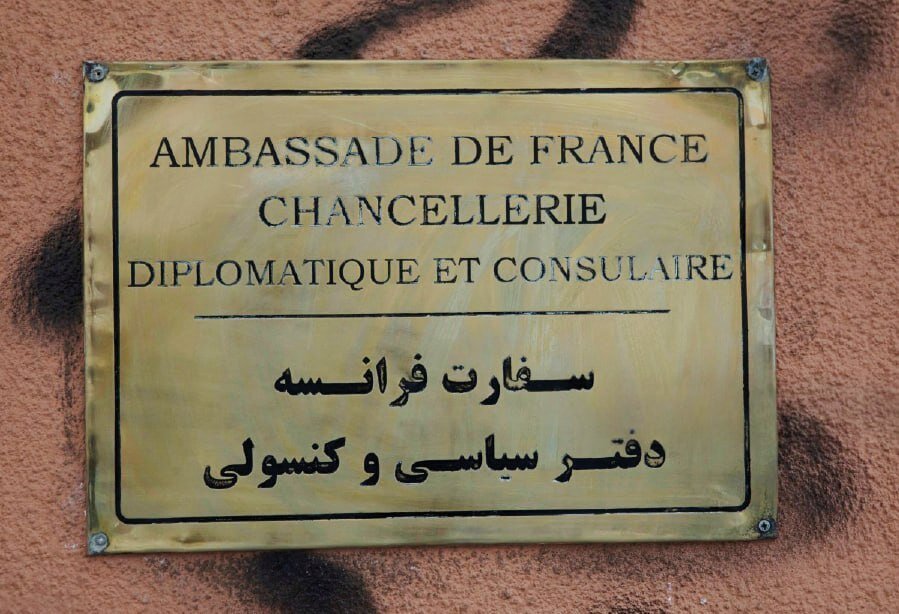
TEHRAN — The Islamic Republic on Saturday reacted strongly to Paris as two French diplomats are involved in a foreign infiltration project in Iran.
Iran’s Intelligence Ministry warned France that Tehran will take “appropriate action” if similar activities are repeated.
The warning goes beyond the conduct of the two diplomats to encompass foreign interference, human rights double standards, sanctions and growing European alignment with Washington.
“France should not waste its citizens’ tax money on illegal interference in Iran’s affairs,” the Public Relation Office of the ministry said in a statement.
According to the ministry, the two French diplomats were discovered at the site of a secret meeting while Iranian security forces were executing a judicial order to arrest two suspects in a major case involving foreign infiltration and interference. The ministry said the diplomats had a record of conduct it considered inconsistent with Iranian law and their diplomatic obligations.
Iranian authorities verified their identities and informed the Foreign Ministry. Tehran said it initially withheld details of the incident while investigators examined documents and evidence recovered from the site.
The Intelligence Ministry said its preliminary examination of the seized material had uncovered a “sinister project” involving the identification of targeted individuals, the establishment of covert contacts and the construction of networks inside and outside Iran.
The ministry further stated that contracts found during the investigation bore the signature of France’s former ambassador to Iran. It said it exemplifies France’s violation of Iranian law and diplomatic norms and demanded an explanation from the Paris government.
Tehran has placed particular emphasis on the timing of the activities, saying they took place during wartime, an open reference to the United States’ war on Iran.
The ministry portrayed the diplomats’ activities as extending beyond conventional diplomatic engagement and into organized interference in Iran’s internal affairs.
It warned that foreign diplomats would not be permitted to use their diplomatic status for “illegal or interventionist activities” and said those responsible would face appropriate action if such conduct were repeated. The investigation remains open, with the ministry indicating that further details may be released.
Paris has characterized the treatment of its diplomats as a serious diplomatic matter.
French Foreign Minister Jean-Noël Barrot previously alleged that the two diplomats had been detained for several hours, interrogated, and that one had been physically abused. Tehran has categorically rejected that account, with Foreign Ministry spokesman Esmaeil Baqaei accusing the diplomats of interfering in Iran’s internal affairs under the guise of contacts with civil society.
Araghchi accuses Europe of double standards
Iranian Foreign Minister Abbas Araghchi has also accused the European Union and some of its member states of applying “double standards.” In separate telephone conversations with his Greek and Austrian counterparts, Araghchi accused Paris of hypocrisy for presenting itself as a defender of human rights and international law while supporting Israel’s military campaign in Gaza and military action against Iran.
The exchange illustrates how the dispute over the French diplomats has become intertwined with a much broader confrontation. For Tehran, European criticism of Iran’s domestic policies cannot be separated from European support for Israel and Washington in regional conflicts.
These developments remain contested and should be treated as challenges rather than a crisis. But their emergence reflects the depth of mistrust surrounding the European diplomatic presence in Tehran.
Sanam Vakil of Chatham House has warned that Europe can no longer remain on the margins of diplomacy with Iran or simply act as Washington’s junior partner, stressing that Tehran’s position on the Strait of Hormuz, sanctions, nuclear issues and regional security directly affects European interests.
Iran’s strategic importance has become even more pronounced because of the Strait of Hormuz. Analysts at Brookings have assessed that Iran emerged from the war in a stronger position and has exercised control over the strategic waterway, giving Tehran additional bargaining leverage.
The consequences are not confined to the Middle East: European governments remain exposed to higher energy prices, shipping disruptions and broader economic instability resulting from prolonged uncertainty around the strait.
This gives Tehran an important advantage in dealing with European capitals. Iran can influence issues that matter directly to Europe — maritime security, energy flows, regional stability and the prospects for de-escalation — while Europe has yet to develop an independent strategy without substantial reliance on Washington.
Iran’s strongest position is not necessarily in confrontation with Europe, but in demonstrating that meaningful progress on energy security, maritime stability and regional de-escalation cannot be achieved without Iranian participation.
In that sense, the current dispute may ultimately expose a paradox at the heart of Europe’s Iran policy: the more Europe seeks to pressure Tehran without addressing Iran’s strategic weight, the more it risks reducing its own diplomatic leverage. Iran, meanwhile, enters the next phase of engagement with Europe from a position in which geography, energy security and regional power give it considerably more bargaining weight than conventional economic pressure alone might suggest.