This is one outlet's own report from Deutsche Welle — the article as it was filed. Other outlets are covering the same event; open the full story to compare every source side by side.
India: Student anger over alleged exam issues spreads to Jharkhand
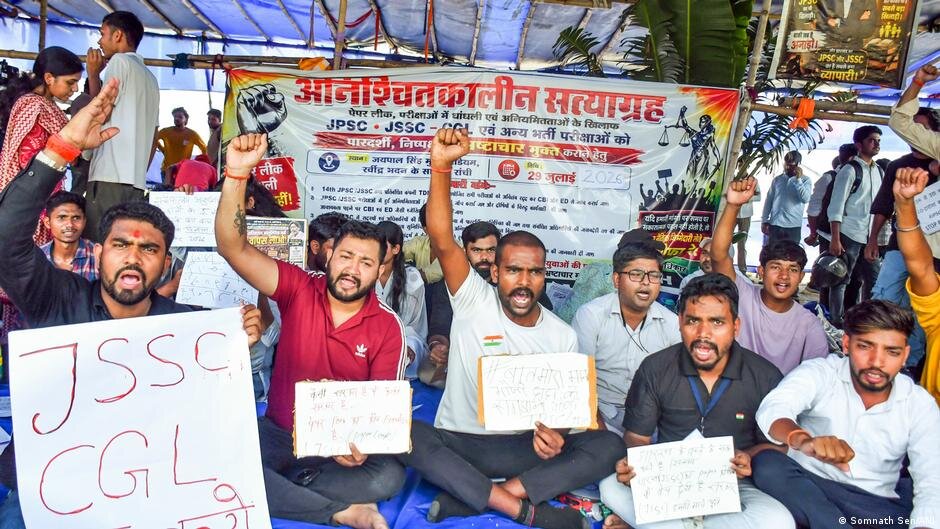
Inspired by the Cockroach movement, young people in India's eastern state of Jharkhand are marching on the state assembly to demand transparency and a probe into alleged irregularities in civil service recruitment exams.
https://p.dw.com/p/5IYSh Advertisement Thousands of protesters in Jharkhand are marching on the eastern Indian state's parliament to demand a federal inquiry into alleged irregularities in recruitment exams for government jobs, for the tests to be canceled and for a more transparent hiring process.
Police used water cannons against the protesters on Monday as they tried to breach security barricades en route to Jharkhand Legislative Assembly.
The confrontation marked a sharp escalation between the authorities and the protesters.
The movement began on July 25, when demonstrators started camping at Jaipal Singh Munda Stadium in the state capital, Ranchi.
In scenes reminiscent of the youth-led " Cockroach " protests that swept New Delhi last month, some protesters also went on a hunger strike .
Rahul Kranti, a 40-year-old government job aspirant and one of at least six protesters participating in the hunger strike, was moved to intensive care after his health deteriorated.
"The future of Jharkhand's youth will not be allowed to be sold. I will remain on hunger strike, whether I am in hospital or at the protest site," Kranti told DW.
He pledged to continue his protest until the government cancels Jharkhand Public Service Commission (JPSC) exams and orders a criminal inquiry by the national Central Bureau of Investigation (CBI).
After hours of negotiations on Sunday, the government agreed to suspend this year's disputed JPSC exam, and three members of the commission resigned.
But the protesters say the concessions fall short of their demands, which include the cancelation of the Jharkhand Staff Selection Commission's Combined Graduate Level (JSSC-CGL) examination, a major recruitment test for state government jobs, and a full federal probe into alleged irregularities across Jharkhand's recruitment system for public sector jobs.
The initial trigger was the latest JPSC civil services examination, which advertised just 103 government posts. More than 2,000 candidates qualified for the next stage when results were announced in early July.
Then, an answer sheet began circulating online, apparently showing a candidate who had passed the exam, despite completing very little of it. The image went viral, prompting allegations that the results had been manipulated.
Police have arrested the candidate at the center of the controversy, along with 10 others, and the commission's chair resigned under pressure.
But the protesters say those steps have not addressed the larger problem.
The Jharkhand protesters want the exam results to be scrapped and for the exam to be repeated.
They are also calling for an independent inquiry, either by retired High Court judges from outside the state, or by federal authorities. The protesters argue that a state police probe cannot adequately examine allegations involving Jharkhand's own recruitment machinery.
The Jharkhand Chhatra Sangh (JCS), one of the student groups involved in the protests, is also demanding greater transparency in answer sheets and test results, biometric verification, tougher safeguards against paper leaks and accountability for officials and private, third-party recruitment agencies.
The JCS also wants alleged tainted examinations from recent years to be investigated and, where necessary, canceled and retaken.
"The government must clean up the entire JPSC and JSSC recruitment system, investigate those responsible, blacklist tainted agencies and make future examinations transparent and fraud-proof," S Ali, national president of the JCS, told DW.
The Ranchi protest began days after the Cockroach Janta Party (CJP) called off its 36-day protest in Delhi over leaked medical entrance examination papers.
That movement, which saw youths stage hunger strikes and camp outside the Delhi observatory, Jantar Mantar, culminated in the resignation of India's education minister, Dharmendra Pradhan .
CJP founder Abhijeet Dipke has announced plans to travel to Jharkhand, while a delegation has already reached Ranchi to support the protesters.
But Jharkhand's movement is more than a mere copy of the CJP. The JPSC-JSSC Reforms Manch has led the protests, alongside the Jharkhand Loktantrik Krantikari Morcha. Student unions, including All-India Students Association (AISA) and All India Students' Federation (AISF), have also joined.
Neha Bora, AISA president, visited the protesters in Ranchi.
"Whether at Jantar Mantar or in Ranchi, these protests symbolize the broken trust young people feel towards the system ," Bora told DW.
"They are demanding to be heard, but also asking for changes that can prevent such crises in the future."
Jharkhand has its own history of popular struggles over land, identity and political rights.
Political analyst Radhika Ramaseshan said the students had clearly taken cues from Delhi, but were also drawing on that local tradition.
"Jharkhand has doubtless adopted the CJP playbook to flag a different set of issues that also impinge on the future of young people," Ramaseshan told DW.
"The difference is that the protesters' target is the coalition government in Ranchi, which, like the union government, responded late," she added.
Chief Minister Hemant Soren has said he is open to talks, while authorities have restricted protests within 750 meters (820 yards) of the assembly through August 12.
"The solution to every issue lies in dialogue, not batons and guns," Soren said at Jharkhand's annual tribal festival in Ranchi on Sunday. He sought to assure students that those responsible for the alleged recruitment irregularities would face severe punishment.
India's Cockroach movement — and why it matters To view this video please enable JavaScript, and consider upgrading to a web browser that supports HTML...
AIPROPX is an independent multi-source news index — we track, compare, and connect coverage from across the web into one place you won't find anywhere else.