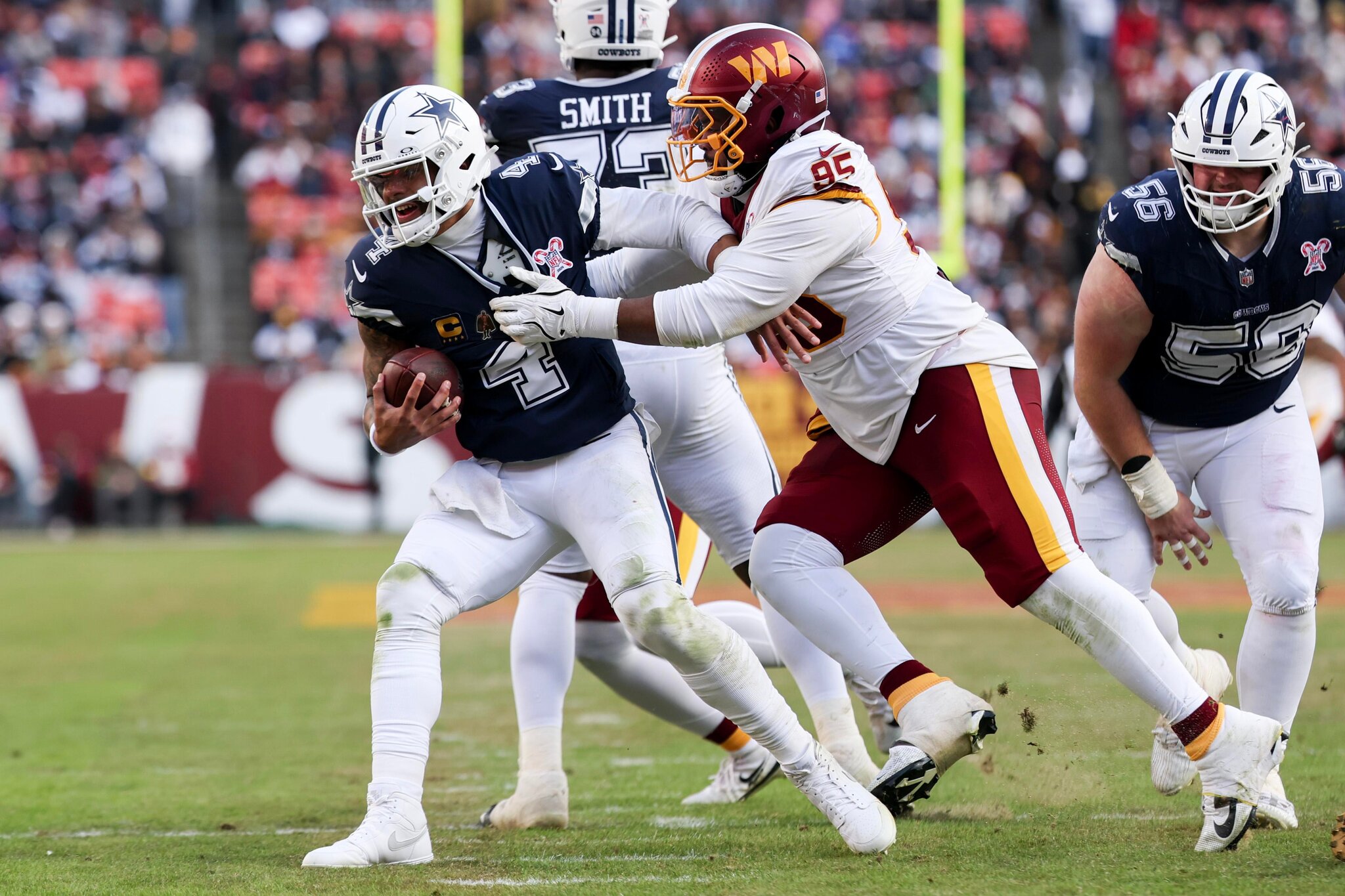
The conventional wisdom on Jer’Zhan “Johnny” Newton is that he has yet to play up to the expectations of his NFL draft status. They were set very high by GM Adam Peters’ comments after picking Newton No. 36 overall in the second round of the 2024 draft:
…Johnny, we could not believe he was still there. We were a little nervous that he wasn’t going to make it to us at 36. We looked at moving up to get him, very surprising. We had a first-round grade on him and he is an explosive, violent player. He’s a team captain. He got the Commander tag and he’s exactly who we want to bring in this building. We think he’s an advanced player who can come in and play right away. Really a three-down player who you can play on the run downs, play on pass downs, skilled, hands and feet are tied together. And he arrives violently when he gets to the ball and he plays just like we want him to play. So just thrilled to get Johnny.
Heading into his third NFL season, his first playing in Daronte Jones’ exotic defense, questions abound about whether Newton was worth the Commanders’ investment of an early-second round pick .
In his first two seasons, Newton has filled a rotational role in the Commanders’ defensive front. His rookie season was hampered by recovery from offseason foot surgeries . Nevertheless, he stepped up when starter Jonathan Allen missed nine games, and ended up playing 51% of regular-season defensive snaps, the second largest share among interior defensive linemen. In 2025, his playing time dropped to 38% of defensive snaps, placing him third in the rotation behind starters Javon Kinlaw (63.6%) and Daron Payne (53.3%).
Newton’s production totals to date have been relatively modest. As we’ll see in a minute, though, raw production stats taken out of context can be deceiving. But before we get to that, we need to take a look at what kind of player Newton is. That will tell us what performance matters.
Simplistically speaking, we can think of two poles of defensive line play. Space-eating defensive linemen use size and power to clog running lanes and occupy blocks to allow their teammates to make plays in the running and passing games. At a listed weight of 6-foot-2 and 295 pounds, Newton lacks the bulk we typically associate with two-gapping iDL, and he lacks the power to make up for his less than prototypical size. He will likely never be the guy to hold the point of attack in the running game or eat double teams to free up edge defenders and blitzers in the pass rush.
Toward the other pole of the position group are the gap shooters. Newton is an example of the typically smaller interior defenders who win with explosiveness to gain penetration and make plays in the backfield. In addition to exceptional athleticism, Newton’s skillset includes good anticipation, advanced hand fighting skills to defeat blocks and unexpected pursuit speed to catch runners from behind and chase plays across the formation.
So, why hasn’t that skillset translated to high-level sack production or tackles for loss totals after two years in the league? Or has it?
My previous article on UDFA WR hopeful, Jaden Bradley used an analytical technique to look through the veil of confounding factors to see how good receivers really are at coming down with the football. This one uses a lot simpler math to adjust for the one factor which bedevils most comparisons between players based on statistical totals – differences in playing time.
Players are frequently ranked based on production stats , which are based on cumulative totals. Such comparisons can be revealing — to a certain extent. But using raw production stats can lead to erroneous conclusions, like Emmitt Smith being a better running back than Barry Sanders.
Adjusting production totals for differences in numbers of opportunities or playing time gives productivity stats (e.g. yards per carry). Productivity stats tell us more about a player’s ability to produce on the field than which player got the most playing time or opportunities to compile stats. This becomes particularly important when evaluating players with limited playing time, like Newton.
To evaluate where Newton is, and where he might be headed, this analysis will focus on stats that speak to performance at making high-impact plays in his role as a penetrating interior defender. These include metrics for the pass rush, stopping the run short of its goal and generating turnovers.
NFL official stat totals
To start things off, let’s take a step back and have a look at the official NFL cumulative stats, as reported by Pro Football Reference . While I have already pointed out some limitations, these stats illustrated below are most often used to rank and compare players.
The bar graphs show Newton’s regular- plus post-season totals in 2024 (gold) and 2025 (burgundy). Numbers above the bars indicate his rank among the top 96 NFL starters and major contributors at iDL in each season (2024: min. 365 defensive snaps; 2025: min. 400 defensive snaps).
Newton played 586 defensive snaps, with 11 starts, as a rookie. He finished the season around the middle of the pack among major contributors at iDL in both sacks (rank 55, 43 rd percentile) and QB hits (rank 42, 56 th percentile). He was above league average at generating tackles for loss (rank 28, 71 st percentile). Despite common perceptions, the production total was not bad at all for a rookie coming back from offseason foot surgery. Johnny’s numbers did got a boost from playing in three more games than players on teams that failed to make the playoffs. But that is balanced to some extent by the fact that he did not get as much playing time as most designated starters, even counting the nine games when he filled in for Jonathan Allen , because of the relatively flat distribution of snaps in Joe Whitt’s defensive-line rotation.
Newton’s playing time diminished to 432 snaps with two starts in 2025, ...