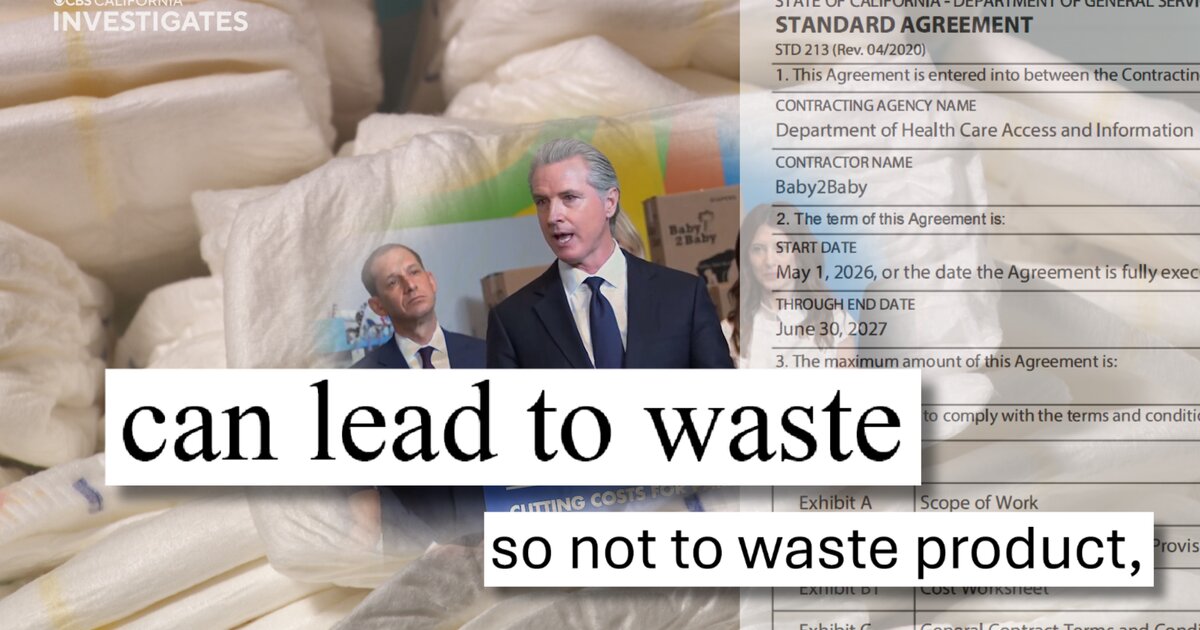
Newborns outgrow their first diapers in weeks. Experts say so. California\u00a0records\u00a0show it, and\u00a0several organizations that competed with Baby2Baby\u00a0to run the state\u0027s free diaper program made the same point.One nonprofit pointed to a federal diaper pilot in California that found\u00a083% of family requests were for Size 4 and up. Another warned that providing too many diapers of a single size "can lead to waste as babies may outgrow infant diaper sizes before they are used."Agency officials raised similar concerns with Baby2Baby, one of whose co-CEOs serves on the board of First Partner Jennifer Siebel Newsom\u0027s California Partners Project. Baby2Baby ultimately won the multimillion-dollar contract to manufacture and distribute California-branded free diapers.Officials questioned Baby2Baby about its plan to send every new baby home from the hospital with 300 to 400 diapers in only the two smallest sizes. They noted that that many diapers at once\u00a0"might be overwhelming"\u00a0and that parents "may want alternative sizes... so not to waste product."The Newsom administration went with Baby2Baby\u0027s plan anyway. The recently released\u00a0contract\u00a0locks in 400 California-branded diapers for every baby, limited to Newborn and Size 1, handed over once at hospital discharge with "no right to return or exchange diapers."For 66 days, the state\u00a0delayed releasing that contract and the related records, citing what the governor called a "competitive bid process." It wasn\u0027t.Those records arrived on July 17, six hours after CBS California Investigates published an investigation revealing that the administration bypassed the normally required competitive-bidding process using an exemption written into the state budget.Across the 356-page\u00a0release, there are no\u00a0bid scoring sheets, evaluation criteria or rankings. The agency\u0027s own final recommendation shows the other finalist offered more diapers, in more sizes, for roughly the same price.One point up front: This story is not about whether Baby2Baby is a good charity. Baby2Baby is a\u00a0highly rated charity. Its co-CEOs each earn\u00a0under $70,000, and its celebrity board members earn nothing. About $3.9 million of the $6.2 million contract buys the diapers themselves at a competitive price.Similarly, nothing in the released records reveals illegal conduct. The\u00a0exemption lawmakers added to the budget made it legal for the administration to bypass ordinarily required competitive bidding and state contract review.Instead, the records raise questions about why the state designed a program its own agency warned could waste taxpayer-funded diapers. They also show the state selected Baby2Baby even though its recommendation identified the other finalist as ready to provide the planned direct-to-consumer component.How the state selected Baby2Baby\u00a0In government contracting, the words matter. A "Request for Proposals," or RFP, kicks off a real competition: vendors submit bids, the bids are scored against published criteria, and losing bidders can protest. A "Request for Information," or RFI, is just what it sounds like: the state asking companies to tell it about themselves. No bids. No scores. No winner.California issued the second kind. The\u00a0document that started this process says so itself: it is "Not a Solicitation," issued "for information and planning purposes only."But state officials repeatedly described it like the first kind. At a 2025 budget hearing, HCAI\u0027s director told lawmakers,\u00a0"We\u0027ve issued an RFP."At a May 2026 hearing, HCAI\u0027s chief deputy told senators proposals\u00a0"are evaluated and scored," then narrowed to finalists through interviews.The records the state released contain no scores. HCAI\u0027s\u00a0July 17 release says all 15 submissions "were reviewed using the same evaluation process," without disclosing what that process was. It never uses the words "competitive bid."The contract itself confirms the deal was exempt from the Public Contract Code, the State Administrative Manual and Department of General Services review.How the reporting beganThe diaper deal drew fire the day Gov. Gavin Newsom announced it. Critics pointed to the First Partner\u0027s ties to a Baby2Baby co-CEO who sits on the board of Jennifer Siebel Newsom\u0027s nonprofit, the California Partners Project.Our May\u00a0fact-check found the loudest criticisms of the program and Baby2Baby were wrong: taxpayers will pay about 18.5 cents per diaper, not the 50-cent figure circulating online. Baby2Baby is a highly rated charity, and its co-CEOs do not pay themselves six-figure salaries.Aside from the state refusing to immediately provide a copy of the contract, the initial reporting raised one central red flag: the plan to send every new parent home from the hospital with 400 diapers.Parenting and pediatric experts caution that newborns often outgrow diaper sizes within the first few weeks, and stockpiling leads to waste. At the time, program officials couldn\u0027t say how they planned to ensure taxpayer-funded diapers given out in bulk would not go to waste.It would be 66 days before the state turned over records showing agency officials had raised the same questions we did.Concerns about diaper waste and sizesThe warnings came from everywhere, including inside HCAI, the agency that signed the deal.The state warned Baby2Baby directly. HCAI\u0027s August 2025\u00a0follow-up questions acknowledged that sending parents home with 300 to 400 diapers "might be overwhelming" and that parents "may want alternative sizes than N and Size 1 so not to waste product." Its September questionnaire repeated the concern: a large number of diapers at discharge "might present logistical problems."Baby2Baby pushed back, noting its diaper boxes are "not a burdensome or hard to carry package." It also argued against offering additional sizes, saying even one more would create\u00a0"additional logis...