This is one outlet's own report from Gizmodo — the article as it was filed. Other outlets are covering the same event; open the full story to compare every source side by side.
Astronomers Discover a Brand-New Type of Object: Part Black Hole, Part Star
At the cosmic dawn, the universe was sprinkled with giant black holes—monstrosities so huge that scientists are still struggling to explain how they could have even existed. The answer may lie in a never-before-seen object from this cosmic era.
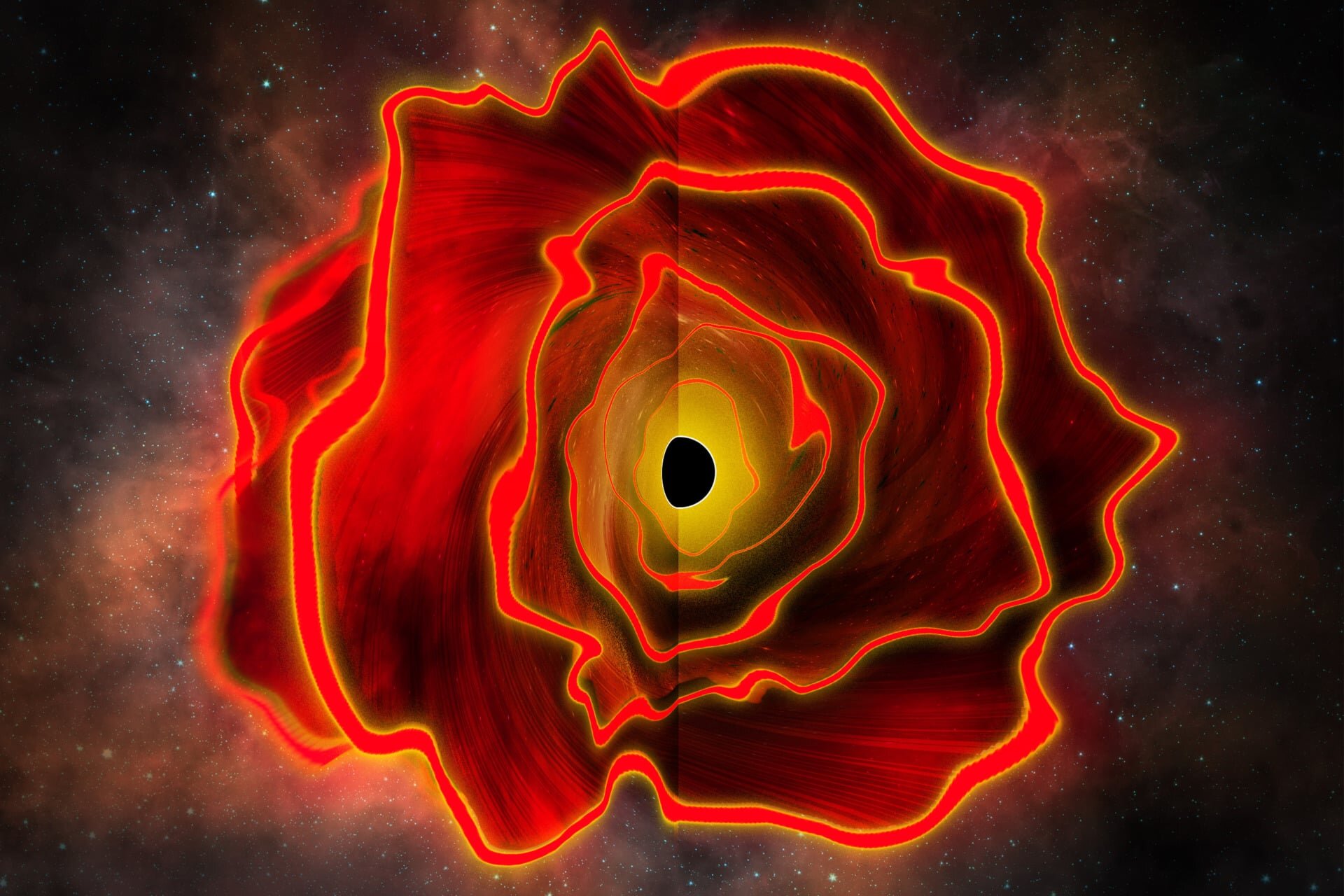
In a paper published today in Nature, astronomers report the discovery of an extremely unusual, bright spot of red from the early universe. Externally, it looks like an enormous star about the size of the entire solar system. It’s radiating about 100 billion times more energy than any known star, making it more like a black hole. After careful analysis, the team concluded that it's an entirely new type of object: a “black hole star.” This black hole star, named MoM (Mirage or Miracle)-BH*-1, “is so swaddled within shrouds of dense gas that it effectively radiates in a manner reminiscent of stellar phenomena,” Rohan Naidu , the study’s lead author, told Gizmodo.
“It is a very special thing to find an object with no comparison given the vast stores of data on billions of stars, galaxies, and black holes that we have in our archival databases,” added Naidu, an astronomer at the University of Hawaii. “MoM-BH*-1 is one in a billion!”
If you follow astronomy news, you’ve probably heard the chatter about “little red dots” seen in the early universe. These are bright, compact objects observed at high redshifts, meaning the “light from them that reaches Earth has been traveling for billions of years,” according to an accompanying News & Views by Dominik Schleicher and Rodrigo Herrera-Camus, astronomers at Sapienza University of Rome in Italy and the University of Concepción in Chile, respectively.
Little red dots might not sound too impressive. But when they were first discovered, astronomers genuinely thought that something broke in the James Webb Space Telescope, which observed these ancient objects. On the other hand, much about the universe’s earliest days remains a mystery. So pinning down the true identity of little red dots— relics from the cosmic dawn —would represent a huge advance in our understanding of our universe’s history.
Mysterious ‘Red Dot’ Galaxies Could Have ‘Relic’ Black Holes Predating the Big Bang
The discovery of MoM-BH*-1 touches on little red dots, as well as the mystery surrounding supermassive black holes from the early universe, which weigh millions to billions of solar masses. To Gizmodo, Naidu explained that black hole stars may be the “birth story of possibly every supermassive black hole,” whereas little red dots could be seen as a black hole star “embedded within a larger galaxy.”
Typically speaking, dust absorbs and scatters blue light efficiently. So when astronomical objects appear red, astronomers assume that dust is behind this reddish tint, wrote Schleicher and Herrera-Camus. However, the spectral properties of MoM-BH*-1 are more consistent with the presence of a large cloud of ionized gas and minimal contribution from dust, according to the paper.
What’s more, the light from this object “abruptly disappears” below a certain wavelength, a phenomenon formally known as a Balmer break , Naidu explained. In this way, black hole stars “simultaneously show several of the quintessential properties of both black holes and stars,” he added. “What is special about MoM-BH*-1 is that it is effectively outshining its entire host galaxy, and so we are seeing ‘pure’ black hole star light.”
According to Schleicher and Herrera-Camus, the findings raise new questions and insights into little red dots and, by extension, the state of the early universe. For instance, if the distinct color of little red dots is caused by gas, not dust, this could explain why the earliest supermassive black holes are far larger than what’s predicted by conventional cosmological models. The study’s analysis also complements other work that identified similar traces of gas accreting around active black holes, they added.
Naidu is eager to dig deeper into the mystery of black hole stars. Naidu and colleagues have already secured JWST observation time. Starting in December, he said, the team will be hard at work locking down the “detailed physics of these remarkable objects—how massive exactly are they, and what do their ‘stellar’ features tell us about their ‘stellar’ atmospheres?”
“Astronomers who study the early universe are so amped right now because of little red dots and black hole stars,” Naidu said. “Many astronomers have made comparisons to the 1960s and 70s when we first found supermassive black holes in the form of quasars. […] And now, thanks to JWST, and thanks to how delightfully surprising the universe is, we are reliving that very special period when we are rewriting the textbooks and filling out new chapters for things that we didn’t even know existed!"
AIPROPX is an independent multi-source news index — we track, compare, and connect coverage from across the web into one place you won't find anywhere else.