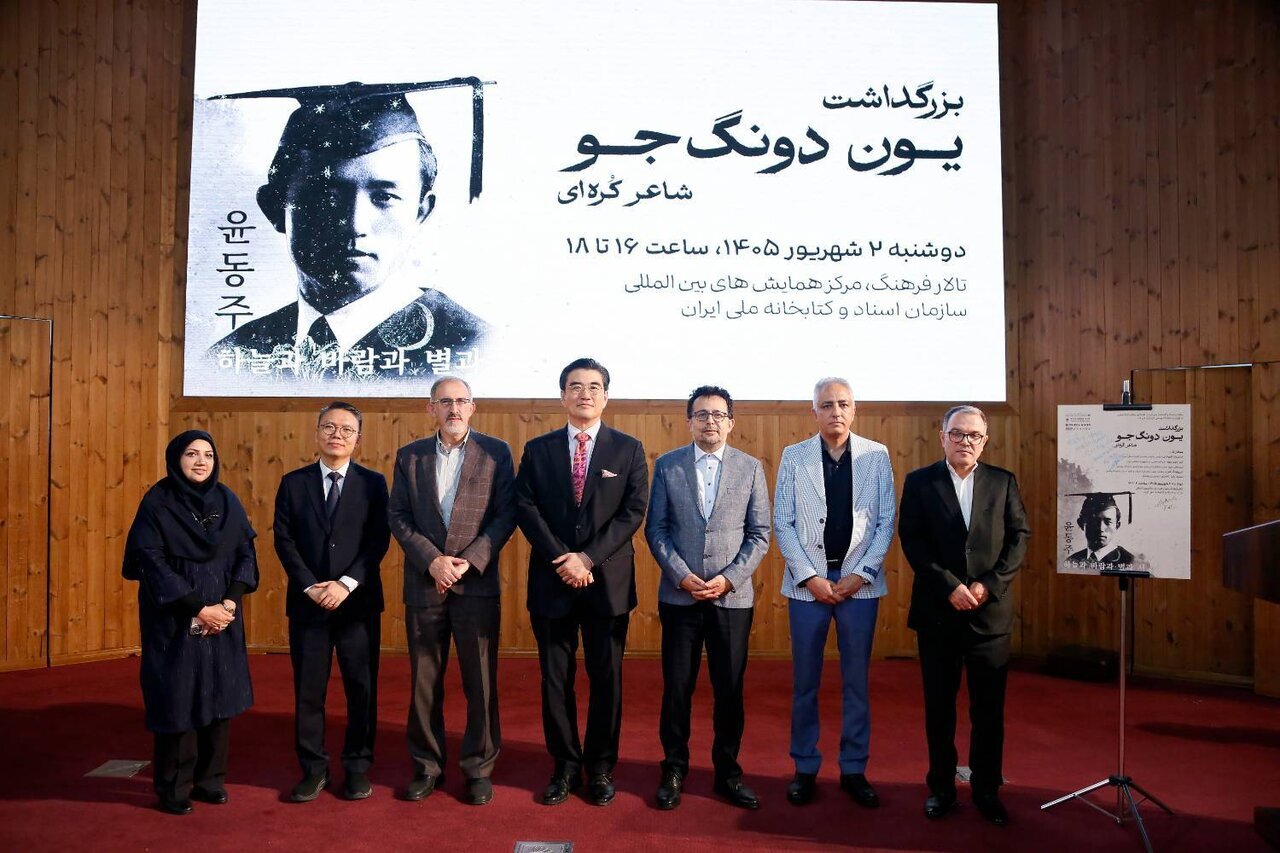
TEHRAN- In a vibrant testament to the power of literature to transcend borders, the National Library and Archives of Iran (NLAI) hosted a commemorative ceremony on Monday, August 24, honoring Yun Dong-ju, one of Korea's most beloved contemporary poets.
The event, held at the NLAI's Farhang Hall, was organized in collaboration with the Embassy of the Republic of Korea in Tehran and Yonsei University, drawing a distinguished audience of cultural officials, university professors, researchers, and poetry enthusiasts from both nations.
The gathering underscored a fundamental truth: poetry and literature remain among the most enduring mediums for dialogue between nations, offering profound insights into the historical and cultural experiences of diverse peoples. The ceremony featured speeches from Gholamreza Amirkhani, President of the NLAI; Kim Junpyo, Ambassador of Korea to Iran; Joo ILL Sun, Dean of the College of Liberal Arts at Yonsei University; Shin Ji Young, Vice Dean of the same college, and Saeid Reza Ettehadi, Translator and Researcher.
Also the hall for 500 audiences was fully occupied by the BTS.
Speaking in the event, Gholamreza Amirkhani, referring to the position of the National Library and Archives Organization of Iran in preserving the country's written heritage, said: "The organization does not only engage in preservation and maintenance; a significant part of its activities is related to cultural diplomacy, and today we are witnessing one of its programs."
Referring to the cultural relations between Iran and Korea, he added: "In the past year or two, activities have increased and we have established very good connections with various countries around the world. Today, too, a program centered on Korea is being held, dedicated to an important and renowned poet of that country."
The head of the National Library and Archives Organization of Iran, referring to the fiftieth anniversary of the establishment of Iranology chairs at Korean universities, said: "To date, nearly 1,500 students from Korean universities have graduated in the field of Iranian studies, and each of these individuals can serve as worthy ambassadors of Iran's history, culture, and civilization in South Korea."
Amirkhani also spoke about library cooperation between the two countries, stating: "We dedicated the first dedicated room and special space to Korea in 2009, which today includes hundreds of books in English, available to researchers in the field of Korean books and bibliography. We hope that interactions between the two countries, centered on the National Library, will expand even further."
Ambassador Kim also delivered speech, that comes as follows:
I sincerely welcome all of you who have gathered here for the seminar on Yun Dong-ju—one of the most beloved poets of today's Korea among its people.
And today, when I came here, an impressive scene was imprinted on my mind.
As you all know, you are all familiar with the famous Korean group BTS, aren't you?
But today, when I came here, I felt... as if we too have been placed alongside BTS.
That bridge is none other than you yourselves.
Every one of you who is interested in Korean poetry and culture and is present here today is yourself a bridge connecting Tehran and Seoul; you are BTS.
I invite all of you who have attended this program to express your appreciation for one another with a warm round of applause.
I also sincerely thank Dr. Gholamreza Amirkhani, the respected President of the National Library of Iran, and all the organizers of this institution who have stood by us in holding this valuable program.
I also extend my sincere gratitude to Professor Joo ILL Sun, the respected Dean of the College of Liberal Arts at Yonsei University, a senior scholar and alumnus of the university; to Ms. Shin Ji Young, the respected Vice Dean of the College; to the organizers of the Yun Dong-ju Memorial Museum; and to Mr. Saeid Reza Ettehadi, who has undertaken the presentation of this program.
I kindly ask you all to give them a warm round of applause as well.
During the time I have lived in Iran, I have always felt one thing again and again.
Iran is truly a land that loves books and poetry. In the heart of its thousands of years of history, poetry and literature remain alive and flowing in the everyday lives of its people.
For this reason, I believe that the encounter and connection between Iran and Korea through the medium of books is something very natural.
In 2010, based on cooperation between the national libraries of the two countries, the "Korea Corner" was established here.
After that, thousands of Korean books were donated to this collection, and with the support of Samsung, the "Korea Corner" was developed into a multimedia space as well.
And today, we are taking another step forward.
We have gone beyond simply introducing a book—today, we are speaking with one another about the life and inner world of the person who wrote that book.
And for me, the fact that the first figure on this path is Yun Dong-ju holds a special meaning. The poet Yun Dong-ju is also a special figure for me.
He is also one of the senior scholars and alumni of my university, before my time.
Whenever I passed by the memorial stone of Yun Dong-ju on campus during my student days, I felt that his spirit and ideals, engraved on that stone, were also being engraved in my heart.
"Until the day I die, I keep my eyes toward the sky and let not even a speck of shame exist within you."
That single verse, in my youth, became the compass of my life—that I must give my utmost effort in the life entrusted to me, and live with love and kindness alongside those around me.
So that I do not forget that feeling and belief from those days, even after becoming a diplomat, I carry this poetry collection with me wherever I go.
And after coming to Iran, I became acquainted with great poets such as Hafez and other magnificent Iranian poets. If Yun Dong-ju's poetry in Korea m...