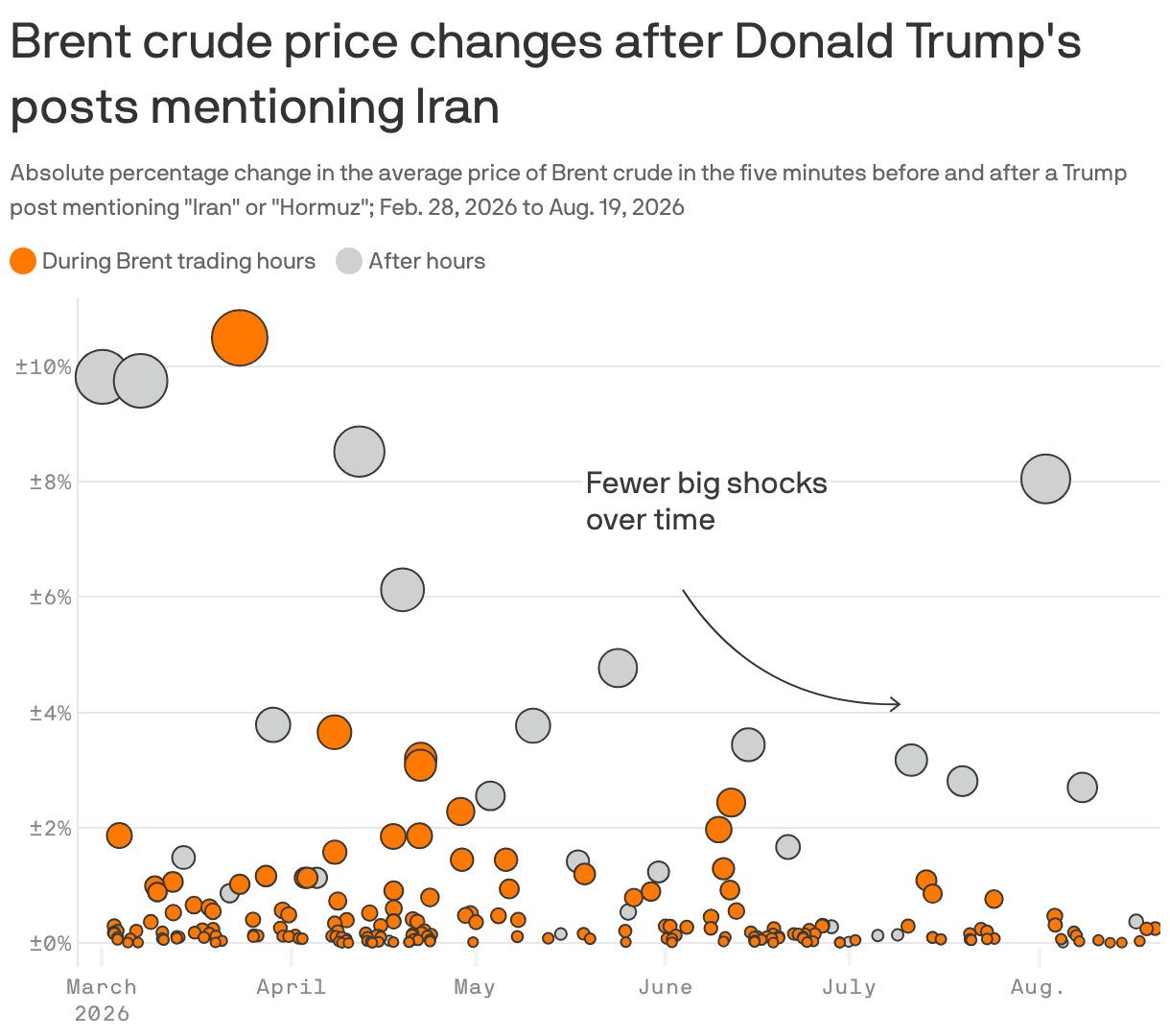
The big picture: In the early weeks, there was an "information vacuum" and high uncertainty about U.S. policy and objectives, said oil analyst Ben Cahill.
Markets "overreacted" to a lot of posts in response.
"For months now, the market has been tuning out social media posts because they just don't reflect the reality on the ground," said Cahill, a senior fellow with the Atlantic Council.
Many of Trump's proclamations about the status of the Strait of Hormuz, his policies, and the war's aims have had "zero correlation" to how many barrels are leaving the waterway, he said.
How it works: Axios tracked 269 posts on Truth Social between Feb. 28 and Aug. 19 that mentioned Iran or the Strait of Hormuz.
During that period, the average five-minute change in the futures price — that is, comparing adjacent, non-overlapping five-minute blocs — was 0.2%.
But in the five minutes after these Truth Social posts appeared, or in the five minutes after the next market open, the average change was almost four times higher, averaging 0.73%.
Yes, but: The effect is diminishing, as you can see above.
Catch up quick: The Iran war shows how Trump's posts have the power to quickly move markets.
Truth Social has begun charging Wall Street up to $1.2 million a year for a split-second edge on posts , but the offering is facing litigation .
What we're watching: Trump's waning power to "jawbone" oil markets has political consequences, as Democrats use energy prices as a cudgel against Republicans in the midterm elections.
"In the first couple months, I think the White House was quite successful in controlling the narrative and talking down the oil prices," Cahill said. "But it has lost its effect."
AIPROPX is an independent multi-source news index — we track, compare, and connect coverage from across the web into one place you won't find anywhere else.