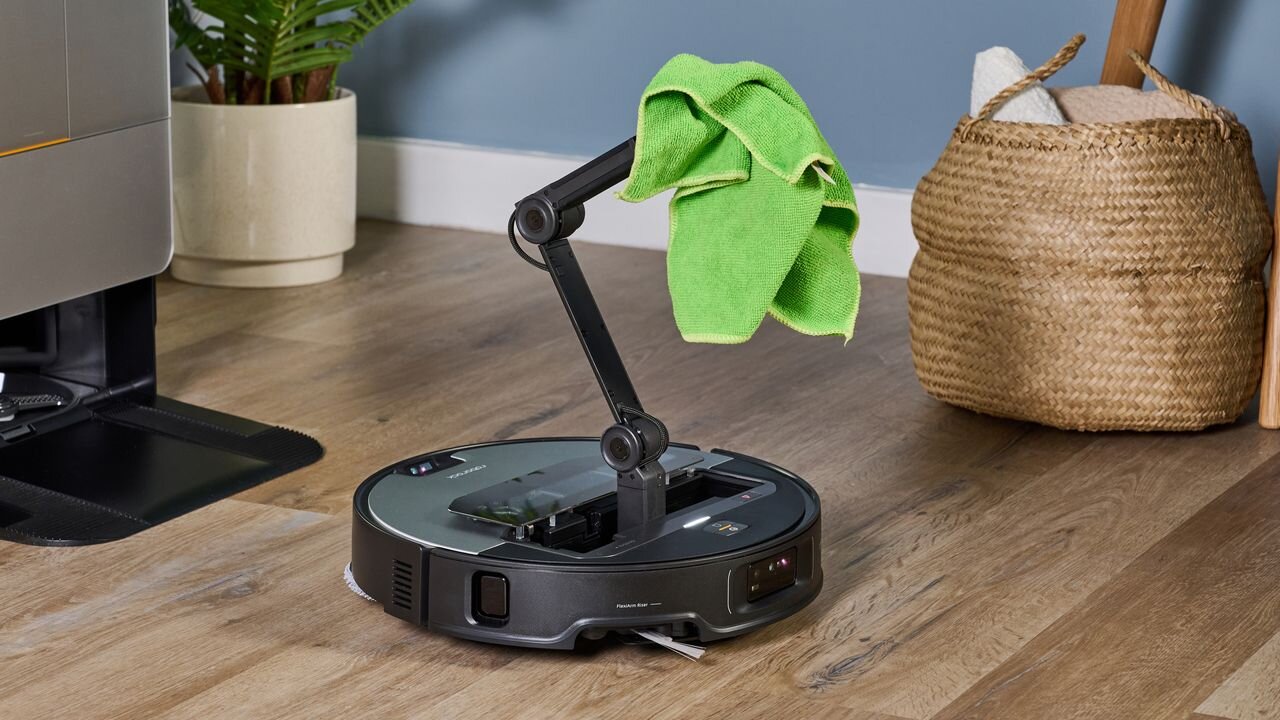
The world of robot vacuums has come a long way. I've been testing and writing about these puck-shaped home helpers for over two years, and during that time I've watched suction specs skyrocket , bots sprout legs and pincer arms , and docks transform into formidable, self-sufficient cleaning stations. Robot vacuums are looking cleverer and more useful than ever.
I wanted to get an idea of where the industry is headed, and what the next generation of robovacs might look like. So I rounded up representatives from some of the best robot vacuum brands to get their insights — and it's clear from what they told me that this smart-home segment is going to get even bigger… and even weirder.
Complete cleaners
The obvious place to start is with the cleaning itself, and there's one point that my interviewees all agreed on: it's no longer all about the suction specs. "Customers are looking beyond headline suction figures and realizing the performance of robot vacuums is the combination of a lot of features," says Michael Meng, President of Dreame 's robot vacuum division.
Nowadays, customers are looking for better cleaning, rather than just outright power, and robovac brands have been happy to oblige, with all manner of inventive solutions.
Customers are looking beyond headline suction figures and realizing performance is the combination of a lot of features
Michael Meng, Dreame
Roborock , for example, has been working hard to make sure no corner goes uncleaned. "We see a massive push for ultra-slim designs that don't sacrifice power," says Ricky Ma, general manager for Europe and America. "People want a device that can finally clean the forgotten spaces under low-profile furniture — couches, beds, and cabinets — where dust and allergens traditionally accumulate and remain out of reach for bulkier robots."
The brand's newest bots use an innovative navigation system that doesn't require a raised puck to sit on the top surface. Roborock — alongside Dreame — has also experimented with pucks that can extend or retract, periscope-style, depending on the vertical height available.
This navigation puck, on the Roborock Qrevo Curv 2 Pro, can retract when the bot needs to squeeze into a tight spot (Image credit: Future)
Mopping functions have been the subject of much attention, too. Wet cleaning is nothing new — in fact, these days you might struggle to find a model that can't mop — but I've been seeing an increasing preference for roller mops rather than flat mop pads (either of the D-shaped or disc-shaped variety). The benefit of a cylindrical mop is that the dirty water can be scraped off, and clean water added in, as the robovac goes about its mopping business.
"One development that particularly excites me is the introduction of roller mop technology, which helps ensure floors are continuously cleaned with a fresh mop surface," says Reena Patel,
Floorcare Category Manager at iRobot, the brand behind Roomba.
Faraz Mehdi, managing director at Eufy , agrees. "Users increasingly care about whether the robot is actually cleaning with a clean mop and truly removing dirty water, rather than just spreading mess around," he says. "Real-time self-cleaning mopping makes a meaningful difference."
Roller mops — like the one on the SwitchBot S20 here — can scrape the dirty water off as they roll around, to prevent spreading spillages (Image credit: Future)
Eufy is also looking into improving filtration. In manual vacuums, Dyson has popularized multi-step filtration systems, which make use of cyclones to separate waste particles of different sizes. However, that hasn't really carried over into robot vacuums, which typically have a much more basic setup.
Eufy's AeroTurbo filter setup is significantly more complex. "We’re interested in airflow and dust-separation systems that help deliver more sustained suction performance, especially in homes with carpets and hair," explains Faraz. "One of the biggest pain points in the category is that cleaning performance can fall over time as filters clog, so technologies like multi-cyclone separation matter because they improve long-term consistency."
Our robotic arm design folds and unfolds in a way that mimics natural arm movement
Michael Meng, Dreame
Dreame has made particular strides in innovations focused on getting right into edges and corners. "No matter how powerful a robot vacuum is, dust and debris collect in corners and along edges where brushes simply can't reach. It's one of those problems that sounds minor until you actually look at how dirty those corners get," says Michael Meng.
Its newest bot — the X60 Pro Ultra Complete — has 'UltraExtend technology', which enables the mop pad to kick out up to 7 inches / 18cm from the robot body, and the side sweeper brush to unfurl, E.T.-style, to reach up to 4.7 inches / 12cm.
The design is inspired by human limbs. "When you extend your forearm, your reach increases significantly," Meng explains. "We applied that same principle to our robotic arm design — engineering it to fold and unfold in a way that mimics natural arm movement."
A number of brands have introduced sweepers and mop pads that can kick out to get closer to the edges of rooms — as seen here on the Dreame Matrix10 Ultra (Image credit: Future)
Intertwined with cleaning performance is battery function. "A robot vacuum that runs out of power mid-clean is more frustration than solution," says Meng. "Consumers with larger homes or open-plan layouts need a robot that can complete a full clean in a single charge — or intelligently return to dock, recharge and resume exactly where it left off. Battery efficiency, combined with smart charging and resume functionality, has become a key purchasing consideration for households of all sizes."
Mind the (performance) gap
Even with all the performance advancements, it's still the case that a robot vacuum-mop won't clean as well as a manual vacuum could. Robovacs are winning on convenience, but not on cle...