This is one outlet's own report from Tehran Times — the article as it was filed. Other outlets are covering the same event; open the full story to compare every source side by side.
TEHRAN – The recent oil pollution around the Persian Gulf island of Qeshm is the result of the US military presence in the region, exacting a devastating toll on public and marine lives in southern parts of the country.
As videos about oil pollution along the southern shores of Qeshm and surrounding coastal areas started to go viral, social media were flooded with questions about the source of the contamination.
Follow-up inquiries made to oil industry officials and experts indicate that the oil slicks in Qeshm Island have nothing to do with Iran’s oil production, transport, storage, or export processes. Rather, it stems from foreign military aggressions in the region, Mehr news agency reported.
Officials from the oil industry have confirmed that the oil terminal facilities, pipelines, and platforms operating in the Persian Gulf and the Sea of Oman are in optimal condition and are under continuous monitoring by Health, Safety, and Environment (HSE) units, with no signs of leaks or operational disruptions recorded in the area.
In response to this catastrophic environmental threat, Iranian officials have elaborated on the reason, urging the global community to hold aggressors accountable for their environmental crimes.
On Thursday, the head of the Department of Environment (DOE), Shina Ansari, in her X account wrote, “The oil pollution of the southern coasts of Qeshm is just one example of the widespread pollution that has destroyed the region’s marine ecosystem over the past few decades. Who is responsible for compensating for the damages inflicted—is it the energy-consuming countries that import from our region, or the aggressor parties that have turned this area into a playground for military operations?”
Foreign Ministry spokesperson Esmaeil Baqaei underlined trillion-dollar damage on Iran’s coasts. “Why must addressing the environmental condition of the Strait of Hormuz and its surrounding waters form an integral part of any future administration of the Strait?
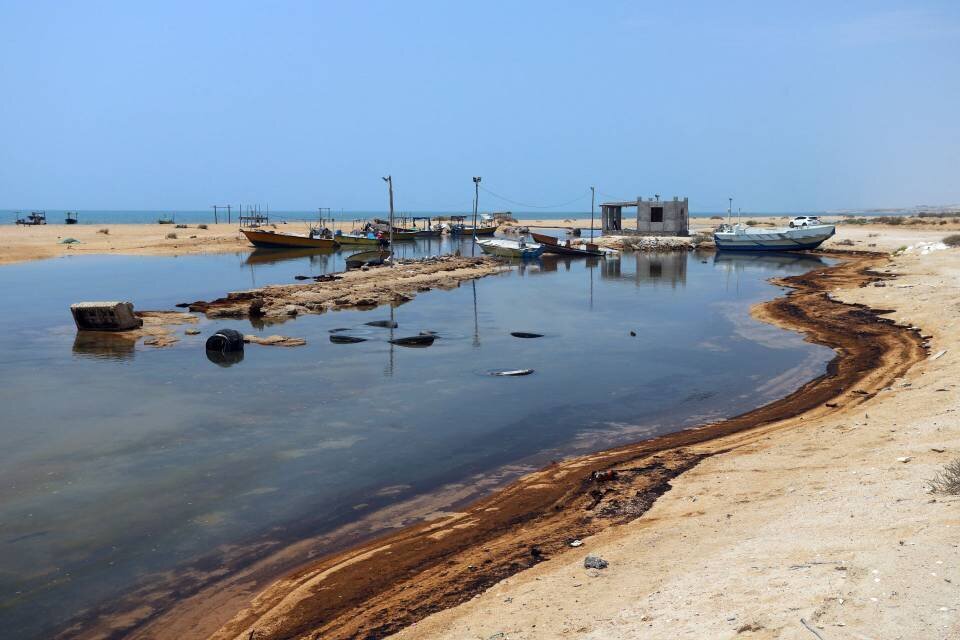
In recent days, videos have circulated showing oil pollution along the shores of Qeshm Island. This pollution drifted toward the coast from the Persian Gulf, and preliminary evidence indicates a foreign bulk carrier as the source. Contamination has been documented at three coastal sites and across portions of the sea surface.
This incident is only one visible example of the extensive pollution—both overt and concealed—that has degraded the waters of the Persian Gulf and the Sea of Oman, as well as the region’s marine ecosystem, over recent decades, imposing trillions of dollars in damage on Iran’s coastal areas.
Who bears responsibility for compensating these damages? Is it the nations that consume the inexpensive energy exported from our region, the shipping insurers, or the aggressors and their partners who have transformed the Persian Gulf and the Sea of Oman into a theatre for military operations and the testing of highly destructive weaponry?
As the country with the longest coastline along the Persian Gulf and the Sea of Oman, Iran cannot remain indifferent. Every party that benefits from commercial shipping through the Strait of Hormuz carries both a legal and a moral obligation to remediate the environmental harm inflicted upon the Persian Gulf and the Sea of Oman,” he wrote on his X account.
Iranian Deputy Foreign Minister Kazem Gharibabadi in a tweet on Thursday, held foreign military aggression in the region responsible for oil pollution along the shores of Qeshm Island, highlighting that the severe environmental damage inflicted on Iranian coastal areas in the Persian Gulf further underscores the urgent necessity for Iran, as the coastal state, to define and implement its own management mechanism for the Strait of Hormuz.
According to Press TV, Habib Masihi-Taziani, director general of Hormozgan's department of environment, announced that pollution along the southern coast of Qeshm had been almost entirely collected by Wednesday evening, with the remaining efforts nearing completion.
Despite the environmental impact, monitoring teams found no carcasses of dolphins, sea turtles or other aquatic and coastal species linked to the pollution.
Officials confirmed that oil slicks in affected marine areas were removed using specialized absorbent pads and materials, while contaminated sand was carefully stripped from beaches to a depth of two to five centimeters.
The latest pollution forms part of the broader environmental fallout from the US-Israeli aggression against Iran, which has repeatedly targeted the country’s vital oil and energy infrastructure.
In May, the Persian Gulf island of Kharg was coated in a black oil slick. Following the observation of the oil leakage, the DOE, as the responsible organization for protecting the country’s environment, conducted field, technical, and multilateral inspections and announced the results publicly.
According to the findings, the pollution was caused by a tanker discharging oily ballast water after being damaged in the vicinity of the Strait of Hormuz.
On April 8, US-Israeli forces struck Iran’s Lavan oil refinery, triggering fires and extensive damage that released petroleum contamination into surrounding waters.
Iranian environmental authorities subsequently documented pollution along the southern and eastern shores of Lavan Island and the mainland coast near Bandar Maqam, with contamination also detected around Qeshm, Larak, Hengam and Hormuz islands.
These attacks have raised serious concerns over the wider ecological damage inflicted by strikes on Iran’s oil facilities, particularly along the sensitive coastline of Hormozgan province.
Wars and armed conflicts don’t only have human casualties; the environment is one of their biggest victims. Historical experiences, from the Vietnam War, the Gulf War, the Kosovo conflicts, the war in Lebanon, the genocide against Gaza, to the US-Israeli coalition’s actions against Iran, have shown that destruction of inf...
AIPROPX is an independent multi-source news index — we track, compare, and connect coverage from across the web into one place you won't find anywhere else.