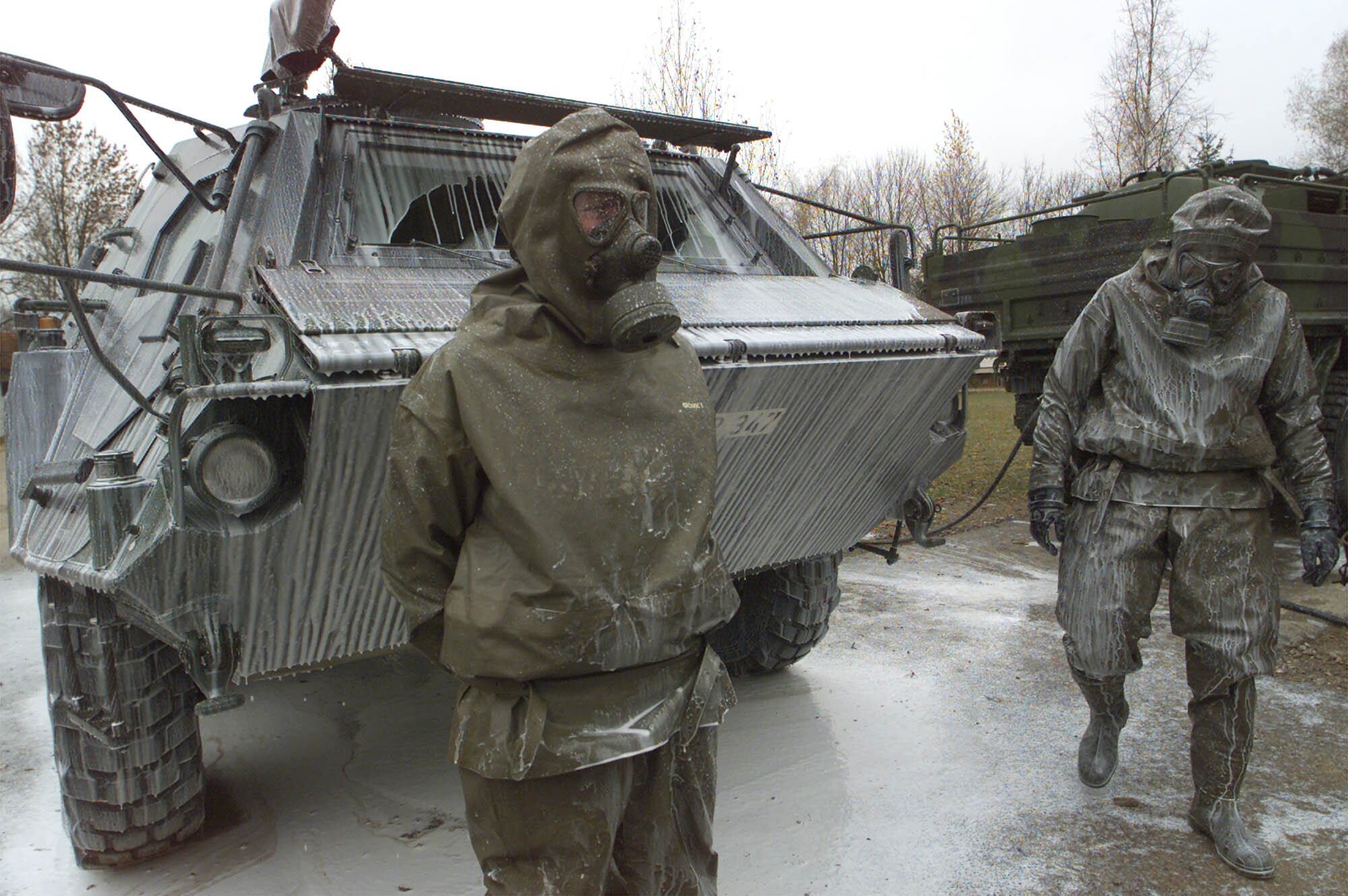
On a hill overlooking the town of Sonthofen, on the edge of the Bavarian Alps, lies a former school for educating the next generation of the Nazi elite that has been used as a base by Germany's Bundeswehr, or armed forces, since 1956. A few streets away lies a barracks built in 1936 for the Wehrmacht's mountain troops.
Today that barracks is home to a Bundeswehr school for chemical, biological, radiological and nuclear defense, and it is there that Lt. Levi — one of an estimated 300 Jewish soldiers serving in the German military — is stationed.
Like many German towns, Sonthofen is inextricably linked to the Holocaust — which affected Levi's own family.
"I obviously cannot ignore the history of this place," says the 33-year-old biologist, who asked to use a pseudonym due to the secretive nature of his work for the military.
For Levi, the Bundeswehr is the army of a free and democratic Germany: "The Bundeswehr does not stand in the tradition of National Socialism."
The former Nazi school, he notes, is now known as the Generaloberst-Beck-Kaserne, named after one of the participants in the July 20, 1944, assassination attempt against Hitler.
"That's a kind of simultaneity you have to be able to live with," Levi says.
Born in Estonia, Levi came to Germany with his family in the early 1990s as a Jewish refugee. Two of his great-grandfathers had been killed fighting the Nazis as Red Army soldiers.
Eight decades after Word War II, Levi describes himself as a "Jewish German." And as such, he wants to defend his country and what it stands for.
For a long time following WWII, the idea of a Jew serving as an officer in the Bundeswehr was considered unthinkable within Germany’s Jewish community. However, with an increasing national push for renewed mandatory conscription and a Jewish community head calling on his constituents to "do their part" for the country, the idea is no longer verboten.
The Bundeswehr was founded in 1955 — only 10 years after the end of WWII, in which the Wehrmacht was instrumental in the murder of 6 million Jews. While the new West German army was part of NATO and committed to democratic values, it did not make a clean break with the past in its personnel: Nearly all of the roughly 15,000 officers in the young Bundeswehr had previously served in the Wehrmacht, and around 300 had been members of the Waffen-SS.
The small Jewish community of the early Federal Republic consisted predominantly of concentration camp survivors and a handful of Jews who had returned from exile. It was barely conceivable at the time that they or their children would ever again serve in a German army — nor were they required to. Jews persecuted under the Nazis and their descendants were granted an exemption: until the abolition of compulsory military service in 2011, they were excused from the draft.
"We are talking about a completely different era than today," says Josef Schuster, president of the Central Council of Jews in Germany.
Since the end of National Socialism, there have been "profound changes" in Germany, Schuster says.
Schuster was born in 1954 in Haifa and moved as a toddler with his parents to the Bavarian town of Würzburg, where they had lived before fleeing the Nazis.
As president of the Central Council, which represents roughly half of the estimated 200,000 Jews in Germany, Schuster is now advocating for a reassessment of the community’s relationship with the Bundeswehr.
In a November 2025 guest column for Jüdische Allgemeine, Germany’s Jewish weekly, Schuster wrote that the time had come for Jews in Germany to ask themselves the question: "Where do we stand today, 80 years after Nazi rule?"
His answer: at the side of a democratic Germany in which Jews are equal citizens, and of its army, which defends those values.
"When the situation demands it, we Jews as a community must today be ready to do our part," Schuster wrote.
A milestone in this rapprochement with the Bundeswehr was the establishment of a military rabbinate in 2021. Rabbi Zsolt Balla became the first Jewish chaplain in a German army in more than 100 years.
Balla calls his role "a privilege" and sees it as an opportunity to help ensure that Germany "remains on the right side of history."
Balla came to Germany as a young man in the early 2000s, where he trained as a rabbi. In his native Hungary, about two-thirds of the Jewish population was murdered by the Nazis and their local collaborators. His mother survived.
Today, Jews in Germany have "a good life, with all the opportunities and challenges that entails," says Balla. "We must do our part to preserve this society."
He too sees a shift in attitude within the Jewish community toward the Bundeswehr. While there is no official count of Jewish soldiers in the German military, Balla's impression is that their numbers are growing.
Jews with roots in the former Soviet Union, he says, tend to have a different, more positive view of military service. They make up 90 percent of the community, after some 200,000 arrived in Germany as refugees fleeing the rising antisemitism in the post-Soviet states following the end of the Cold War.
"Their ancestors often fought in the Red Army," Balla notes. They also have a particular familial and emotional connection to the war in Ukraine.
After Russia's invasion of Ukraine in February 2022, then-chancellor Olaf Scholz coined the term "Zeitenwende," meaning a historic turning point. After decades of peace, Germany would have to prepare for new threats and rearm. A dramatic increase in the military budget followed.
The Bundeswehr is set to grow from its current 186,000 active soldiers to more than 260,000. Starting in 2027, all young men will be required to register for a medical assessment to see if they're fit to serve. Military service itself remains voluntary for now, but according to the government, it could become mandatory again if sufficient recruits cannot otherwise be found.
Anna Zhukovets supports the rein...