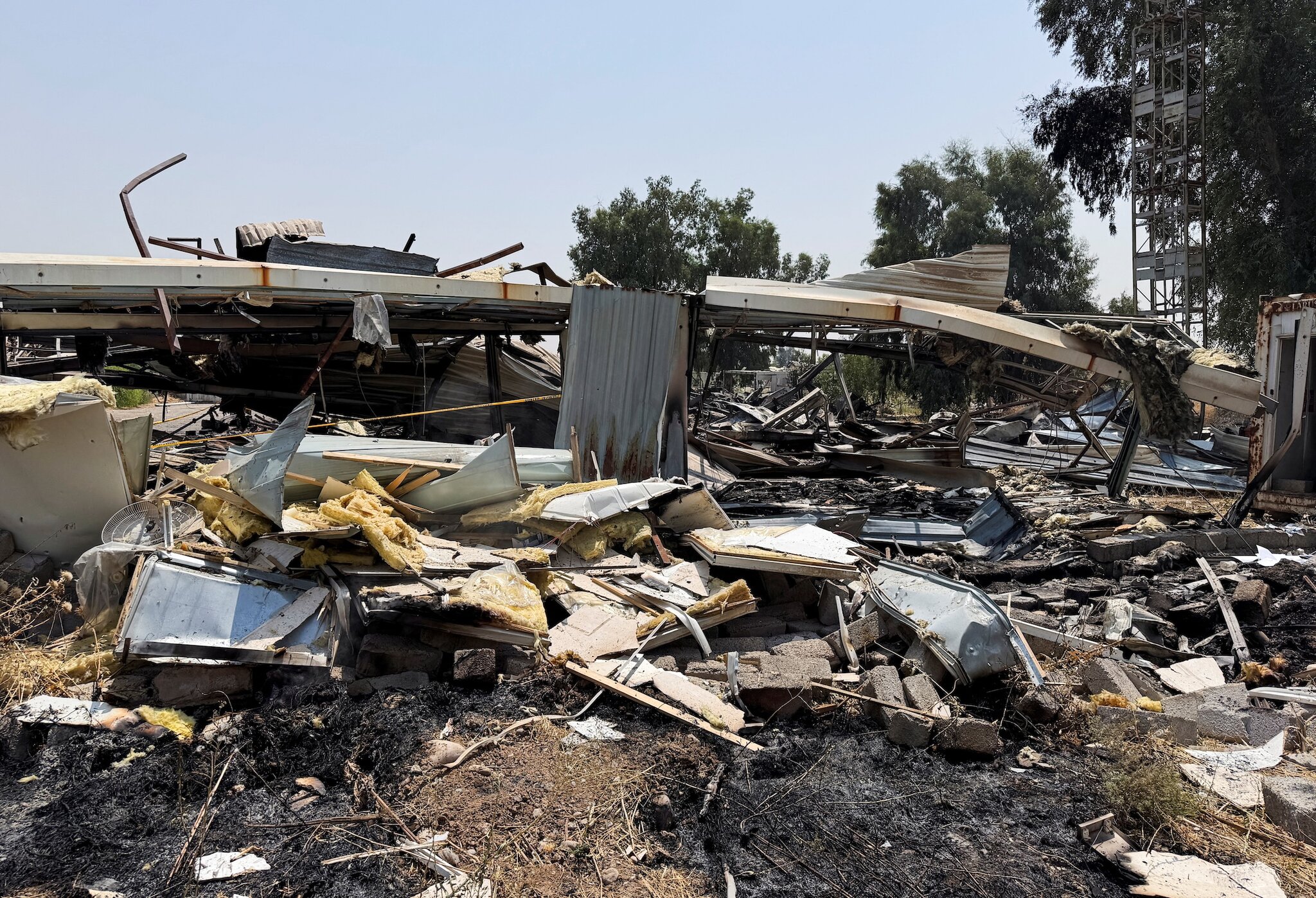
The brief pause in the war with Iran appears to be over. President Trump used blunt language to threaten Iran with further strikes in response to new Iranian attacks on a U.S. base in Jordan. The war also appears to be spreading, with a new explosion reported in Egypt, and joint U.S.-Saudi strikes in Iraq. Nick Schifrin reports. Amna Nawaz: The brief pause in the war with Iran appears to be over. The U.S. has launched its first airstrikes since last weekend. And, tonight, President Trump used blunt language to threaten Iran with further strikes in response to new Iranian attacks on a U.S. base in Jordan. Geoff Bennett: And the war appears to be spreading with a new explosion reported in Egypt today and joint U.S.-Saudi strikes on Iraq. Nick Schifrin has our report. Nick Schifrin: In Iraq's Nineveh province, the aftermath of an airstrike and a sign of war widening across borders. Joint U.S.-Saudi strikes targeting Iranian-backed militia groups turn what the U.S. says were militia bases into crushed concrete. They target Iraqi militias known as Popular Mobilization Forces that the U.S. says has been responsible for more than 30 drone attacks in the past three days, including on key Saudi oil facilities. Today, the militia said the strikes killed 20. Mourners chanted "Death to America." President Donald Trump: It's a great honor to have the prime minister of Iraq with us. Nick Schifrin: Iraq's new prime minister is balancing U.S. demands to disarm the militias with deep Iranian influence in Iraq. And, today, the Iraqi government said it would -- quote -- "confront any violation of Iraq's sovereignty and prevent any source from using Iraqi territory to threaten neighboring states." But it was Iran last night that threatened neighboring states even before the U.S.-Saudi strikes. Iran released video of what it said were missiles targeting U.S. bases in Jordan. Usually, Iran calls these launches a response to U.S. strikes, but it called these offensive and preemptive. The U.S. says they cause no damage. But, this afternoon, President Trump vowed to respond. Donald Trump: So, we had five rockets shot going 8,500 miles an hour, and all five rockets were knocked down to the ground. But they nevertheless took a shot. So it's our turn. Nick Schifrin: This morning he went further, telling FOX News -- quote -- "We're going to beat the effing S. out of them." The war is also spreading from Yemen. Houthi rebels, which also received weapons and support from Iran, have attacked Saudi Arabia, downing a Saudi drone. And, overnight, they attacked another Saudi ship and threatened to begin tolling in the Bab al-Mandab 1,300 miles southwest of the Strait of Hormuz and the gateway to the Red Sea. It all makes for a complicated map, U.S. and Israeli strikes into Iran, Iranian strikes on ships and on the U.S.' Gulf allies, and now militia strikes from Iraq and Saudi and U.S. strikes into Iraq, and the Houthis in Saudi Arabia trading attacks. And, late today, a new strike in a new country, Egypt, an American-owned gas storage tanker on fire that President Trump suggested today was also caused by an Iranian-backed group. Energy experts tell me tonight that the explosion in Egypt is very significant, because if it proves to be a drone strike, it signals Iran and its allies could be targeting a third shipping choke point, the Suez Canal. The incident took place at the Port of Damietta just West of the Suez. Of course, Iran already has a choke hold on the Strait of Hormuz. And as we just reported, the Houthis are threatening the Bab al-Mandab. And so, in total, if the Suez is threatened, that cuts off 20 percent of the world's energy supplies. Amna, as one expert put it to me, this takes the war in Iran to a new level. It is also the first apparent incident in the Mediterranean. And it could threaten Egypt's both energy supply and economy, which is heavily dependent on the Suez. Amna Nawaz: Separately, Nick and I are covering what we're learning about how some in the region could possibly respond to President Trump's threats to potentially escalate the war in Iran. Nick Schifrin: Yes, absolutely. "PBS News Hour" has learned tonight that Khalid bin Salman, Saudi Arabia's defense minister, also Crown Prince Mohammed bin Salman's younger brother, is meeting at the White House. Saudi Arabia is concerned that President Trump could escalate the war with Iran and is being urged to escalate by Israel. And so Khalid bin Salman wanted to reiterate the kingdom's belief that escalation could lead to unknown consequences, including Iranian attacks on Arab capitals, desalination plants, and commercial centers. Now, today, an Israeli senior official told me and other reporters that, in their meeting yesterday, President Trump -- between President Trump and Prime Minister Benjamin Netanyahu, Netanyahu did not urge President Trump to escalate, but did go through the options on Iran and raised the possibility that the U.S. expand the current naval blockade to block land routes into Iran. A separate Israeli official told me today that Israel's concerned about the current U.S. strategy being a kind of lack of decision, neither escalation nor all-out diplomacy. And this official suggested to me that that was not sustainable. And that is a concern, Amna, that I have actually heard from other U.S. officials as well. Amna Nawaz: All right, Nick Schifrin, thank you very much. Nick Schifrin: Thank you.