This is one outlet's own report from NPR News — the article as it was filed. Other outlets are covering the same event; open the full story to compare every source side by side.
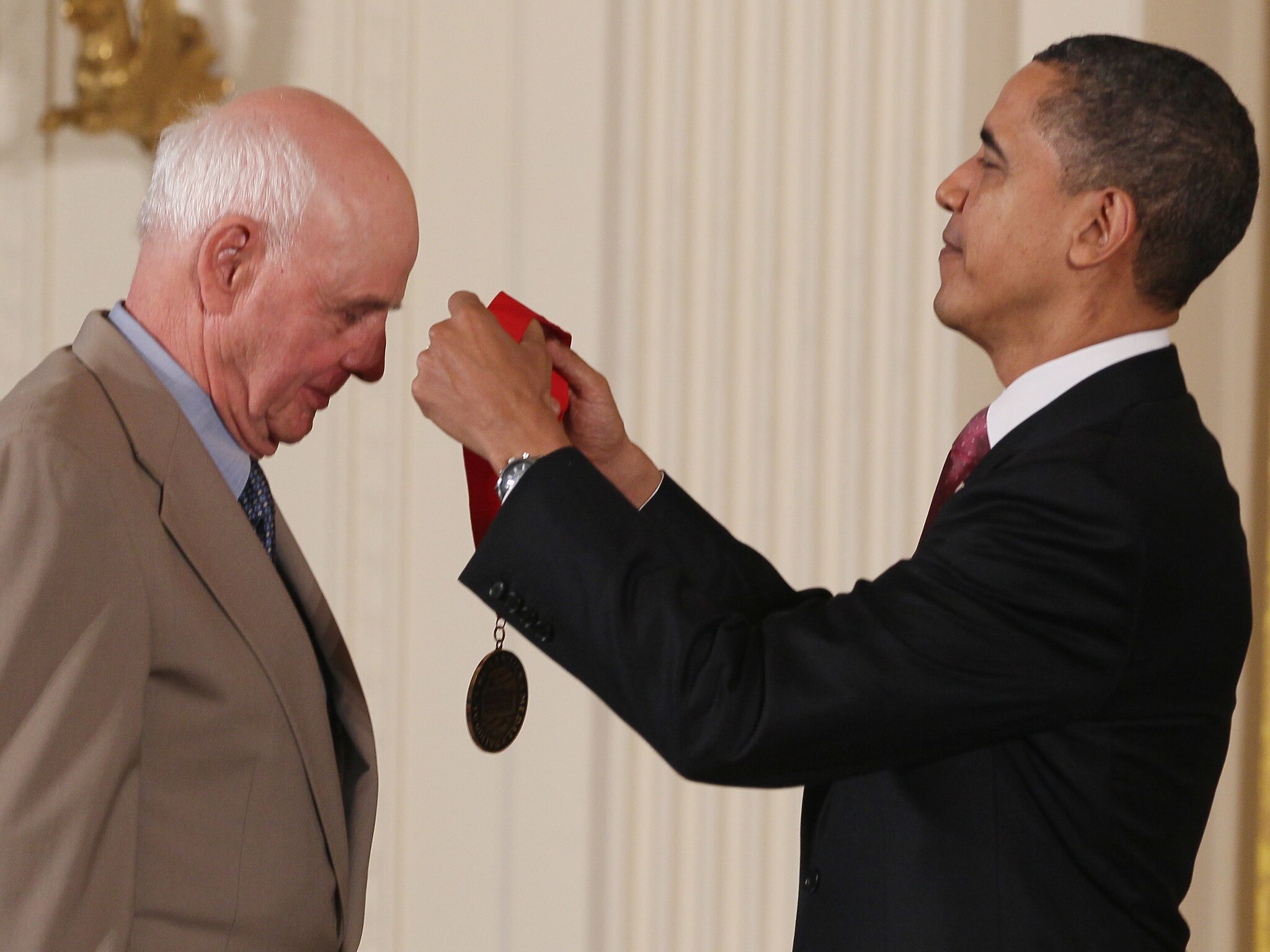
Enlarge this image President Barack Obama presents the 2010 National Humanities Medal to Wendell E. Berry during a White House ceremony in 2011. Mark Wilson/Getty Images hide caption
President Barack Obama presents the 2010 National Humanities Medal to Wendell E. Berry during a White House ceremony in 2011.
Novelist and poet Wendell Berry spent his life farming his land for food and for prose. It was land his family farmed and lived on for seven generations before him, in Henry County Kentucky.
He died at his home in Port Royal, Kentucky at age 92.
Berry started his career as a writer as an academic. He studied at the University of Kentucky, then Stanford, and had taken a prestigious position as an English professor at New York University by the time he was 28. But city life was never for him.
Book Reviews Wendell Berry veers from gratitude to yearning in 'Another Day' In the 1968 essay A Native Hill , Berry wrote about his decision to leave behind the New York literary world just two years into his career, in favor of his home county in Kentucky. "I had made a significant change in my relation to the place: before it had been mine by coincidence or accident; now it was mine by choice. My return, which at first had been hesitant and tentative, grew wholehearted and sure. I had come back to stay. I hoped to live here the rest of my life."
13.7: Cosmos And Culture 'The Seer:' Wendell Berry And The Vanishing Beauty Of Small Farms It was a hope he accomplished. The land Berry farmed in Henry County became the primary inspiration for his work as a writer and as an environmentalist. He was a stark critic of industrialized farming, and generally skeptical of technology. He never owned a computer–preferring instead to hand write his work, and then type it up on a typewriter he purchased new in 1956 and never needed to replace.
The Salt The Gospel According To Wendell Berry, On Screen Berry's writing was an endeavor in slowing down, and noticing his surroundings – whether these were trees, people, or the imprint of a breeze on a hill – as in the 2001 poem "June Wind."
Other poems used similarly sharp prose to comment on the broader political sphere. "Against the War in Vietnam" was published in 1968.
Berry was awarded the National Humanities Medal by President Obama in 2012, and he became the first living author inducted into the Kentucky writer's Hall of Fame in 2015.
In a 1998 interview for All Things Considered, Berry was hesitant to provide advice to young people looking to take after him, telling NPR's Noah Adams, "I think advising the young about a life course is probably not a responsible thing to do."
But when pressed, Berry added that, if at all possible, young people should look for opportunities to "stop some place, and stay there. Learn the history of it, and the names of the plants and animals and the neighbors."
Berry's writing is a lesson for the ages on slowing down, noticing, and deeply loving and respecting our surroundings.
NPR does not offer or accept money for coverage or interviews. Anyone who makes such an offer or request is not an NPR employee and does not represent NPR.
AIPROPX is an independent multi-source news index — we track, compare, and connect coverage from across the web into one place you won't find anywhere else.