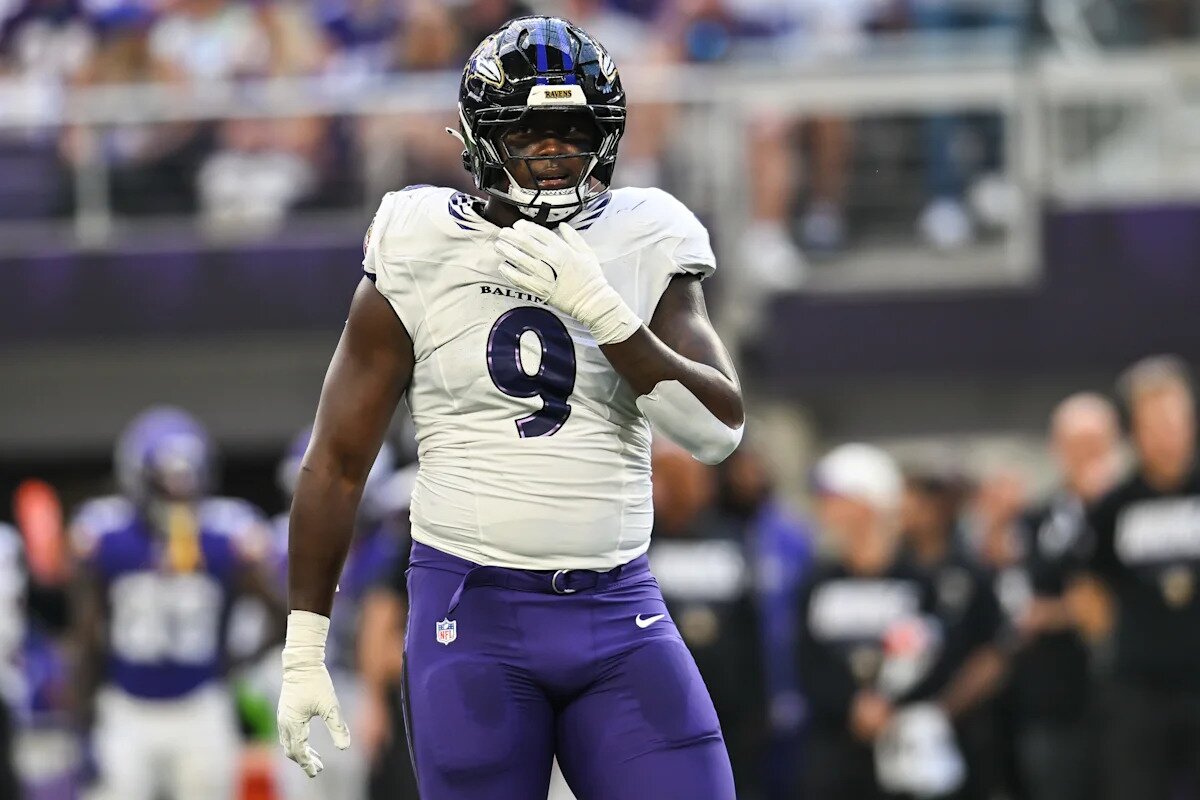
The Baltimore Ravens released their final unofficial depth chart of the preseason ahead of Friday night’s matchup against the Washington Commanders . The chart provides another look at Baltimore’s roster hierarchy before the team concludes the preseason and reduces its roster to 53 players by 6 p.m. Sunday. It also confirms that at least two starting competitions remain unresolved.
Unofficial depth charts are compiled by the communications department and should not be treated as final roster decisions. They can, however, reveal how players are grouped and which competitions remain open.
Here are seven takeaways from Baltimore’s latest depth chart.
The center competition remains unresolved
Jovaughn Gwyn and Ethan Pocic share the starting center position with an “or” designation. The competition became more significant after Danny Pinter suffered a torn patellar tendon during a joint practice with Minnesota. Pinter remains listed fourth on the depth chart but is expected to miss the season. Gwyn’s athleticism and familiarity with offensive line coach Dwayne Ledford have helped him earn first-team work. Pocic offers considerably more NFL experience and has returned to game action after recovering from an Achilles injury.
Wednesday’s joint practice and the preseason finale provide the final major evaluation opportunities. Baltimore needs the winner to develop communication and timing with Lamar Jackson before Week 1.
Trenton Simpson and Teddye Buchanan share the WLB job
Simpson and Buchanan are also separated by an “or” designation at weak-side linebacker. The listing should not be viewed as a negative development for Simpson, who has produced one of the strongest training camps of his career . Coaches have praised his confidence, versatility and improved understanding of the defense. Buchanan is still being reintegrated after tearing his ACL in December. He recorded 93 tackles and earned PFWA All-Rookie Team honors before the injury.
The Ravens could use both linebackers in different packages alongside Roquan Smith. For now, the depth chart shows Baltimore has not publicly settled on one full-time option.
Joe Fagnano remains the No. 3 quarterback
The quarterback order is clear: Jackson, Huntley, Fagnano and Austin Reed. Huntley’s position as Jackson’s backup is secure. The decision involves whether Baltimore will keep Fagnano as a third quarterback on the initial roster. The undrafted rookie has played well during two preseason victories, displaying accuracy, poise and command of the offense. He completed 11 of 14 passes for 118 yards and a touchdown in the opener before helping Baltimore defeat Minnesota.
The Ravens have frequently carried only two quarterbacks, but Fagnano’s preseason production has given them a reason to reconsider that approach. His placement ahead of Reed confirms that he has established himself as the clear QB3.
The running back order may not reflect the current competition
Rasheen Ali is listed third behind Derrick Henry and Justice Hill, with Adam Randall occupying the fourth spot. The preseason performances suggest Randall has moved ahead. The fifth-round pick rushed 12 times for 46 yards and a touchdown against Philadelphia, displaying the power and physicality Baltimore wanted when it moved him from wide receiver to running back. Ali has dealt with an injury, limiting his opportunity to respond. His position as the primary kickoff returner gives him another route to the roster, but Randall appears to have earned the advantage for the third running back job.
This is one area where the unofficial depth chart may be trailing the on-field evaluation.
Young receivers sit directly behind the starters
Zay Flowers and Rashod Bateman lead the two receiver lines. Devontez Walker and LaJohntay Wester follow Flowers, while Ja’Kobi Lane and Elijah Sarratt are positioned behind Bateman. Lane’s placement directly behind Bateman reflects his rapid development. The third-round pick has impressed throughout camp with his size, contested-catch ability and growing connection with Jackson. Sarratt has also shown enough to remain firmly involved in the roster discussion. Walker offers vertical speed, while Wester has increased his value as a receiver and return specialist.
Wester is listed as the primary punt returner, followed by Sarratt and Dayton Wade. Those responsibilities could help Baltimore justify keeping six receivers.
Edge depth remains difficult to evaluate on paper
Trey Hendrickson leads the rush-linebacker position, followed by Mike Green and Kaimon Rucker. Tavius Robinson leads the strong-side group, with Zion Young, Adisa Isaac and Ethan Burke behind him. Young’s placement behind Robinson does not create a roster question for the second-round pick. It does show that Baltimore is allowing the rookie to develop behind an established veteran rather than immediately handing him a starting role.
Burke’s place at the bottom is another reminder that preseason production can move faster than an unofficial depth chart. The undrafted rookie recorded a sack and forced fumble during Baltimore’s 13-3 victory over Minnesota .
Burke is making a legitimate push for the roster despite his current placement.
Kyle Hamilton remains a positionless defensive weapon
Hamilton is listed as a defensive back rather than a strong safety or free safety. Keyon Martin and rookie Chandler Rivers follow him at the position. That designation reflects how Baltimore plans to deploy one of its best defensive players. Hamilton can align deep, cover the slot, play near the line of scrimmage or pressure quarterbacks.
Jaylinn Hawkins is listed at strong safety, while Malaki Starks leads the free safety line. Marlon Humphrey and Nate Wiggins occupy the starting cornerback positions, with T.J. Tampa behind Humphrey and Chidobe Awuzie behind Wiggins. The chart gives Baltimore’s secondary a traditional structure while preserving the flexibility to move Hamilton wherever he can have the ...