A non-profit newsroom, powered by WNYC. Gothamist Listen Live Donate News Bid farewell to summer by looking to the stars in September By Rosemary Misdary Published Aug 30, 2026 at 6:30 a.m. ET
Twitter Reddit Email Never miss a story Email address By submitting your information, you're agreeing to receive communications from New York Public Radio in accordance with our Terms . By Rosemary Misdary Published Aug 30, 2026 at 6:30 a.m. ET
Twitter Reddit Email We rely on your support to make local news available to all Make your contribution now and help Gothamist thrive in 2026. Donate today
Gothamist is funded by sponsors and member donations
A new season of stargazing begins in September.
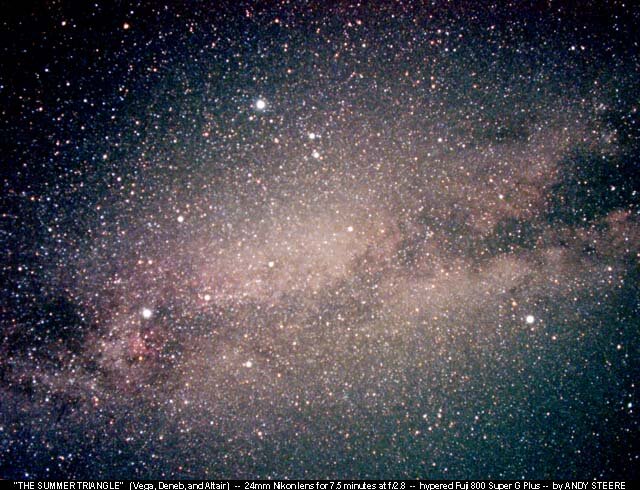
Fall officially begins on Sept. 22 with the autumn equinox, which features equal hours of sunlight and darkness. The evenings will then become longer as the days become shorter. There is still a chance to see iconic summer sights like the Milky Way and the Summer Triangle, while also welcoming fall’s herald, the constellation Pegasus.
“ You're saying goodbye to the Summer Triangle in September, and you're saying hello to Pegasus,” said Jackie Faherty, astrophysicist at the American Museum of National History.
The Summer Triangle is an easy star pattern to spot in New York City. Look for the bright stars Deneb, Altair and Vega, which form a triangle overhead.
The Milky Way is the crown jewel of summer night skies. The cloudy ribbon has been spotted within the city limits in Floyd Bennett Field and the Rockaways, but the best views are in darker skies away from light pollution. The best viewing times are between sunset and 10 p.m. A good night to spot the center of Earth’s home galaxy is the new moon on Sept. 11, when skies are darkest.
“Fall is here, and you get a good amount of time to be outside and stargaze if you want, while still not hating everything because it gets dark so early,” Faherty said. “It's our turnover point.”
Pegasus ushers in the autumn night skies. The constellation is marked by four bright stars – Markab, Scheat, Algenib and Alpheratz. The pattern is also referred to as the baseball diamond because it appears around the start of the playoffs in Major League Baseball.
Next to Pegasus, there is a fuzzy patch of light. That’s the Andromeda Galaxy, the closest neighboring galaxy to the Milky Way, about 2.5 million light years from Earth. Stargazers will have to get out of the city to observe Andromeda under darker skies.
In the same section of sky is Cassiopeia, a W or M-shaped constellation made of five distinct stars – Alpha, Beta, Delta, Gamma and Epsilon. Next to Cassiopeia is Perseus, which is shaped like a Y or a wishbone.
To learn more about the fall constellations, the Amateur Astronomers Association is hosting a free online class on Sept. 22.
”One of the beautiful things about astronomy in general is that if you wait long enough, something comes up, something sets, all night,” said Bart Fried, a member of the American Astronomical Society. “At any given time you can see most of the night sky, especially in the fall and winter time because you have much longer nights.”
Venus, which has been the brightest object in the night sky, will be very difficult to see by the end of September. The best time to view the second planet from the sun is right after sunset.
As Venus fades, Saturn will shine brighter. The ringed planet will be at opposition in early October, which means it will be at its closest position to Earth, appearing brighter and larger. A good night to spot the gas giant is on Sept. 26 when it will appear near the full moon.
Neptune is at opposition on Sept. 25. Even at its nearest position to Earth, you'll need binoculars or a telescope to see the farthest planet in the Milky Way.
”You have a straight line between the sun and Earth and Neptune when it's at opposition,” Fried said. “Even though it's a full moon, you should be able to see Neptune because it's bright enough that the moon doesn't wash it out.”
The best way to experience astronomy is to go to a free telescope-viewing event while the weather is still pleasant. The city’s parks department and the Amateur Astronomers Association host several weekly events across the five boroughs.
Moon lovers can celebrate NASA’s International Observe the Moon Night on Sept. 19. Pioneer Works in Red Hook, Brooklyn is hosting an event with telescopes set up next to the historic ship Mary A. Whalen, a 1938 bright red oil tanker docked on Pier 11 in Red Hook. The moon will be in the first quarter phase, and just over 50% illuminated.
This phase is a good time to view the moon because its shadows are longer, making lunar features such as craters and peaks more pronounced.
“ September has the weather, which is what you need to go outside and stargaze," Faherty said.
Rosemary is health & science reporter. Got a tip? Email [email protected] or Signal 646-544-9524.
NYPD officers arrested Jesus Acosta, 31, in connection with two shootings that killed two men and injured a third earlier this week.
The suit also claims she was subjected to unsafe housing conditions and exposed to pepper spray.
Catch up on the most important headlines with a roundup of essential NYC stories, delivered to your inbox daily.
Gothamist is a website about New York City news, arts, events and food, brought to you by New York Public Radio.