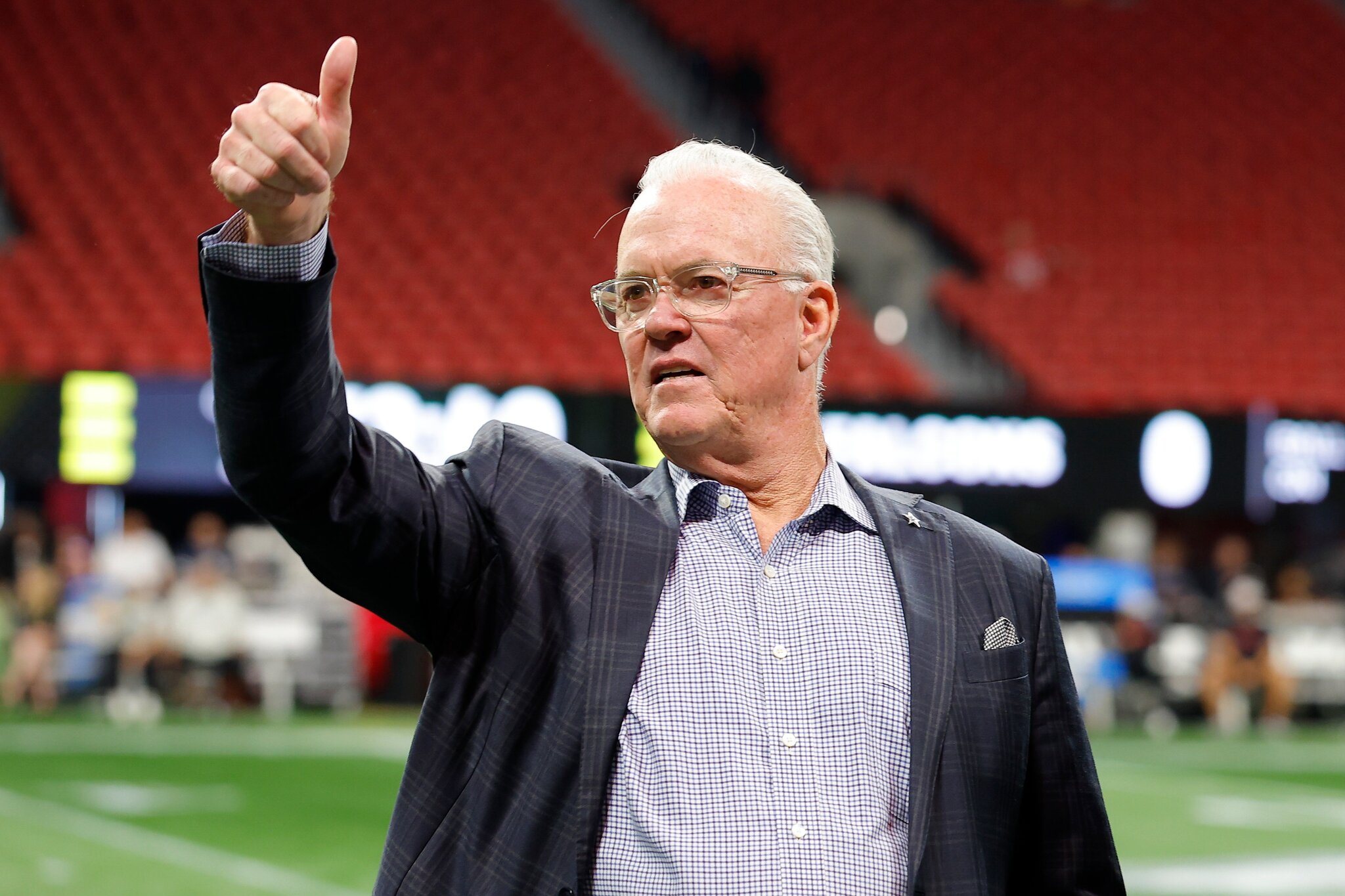
ATLANTA, GEORGIA - NOVEMBER 3: Dallas Cowboys CEO Stephen Jones looks on prior to the game against the Atlanta Falcons at Mercedes-Benz Stadium on November 3, 2024 in Atlanta, Georgia. (Photo by Todd Kirkland/Getty Images) | Getty Images
The Cowboys have spent the last two years (mostly) doing exactly what you would expect an NFL team to do: identify their best players and pay them.
Dak Prescott (highest-paid QB at signing), CeeDee Lamb (second-highest-paid WR at signing), Tyler Smith (highest-paid iOL at signing), Brandon Aubrey (highest-paid kicker at signing) and now Quinnen Williams (second-highest-paid iDL).
Dallas has handed out top-of-the-market contracts to all five. And that’s the right thing to do. NFL teams don’t win by deliberately letting their best players walk. Either trade them (Micah Parsons) or pay them (see above). The problem is that NFL teams don’t get unlimited credit for identifying good players. Eventually, they have to fit those players under the salary cap.
So the interesting question isn’t whether the Cowboys can afford to pay their stars. It’s whether they can keep finding enough good players cheaply enough to afford the stars they already have.
And that’s where the draft becomes much more than a talent-acquisition exercise.
You can’t pay everyone
Let’s start with a simple thought experiment.
There are five positions that sit at the extreme ends of the passing game: the guy who throws the ball (QB), the guy who chases the guy who throws the ball (DE), the guy who best catches the ball (WR), the guy who covers the guy catching the ball best (CB), and the guy who blocks for the guy throwing the ball (OT) – the Money 5.
If you build a roster around one top-of-market player at each of those positions and use the 2026 franchise tag as a proxy for what those players cost, here’s the bill:
body .sbnu-legacy-content-table td,
body .sbnu-legacy-content-table th,
body .sbnu-legacy-content-table {
border: 1px solid #000 !important;
border-collapse: collapse !important;
}
body .sbnu-legacy-content-table td,
body .sbnu-legacy-content-table th {
padding: 0px 6px !important;
}
Position 2026 Franchise Tag Quarterback $43.9 million Wide Receiver $27.3 million Offensive Lineman (LT) $25.8 million Defensive End $24.4 million Cornerback $21.2 million Total “Money 5” $142.6 million 2026 Salary Cap $301.2 million “Money 5” in % of Cap 47% The franchise tag isn’t a realistic way to build a roster, of course. But it is a useful proxy for the cost of having a top-of-market player at each position. And those five players alone consume 47% of the salary cap.
In reality, you’d probably spend more than 50%, because the franchise tag is a lagging indicator based on previous-year salaries, while the actual market keeps moving upward.
Which means that before you’ve even started filling out the rest of the roster, roughly half your salary cap is gone.
And that’s only five players.
Ten stars would eat almost the entire cap
Let’s extend the exercise.
If you’re building a roster around the positions that have the biggest influence on the passing game, you probably don’t stop at one receiver or one pass rusher. Add a second wide receiver, a second offensive lineman. And then plug in more defenders: a defensive tackle, another defensive end, and a safety.
Now you have a 10-player Franchise Tag Team.
Here’s what that team would have cost over the last five years:
body .sbnu-legacy-content-table td,
body .sbnu-legacy-content-table th,
body .sbnu-legacy-content-table {
border: 1px solid #000 !important;
border-collapse: collapse !important;
}
body .sbnu-legacy-content-table td,
body .sbnu-legacy-content-table th {
padding: 0px 6px !important;
}
Tag by position in $M 2022 2023 2024 2025 2026 Quarterback 29.7 32.4 38.3 42.5 43.9 Wide Receiver I 18.4 19.7 21.3 24.8 27.3 Offensive Lineman I 16.7 18.2 21.0 24.7 25.8 Defensive End I 17.9 20.9 24.0 24.3 24.4 Cornerback 17.3 18.1 19.8 20 21.2 Wide Receiver II 18.4 19.7 21.8 24.8 27.3 Defensive Tackle 17.4 18.9 22.1 22.4 27.2 Offensive Lineman II 16.7 18.2 21.0 24.7 25.8 Defensive End II 17.9 19.7 21.8 24.3 24.4 Safety 12.9 14.5 17.1 18.6 20.1 Grand Total 183.3 200.3 228.2 251.1 267.4 Salary Cap 208.2 224.8 255.4 279.2 301.2 Top 10 in% of cap 88% 89% 89% 90% 89% And here’s the uncomfortable part: This isn’t some unusual 2026 phenomenon. Whether you run the calculation using the 2022, 2023, 2024, 2025, or 2026 salary cap, the answer barely moves – Ten top-of-market players would consume roughly 89% of the cap.
The numbers, in sequence, are 88%, 89%, 89%, 90%, and 89%, respectively.
So, no, you can’t build an NFL roster by paying ten players the going rate for elite talent.
At 2026 prices, you’d have about $34 million left to pay 43 additional players. The math simply doesn’t work. Unless, of course, some of those ten players aren’t actually costing you $20-30 million. And that’s where the draft comes in.
The 4-and-6 model
This is the fundamental value of the rookie contract.
Suppose four of those ten players are still on rookie deals, costing perhaps $4-6 million each rather than the roughly $26 million average you’d pay at the top of their respective markets. Suddenly, you’ve shaved roughly $80 million off the cost of your top ten players. That’s not a minor salary-cap advantage. That’s the mechanism that makes the entire roster possible.
In a healthy roster-building cycle, you want something like six established players getting paid at or near market rates, while four of your best players are still providing production on cheap rookie contracts.
The draft, therefore, isn’t simply a way to acquire talent. It’s a way to replace expensive talent with inexpensive talent before the salary cap forces you to choose between them.
And that means draft misses are particularly costly. If a rookie fails to become the player you expected, you don’t simply lose the value of that draft pick. You may eventually have ...