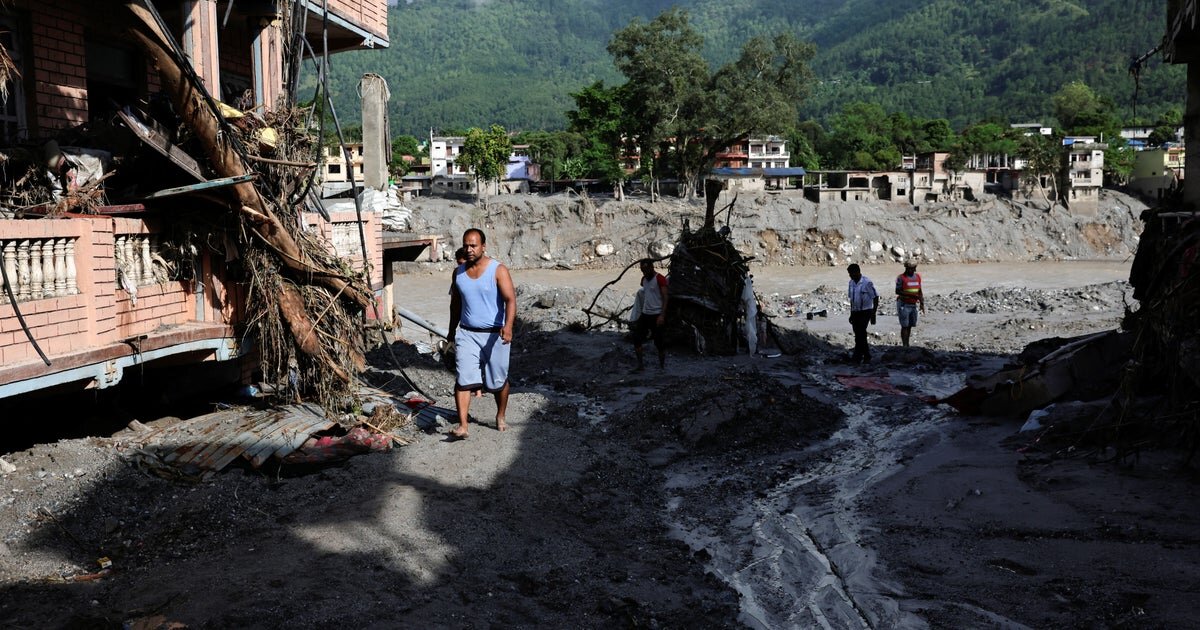
Kathmandu, Nepal \u2014\u00a0Rescuers pulled out survivors caked in dark brown mud and helicopters lifted stranded people to safety Friday as Nepal and China raced to respond after catastrophic flash floods killed more than 540 people and left more than 1,500 missing.Nepal authorities said the death toll there rose to 538, according to French news agency AFP. Injured people were taken to hospitals and helicopters carried more than 3,000 people to safety. Survivors, including the injured, were brought to Kathmandu and other locations.On the Chinese side, there was little information about survivors, although the death toll rose to five Friday as state media showed evacuations of villages and leaders\u0027 efforts to direct relief efforts. China\u0027s state media previously said 558 people were missing and Nepal\u0027s disaster management authority said Friday that 977 people were missing. Hundreds of them were foreigners who were in the area to work, trek or make a pilgrimage to a sacred peak.The Red Cross said Friday that some 90,000 people are believed to have been impacted by the flood, the Reuters news agency reports.Nepal police issued a fresh alert Friday after receiving information that a dam on the Tibet side had burst. Security personnel and rescue and relief workers were told to stay on high alert and immediately move to a safe location if necessary.It was unclear if that concern was related to fears of flooding from an overflowing barrier lake that formed behind a dam made up of debris from the initial flash floods, high up in the Chinese side of the Himalayan mountains. Nepal police spokesperson Abi Narayan Kafle told The Associated Press the rescue operation was continuing but with high alert, saying, "It hasn\u0027t stopped."Although Chinese state broadcaster CCTV reported Friday morning that the lake was more than 6 miles from Gyirong Port, the hard-hit border crossing with Nepal, it said the risk of flooding was high.It said the lake was at an elevation of 9,680 feet, about 3,280 feet above Gyirong Port. \u00a0But CCTV later said flood risks from the overflowing lake were deemed "manageable," Reuters reported.Nepali Army rescuers were working to help people trapped in a hydropower tunnel in Rasuwa, part of the Upper Trishuli-1 Hydropower Project. In video from the scene, rescuers half-pulled, half-pushed a man covered in dark brown mud out of the tunnel. He was one of likely dozens who were trapped. Army spokesperson Brig. Gen. Raja Ram Basnet told The Associated Press the focus was on survivors. "It is complicated to find the entry and exit points of the tunnel because everything has been covered by mud," Basnet said. "Our first priority is rescuing the stranded people." Scientists who\u0027ve studied satellite images said bedrock underneath a glacier high in the Himalayan region had collapsed, taking part of the glacier with it. The rockfall was so extreme, it reached a magnitude 5.2 seismic measurement. The rocks and melted water then swelled the rivers in the valleys below, causing a torrent of water that swept buildings, bridges and earth downstream in Tibet and Nepal.Hikmat Singh Ayer, CEO and senior director of the Nepal Tourism Board, told CBS News\u0027 Arshad R. Zargar on Thursday that at least 65 Americans were among the missing foreign nationals in the small Himalayan nation, almost doubling the number of U.S. nationals reported missing the previous day.In a subsequent update, the tourism board said 27 foreign nationals had been rescued from the flood zone in the Rasuwa district, including two U.S. nationals identified as a man and woman in their 50s. \u00a0A U.S. State Department spokesperson told CBS News on Thursday that the agency was aware of about 90 Americans who may be impacted by the floods, and it was continuing to closely track the situation. The department said three U.S. citizens had been rescued, and the spokesperson said the agency wasn\u0027t aware of any deaths of U.S. nationals. \u00a0 Videos of Wednesday\u0027s disaster showed floodwaters destroying buildings, bridges and vehicles as people ran in front of the stories-high torrent. In the aftermath, broken concrete lay upended in expanses of brown mud that also caked buildings and buried streets. Customs officer Karbir Gaire is among some of the survivors in Timure, the closest Nepalese village to the border with China.Gaire reached his office around 8 a.m. on Wednesday and was busy working on his computer when he first felt the ground shake. "Right after the shake, I noticed a black storm coming towards us," he recalled from Kathmandu, where he is back with family. "We all immediately started running out and within a few seconds, we were climbing uphill on the opposite side of our office building. I think those 10 or so seconds saved some of us." Gaire doesn\u0027t remember exactly how many people were in the office when the disaster struck, but his 15 colleagues have gone missing. "It was like a Hollywood movie scene. I don\u0027t call it a flood, it was a tsunami." He described Timure as a vibrant place filled with government offices, hotels, cafes, banks, primary schools, tea shops and residential buildings, where more than 1,500 people were living. President Trump said the flooding was terrible to see, describing how "strong, well-built buildings were wiped out like they were toothpicks." Speaking to reporters in the Oval Office, Mr. Trump said the U.S. spoke with Nepalese leaders and offered to provide "anything they want."Leslie Crespi, a community liaison for the Isha Foundation, a volunteer-run group that promotes well-being founded by Indian spiritual leader Sadhguru Vasudev, told CBS News in an interview that about 80 people who were taking part in a pilgrimage it was running in the region were missing."At this point we are awaiting word," Crespi said in a phone interview from McMinnville, Tennessee, of the missing pilgrims. "We have done as much outreach as we ...