This is one outlet's own report from Deutsche Welle — the article as it was filed. Other outlets are covering the same event; open the full story to compare every source side by side.
Tunisia's human rights defenders decry civil society crackdown
Five years into the authoritarian rule of Tunisian President Kais Saied, Human Rights Watch and other activists warn that Tunisia's once vibrant civil society is in danger of being completely stifled.
https://p.dw.com/p/5JrLK Advertisement "Most civil society organizations are in a state of shock today," Messaoud Romdhani, a Tunisian human rights activist told DW. "Those who criticize the authorities or situation in Tunisia face widespread repression," he explained, adding that "most have been accused of money laundering, which leads to the suspension of their activities."
Another Tunisian activist, who spoke with DW on condition of anonymity, also said that increasingly people were thinking twice before speaking in public or even choosing to work on sensitive issues.
"What worries me most is the chilling effect: When organizations face suspension and activists face prosecution or detention , the uncertainty itself becomes a form of pressure," he said.
Human Rights Watch has also raised the alarm. In its latest report , published Wednesday morning, the international rights watchdog concludes that Saied is attempting to shutter Tunisia's civil society entirely.
"It is clear that the authorities are abusing every tool at their disposal to close the space for civil society in Tunisia," the report reads. The watchdog also points out that civil society groups in Tunisia have played a key role in holding power to account, delivering essential services and advocating for people's human rights .
"The government has used abusive, arbitrary prosecutions, detentions, financial investigations and suspension of organizations in an attempt to stifle these voices," Bassam Khawaja, a deputy director in the Middle East and North Africa Division at Human Rights Watch and editor of the report, told DW.
He added that it was clear the idea was to shut down all opposition and independent voices in the country. "This amounts to a total crackdown on civil society in Tunisia," he said.
Saied was elected president democratically in 2019. But in July 2021, he dissolved parliament and launched a power grab. Since then, he has dismantled most democratic bodies, repressed political dissent and arrested opposition figures .
For Anthony Dworkin, a senior policy fellow at the European Council on Foreign Relations who focuses on human rights and democracy, Saied's goals remain unchanged. "They have been the same for the last five years, namely to consolidate power and remove potential checks on and critics of his rule," he told DW.
Saied has rejected accusations that he is an authoritarian ruler and argued that his measures are necessary to tackle corruption and uphold democracy. He has accused critics of receiving foreign funding to stir unrest and undermine Tunisia's national interests . DW reached out to the Tunisian presidency for comment but had not received a response by the time of publication.
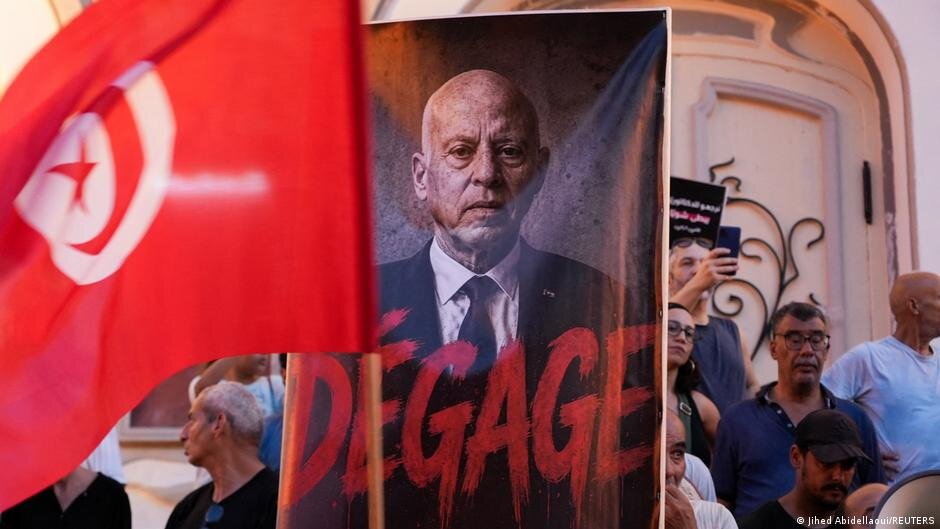
Despite the widespread crackdown on dissent, some people still dare criticize the government. On July 25, the fifth anniversary of the president's power grab, thousands took to the streets of the capital, Tunis, to protest worsening living conditions, democratic backsliding and the government's handling of basic services.
The demonstrations came amid widespread water and electricity outages, which Saied has described as "premeditated acts aimed at inflaming the situation by all means and spreading lies and rumors to sow confusion."
In late August, protesters once again called on the president to step down by chanting "The people want the fall of the regime," a popular slogan from the 2010-2011 Arab Spring uprising .
The demonstration was initiated by Nafas, a new citizen-led umbrella initiative that was launched in May. Mohamed Hawel, a university teacher and member of the Nafas collective, told the news agency AP that Nafas was created to unite people around basic necessities, including water, electricity and food.
Despite some unity at these protests, according to an Arab Barometer survey there is an emerging generational divide in Tunisia. A report published in July on the basis of a survey conducted in the fall of 2025 found that older and less educated people had vastly different views on the country's economic and political conditions from younger, better educated people.
The survey showed that the older generation saw the current political and economic situation in the most positive light since the Arab Spring and had more trust in the government than over the past decade.
In comparison, younger Tunisians were more pessimistic about the country's economic and political development. They also remained more skeptical of state institutions while maintaining a high trust in civil society organizations: 49% of people between the ages of 18-39 expressed trust in these, compared with only 32% of those aged 40 and older.
"What really stands out in Tunisia is that the recent decline in trust in civil society is almost entirely a story about older Tunisians. Two years prior, there was almost no generational gap between citizens," Michael Robbins, the director of Arab Barometer, told DW. "Since then, trust in civil society among Tunisians 40 and older has fallen quite sharply, while it has not changed meaningfully among those who are aged 18-39."
Tunisia has a population of approximately 12 million people. People aged 18–39 account for roughly 30% of the population, while those aged 40 and older account for approximately 43%.
"I think the notion of a divided society is overstated," said Dworkin. "Moreover, the recent demonstrations are not large enough to pose a serious threat to Kais Saied," he added, while admitting that Saied had lost considerable public support over his failure to improve the country's economy. "But there are no attractive political alternatives and people are also tired of political upheaval."
In his view, many Tunisians are just trying to get by with daily life, while many others a...
Tunisia'sFiveTunisian President Kais SaiedHuman Rights Watch
AIPROPX is an independent multi-source news index — we track, compare, and connect coverage from across the web into one place you won't find anywhere else.