This is one outlet's own report from Gothamist — the article as it was filed. Other outlets are covering the same event; open the full story to compare every source side by side.
Springs between NYC subway cars keep injuring transit workers
A non-profit newsroom, powered by WNYC. Gothamist Listen Live Donate News Springs between NYC subway cars keep injuring transit workers By Stephen Nessen Published Aug 19, 2026 at 6:30 a.m. ET
Twitter Reddit Email Never miss a story Email address By submitting your information, you're agreeing to receive communications from New York Public Radio in accordance with our Terms . By Stephen Nessen Published Aug 19, 2026 at 6:30 a.m. ET
Twitter Reddit Email We rely on your support to make local news available to all Make your contribution now and help Gothamist thrive in 2026. Donate today
Gothamist is funded by sponsors and member donations
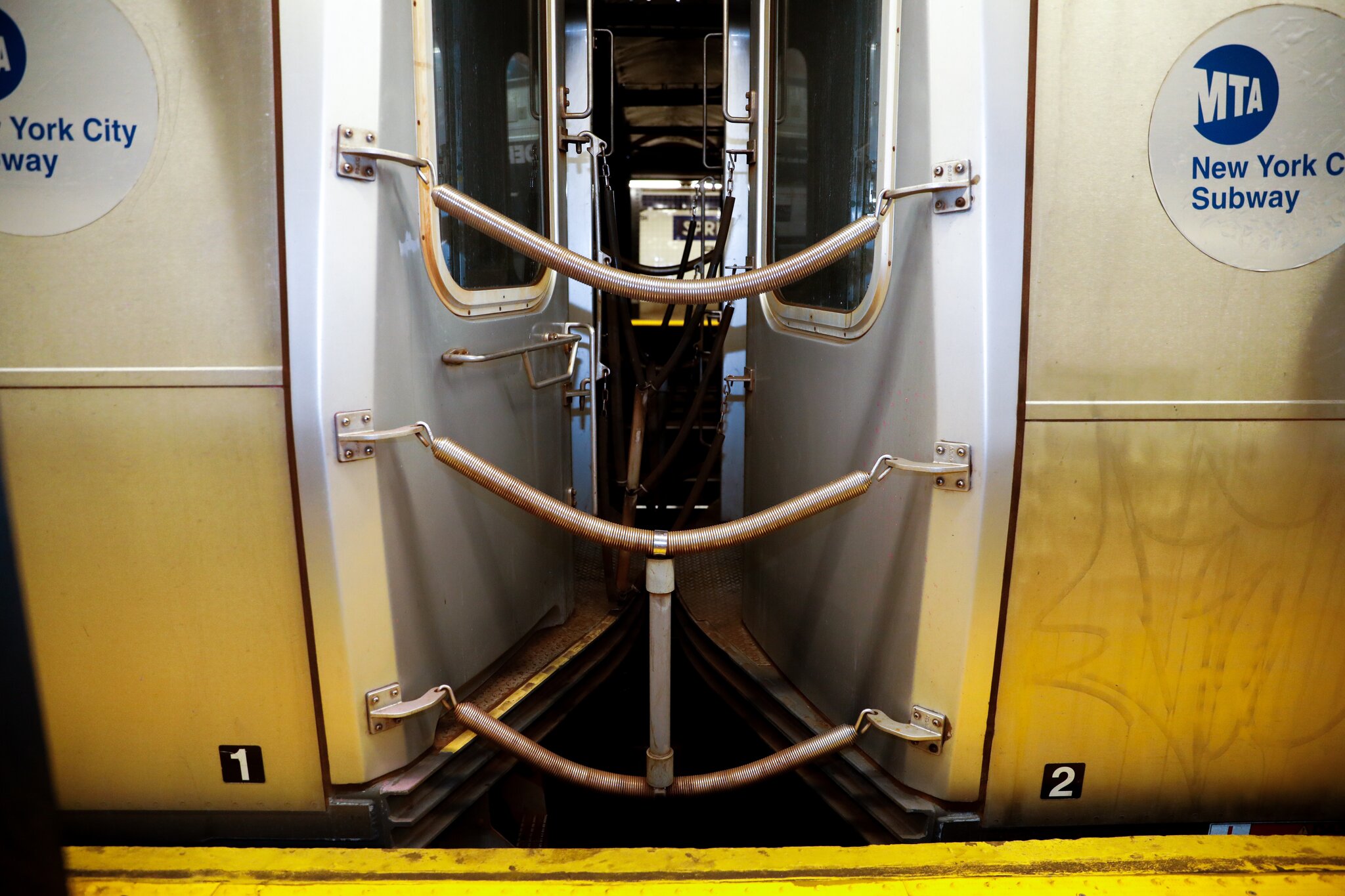
To riders, the metal springs stretched between nearly all of New York City’s subway cars might seem innocuous. But to many transit workers, they’re another hazard in a dangerous job.
The springs are designed to prevent visually impaired passengers from accidentally falling from the platform between train cars. When train sets are decoupled at subway yards, crews have to remove and reconnect the super-sized coils — and sometimes they snap back in a scene that resembles something out of “Looney Tunes.”
An internal MTA memo that was sent to NYC Transit President Demetrius Crichlow last November and obtained by Gothamist laid out more than 1,000 incidents where crews at subway yards reported broken or malfunctioning springs since 2006. The memo documented that at least 75 workers were injured in those incidents.
In one 2024 incident, a worker at the Rockaway Park Yard was attempting to connect the spring on one of the MTA’s newest train sets when he slipped and fell between cars, leaving him with injuries that put him out of work for more than six months. Another worker at Jamaica Yard was clobbered in the forehead in 2020 while taking a spring out of storage. And the records highlight a 2007 incident at Coney Island Yard where a coil snapped back and broke, sending metal shards onto the electrified third rail that sparked and burned a worker’s leg.
The memo called for the agency to buy subway cars with foldable, plastic “pantograph” doors between cars instead of the springs. The doors are in place on some of the MTA’s oldest train cars that run on the 1, 3 and 6 lines. The memo argued the issues with the coils have led to some delays in subway service.
“For nearly 20 years, our own records have been telling us the same story: Barrier springs are injuring our employees and have already contributed to at least one serious service disruption,” the memo stated. “Meanwhile, other railroads — including our own commuter railroads — use safer, simpler devices that do the same job without asking workers to perform a gymnastics routine over ballast and near the third rail.”
MTA officials confirmed 75 workers were injured by the subway car springs over the last 20 years. Agency spokesperson Kayla Shuts in a statement said transit leaders have considered replacing the barrier springs, but has yet to find “alternate designs that meet the design requirements for durability, ozone resistance, fire ratings, etc.. To date, no alternate barrier has been presented.”
Workers have to disconnect the barrier springs in train yards so subway cars can be decoupled, cleaned or reassembled. The work is routine but awkward, and can force workers to climb up on a train and stretch awkwardly to connect the carabiner-like device.
“ No train operators like messing with barrier springs, it’s annoying,” said Eric Loegel, a veteran train operator and staff member at the Transport Workers Union Local 100. “They're not our favorite thing to deal with.”
Loegel said the trains on the 1, 3 and 6 lines that have pantograph gates between cars are safer and easier for workers.
Correction: This story was updated to accurately state which subway lines use trains with pantograph doors between cars. They're in place on the 1, 3 and 6 lines.
Stephen Nessen covers transportation. Since 2008 he has reported on everything from Occupy Wall Street, the rebuilding of the World Trade Center site, Hurricane Sandy, to Trump’s campaign for president. His transportation reporting has taken him everywhere from the MTA’s secret Rail Control Center to the gleaming subways of Seoul. Got a tip? Email [email protected] .
The Wildlife Conservation Society confirms a river otter has been spotted in the Bronx for the first time in a century.
Eric Cato was indicted by a grand jury in Manhattan Supreme Court on eight counts, including sexual abuse and endangering the welfare of a child, according to court documents.
Catch up on the most important headlines with a roundup of essential NYC stories, delivered to your inbox daily.
Gothamist is a website about New York City news, arts, events and food, brought to you by New York Public Radio.
AIPROPX is an independent multi-source news index — we track, compare, and connect coverage from across the web into one place you won't find anywhere else.