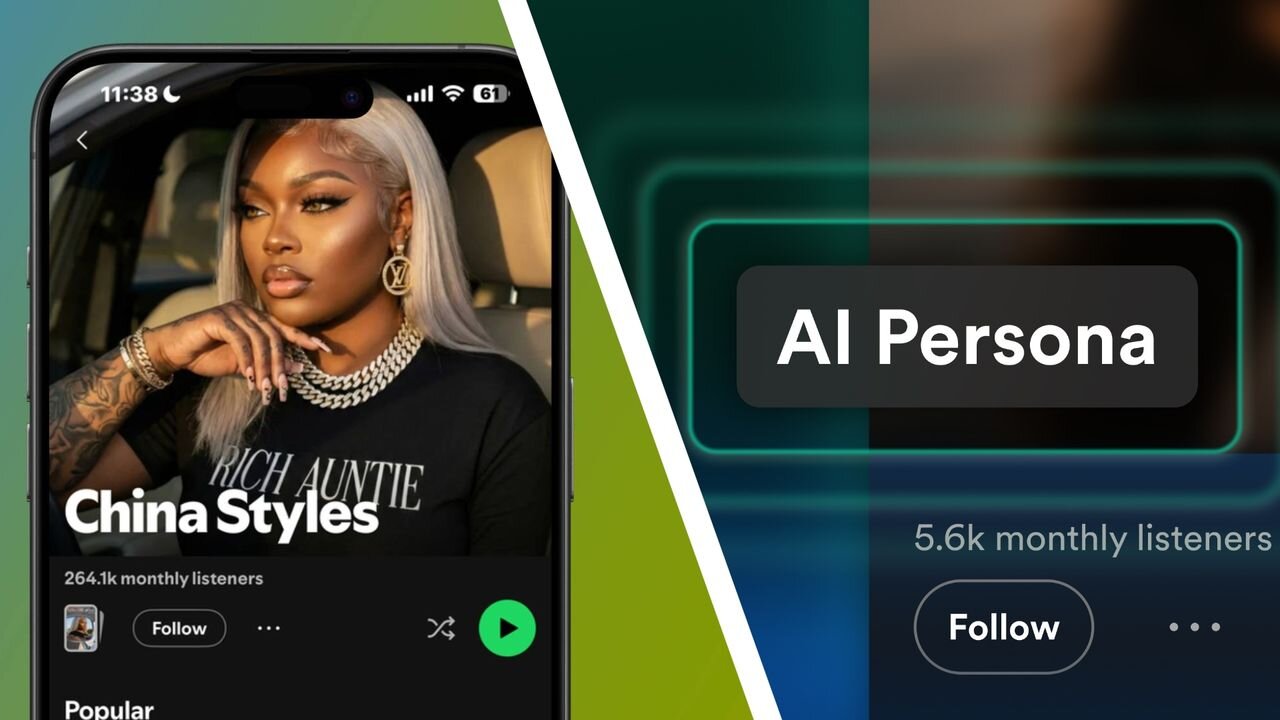
Spotify is introducing AI Persona tags in mid-September
The platform aims to improve user transparency by differentiating real artists from AI-generated ones
Spotify only reviews an artist's profile and images, and not the music itself
Spotify has fallen short on the AI transparency front compared to some of the other best music streaming services , with users pining for a fix — and now the platform is taking its biggest step yet towards combatting AI slop.
The streaming giant announced today (August 11) the arrival of new AI Persona tags, which are designed to differentiate human artists from ones that are AI-generated. Spotify says these tags will roll out to mobile in mid-September, and will appear in an artist’s profile banner, ‘About’ section, in Search, and in song rows in playlists.
Once they become available, users can be safe in the knowledge that the artists they’re listening to haven’t been generated by AI. Spotify added that artists with AI Persona tags will be excluded from all personalized recommendations by default, ensuring that your music-discovery regime remains uninfected by slop.
(Image credit: Spotify)
Though AI Persona tags won’t roll out for another month or so, Spotify says artists can already disclose if their profile is AI-generated. If an artist declares this, a tag reading ‘AI Persona’ will appear next to their name. ‘We hope artists will be transparent, so we are giving them the opportunity to disclose,’ the service shared in its announcement — but it’s not putting all its trust into self-disclosure.
Instead, Spotify says it will take matters into its own hands if need be, and will conduct reviews of profiles where it thinks an artist’s images have been created using generative AI to imitate a lifelike persona. If Spotify detects that an artist profile might be AI-generated, it will display a tag that reads ‘Likely AI Persona’, and the artist will be notified and given the option to self-disclose or appeal.
It’s taken Spotify a long time to catch up to the likes of Deezer when it comes to improving its transparency on AI-generated music. Deezer was the first major audio streaming service to roll out tags that explicitly say if a track has been AI-generated, and recently its Head of Research told us why we need AI filters more than ever .
Spotify’s own AI Persona tags mark a big shift for the platform, and will certainly improve the user experience by giving listeners more peace of mind. However, Spotify’s feature comes with an important caveat.
It reviews the profile only, not the music
(Image credit: Spotify)
AI Persona tags are just one of the ways Spotify has been working towards improving transparency for users. Verified by Spotify was launched a few months back — this is a certification feature that shows if an artist is legitimate, but it’s not as watertight as we’d hoped it would be.
Additionally, Spotify’s SongDNA gives listeners a comprehensive overview of the creatives behind their favorite songs , while AI Credits give artists the opportunity to share where and how they’ve used AI in their music production. It’s not as upfront as Deezer’s methods, but the measures are in place nonetheless, and AI Persona tags are the cherry on top.
That said, AI Persona tags target an artist’s public image, not how the music was made, which could present some issues, as it still leaves room for AI-generated music to slip its way onto the platform.
If Spotify detects that an artist is human-presenting, how are we to know that artist won’t upload AI-generated music to their profile? There’s nothing stopping that artist from publishing slop, because Spotify reviews their name, imagery, and public identity, not the music they upload.
It’s a tricky one, because while Spotify has measures in place that evaluate music and artist image respectively, it doesn’t have a comprehensive tool that reviews both components simultaneously, which again isn’t as upfront as Deezer.
As far as AI-generated content in Spotify goes, I’ve been one of the lucky ones who hasn’t encountered this issue. Because my love for physical media and radio impacts what I listen to on Spotify, I suspect that my algorithm has been trained enough to push AI slop out of my recommendations.
I do think that on top of my streaming habits, Spotify’s anti-AI music measures have helped to keep the fence up and block out unwanted songs to a certain extent — I just wish its approach to tagging was a bit more robust.