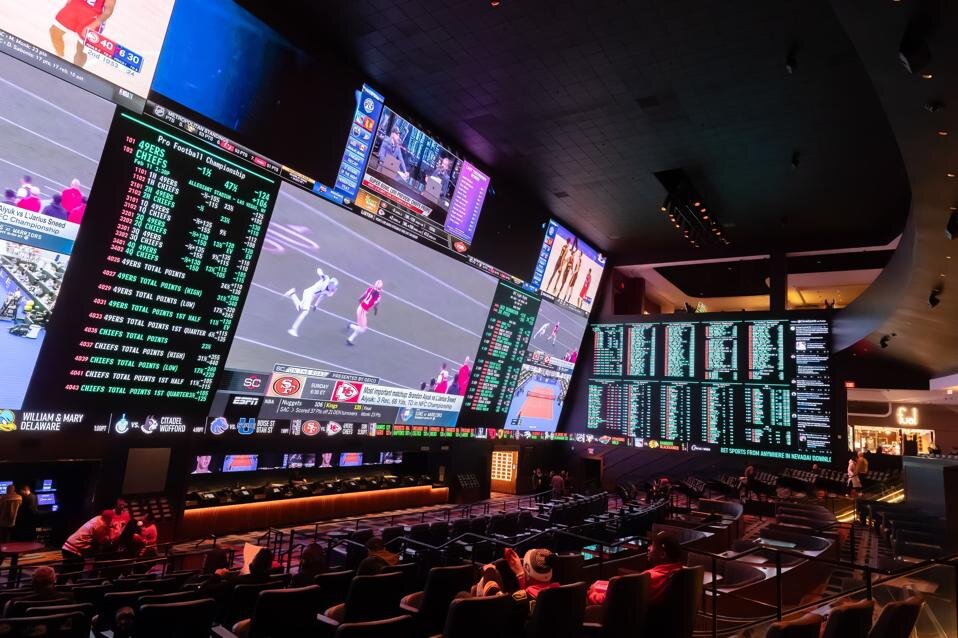
LAS VEGAS, NEVADA - FEBRUARY 10: The sportsbook in the Circa Resort & Hotel ahead of Super Bowl LVIII on February 10, 2024 in Las Vegas, Nevada. (Photo by Mario Hommes/DeFodi Images via Getty Images)
DeFodi Images via Getty Images
One late August morning, University of Florida students intrigued by a future in the fantasy and sports betting industries will virtually file in for the first day of Fantasy and Sports Betting Careers, a new offering from the school’s College of Journalism and Communications.
The instructor -- a UF alum himself -- who’ll progressively roll out the innovative curriculum, offer insights from personal experience, leverage an extensive network for guest speakers and administer the grades?
One could say he’s got some credentials:
Instrumental in getting ESPN to break the sports betting ice on its platforms prior to legalization.
Integral to ESPN securing its first official sportsbook partnership.
Directly responsible for live in-game betting odds being featured on a professional sports broadcast for the first time.
And, in keeping with his successful career’s underlying theme, Professor David Bearman has built the entire course from scratch.
A three-decade-and-counting industry veteran, he did so while fueled by a credo that’s repeatedly served him well – bet on yourself, and good things tend to happen.
Sports Betting Seed Planted Early
Before Bearman landed at what many a sports media hopeful would consider the ultimate employer – the four-letter network in Bristol, Connecticut – and played a pivotal role in the advent of all things sports betting at ESPN, he had quite the circuitous professional journey.
Throughout a winding path of roles that officially began in late 1995, when he talked his way into an internship with legendary prognosticator Hank Goldberg on South Florida sports talk radio station WQAM, and included multiple internships with the then Florida Marlins while still an undergraduate, Bearman took plenty of gambles by plunging headlong into his sports media dream.
During his tenure with the station, he also often lent a hand to radio sports betting pioneer Ed Kaplan, who’d started WQAM’s all-sports format back in 1986 with a nightly show that disseminated Las Vegas odds and famously catered to bettors by not signing off until the last West Coast score was in.
Kaplan’s show, which Bearman credits for “planting the sports betting seed” in him decades before the activity would go mainstream, also served as the platform for a momentous personal milestone – his first winning ticket.
During his final weeks of teen-hood in August 1998, Bearman was assisting the host on a remote broadcast at a Bahamas casino and legally able to place his first official bet while on the island. He took a flyer on the Over 7.5 wins for the Minnesota Vikings in Randy Moss’s unforgettable rookie campaign.
That wager had paid off by the middle of what would be a dominant 15-1 season and gave Bearman the heady taste of cashing in on his sports knowledge for the first time.
“I’m 19 years old, and I’m not sure I’ve made a better bet since,” he fondly recalls.
Laying the Betting Groundwork at the Worldwide Leader
Bearman had also already done some freelance stat work for ESPN by the time the network came calling for an entry-level Production Research department position in 2005.
As he’d done in previous professional stops, he both quickly grew into the role and also began expanding its boundaries.
He eventually began facilitating statistical information for flagship shows such as SportsCenter, and starting in 2007, as the lead researcher for the fledgling College Football Live. By 2011, Bearman had added plenty of research and stat work for ESPN’s BCS and rapidly expanding PGA coverage to his duties.
In the process, he earned himself a promotion to Production Research management and was made responsible for ESPN’s Bottom Line scroll, an innovative-for-its-time on-screen news wire that kept fans abreast of everything from scores to the latest sports headlines.
David Bearman is pictured in his University of Florida faculty photo.
David Bearman UF Faculty photo
During his interview, Bearman had already pitched having betting odds for games listed on the Bottom Line.
While a foregone conclusion in today’s legalized sports betting era, the suggestion was borderline scandalous in 2011, when the leagues were still keeping any tie-in of betting to their sanctioned events at arm’s length.
The idea unsurprisingly got the cold shoulder at the time, but it did plant a very early seed that would eventually bear fruit.
In a 2014 meeting called by network execs to discuss how ESPN could head off an ambitious new competitor, Fox Sports 1 (FS1), Bearman reignited his push for sports betting data, presenting it as a unique way to differentiate the network.
“Why can’t betting content be one of the tools in the toolbox?,” he suggested, envisioning that everything from the Bottom Line to SportsCenter would benefit.
The urgency created by a new competitor made for a slightly more conducive environment for the idea.
While the leagues still didn’t want ESPN associating betting with their products, Bearman and Chad Millman – who’d go on to serve as Editor in Chief at ESPN The Magazine and ESPN.com before an eight-year tenure as Chief Content Officer at Action Network – got the green light to “start off small.”
That equated to the purchase of Gold Sheet data from legendary handicapper Bruce Marshall, a treasure trove of granular individual game information for multiple sports dating back decades:
Every line and total from every NFL regular-season and postseason game in the Super Bowl era.
The same data for every college football regular-season and bowl game since the 1978 FBS-FCS merger.
Ditto for every regular-season and postseason NBA game since Michael Jordan’s 1984 rookie season.
Bearman and Millman set about painstakingly importing the data over the next four y...