This is one outlet's own report from Forbes — the article as it was filed.
AIPROPX ReportForbes · 7h ago
Can The Maldives Become A Serious Food Destination?
Dining Can The Maldives Become A Serious Food Destination? By Lela London ,
Forbes contributors publish independent expert analyses and insights. Lela is a London-based writer and editor who covers food and drink. Follow Author Aug 17, 2026, 04:39pm EDT --:-- / --:-- This voice experience is generated by AI. Learn more . This voice experience is generated by AI. Learn more . Summary The Maldives, long known for luxury escapes, is experiencing a significant shift in traveler expectations. Modern guests now prioritize exceptional culinary experiences, demanding provenance and unique dining, not just stunning villas. Resorts are responding by moving beyond generic international menus to offer distinctive, experiential dining, recognizing food as a key differentiator and revenue stream. Despite logistical challenges inherent to remote island operations, there's a growing push to develop a unique Maldivian food identity. Chefs are increasingly focusing on local ingredients, traditions, and wellness-focused cuisine. The aim is to cultivate a world-class local food culture, making the Maldives a serious gastronomic destination where dining is a primary reason for travel.
For most of its modern tourism history, the Maldives has sold a singular fantasy. Turquoise lagoons, villas suspended above the Indian Ocean, the promise of almost total escape. Safe to say, it’s become one of the world’s most aspirational holiday destinations. And food’s always been part of that fantasy, but it’s rarely been the reason for it.
It’s an interesting dichotomy, too, because the very thing that makes a Maldivian holiday so extraordinary (being marooned, luxuriously, on your own tiny island) also means there’s often no neighbourhood restaurant or supermarket haul to rescue a disappointing dinner.
For five, seven or ten days, the restaurants at your resort essentially become the restaurants of your holiday. And, as a result, mediocrity can become very expensive indeed.
At the same time, the luxury traveller has changed. Many, myself included, now arrive with trips built around restaurants in Tokyo, Copenhagen, and San Sebastián, caring about provenance, recognising serious wine programmes, and hoping the same thought goes into the food programme as as the villa we might cross continents to sleep in.
Harish Gopalakrishnan, General Manager of The Westin Maldives Miriandhoo Resort, sees the same shift. “For many travellers, a memorable meal can define a holiday just as much as the villa or coming here for the beautiful sea,” he says. Guests increasingly want “variety, theatre,and experiences they could not easily recreate elsewhere.
“Food and drink are no longer simply part of the stay,” he adds. “They are part of the reason guests choose us.”
Well, there’s an unusual commercial dynamic at play.
In a great food city, restaurants compete for individual meals. In the Maldives, once a traveller has chosen an island, the decision has largely been made. Gopalakrishnan is realistic that guests are unlikely to routinely transfer between resorts simply for dinner.
“A strong signature restaurant adds another layer to the guest experience and gives people a clear reason to choose a resort over another resort,” he says.
Naturally, a bad restaurant—or too few restaurants—becomes disproportionately difficult to escape.
John Bosco, Food and Beverage Manager at COMO Cocoa Island , describes F&B as an especiallly important secondary revenue stream in a seasonal resort market. “Ultimately, F&B should contribute to both sides of the equation,” he says: “commercial performance and guest memory.” Particularly when lower room rates put pressure on profitability.
“Luxury travellers are much more informed than they were five or ten years ago,” says Alberto Burgio, Executive Chef at The Westin Maldives Miriandhoo Resort . “They are not only asking what is on the menu, but where ingredients come from, how dishes are prepared and whether menus can support their lifestyle.”
Naturally, the change is pushing resorts away from the old formula of international all-day dining (something vaguely Asian, an Italian, and perhaps a grill), as familiarity alone is no longer much of a selling point.
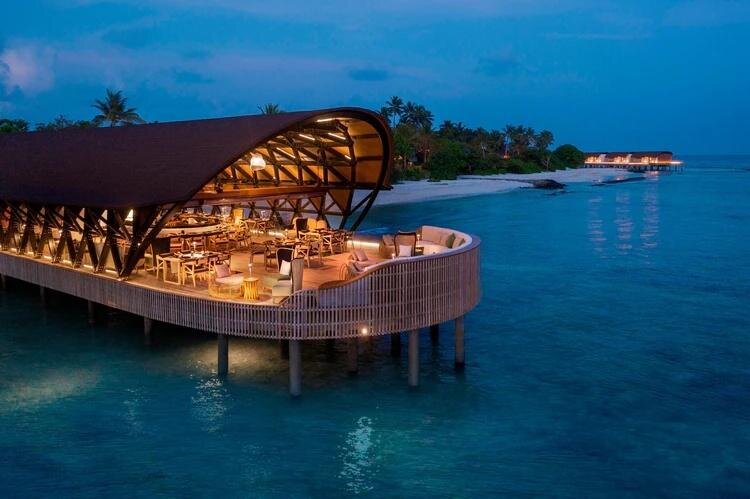
At The Westin, the clearest expression of a more distinctive approach is The Pearl, its intimate Japanese restaurant. Alongside a kaiseki set menu, the limited covers, sunset views and marine life moving through the water below make for an exceptional experience. Gopalakrishnan calls it “the theatre of the location”.
That may point towards the Maldives’ greatest gastronomic advantage. The fact that it doesn’t need to imitate London , Paris or New York, but lean—hard—into what no other destination can.
Running an ambitious restaurant on a private island in the Indian Ocean is, of course, absurdly complicated.
“Logistics are one of the biggest challenges,” Burgio says, with sourcing, storage, transport, staffing, weather and menu consistency requiring unusually careful planning. “It is no longer enough to offer a standard resort menu,” he says. “And that requires strong systems behind the scenes, but also creativity.”
Luxury travellers, after all, are not grading dinner on a curve. The difficulty involved in getting an ingredient to a remote atoll may be fascinating, operationally, but they still have to eat the finished dish.
COMO tries to source seafood through local fishermen and produce through local communities and markets, but Bosco points to a broader structural problem: limited agricultural land supporting a sizeable resort economy.
He believes vertical farming, hydroponics, controlled-environment agriculture and stronger domestic supply chains could all increase the amount resorts are able to source locally.
At The Halcyon Private Isles Maldives , Executive Chef Harpal Singh sees those constraints from the kitchen. After 18 years cooking in the country, he says seasonality, weather, fishing conditions and transportation still dicta...
AIPROPX is an independent multi-source news index — we track, compare, and connect coverage from across the web into one place you won't find anywhere else.