
RESOLVING THE LEDGER
RESOLVING THE LEDGER
Only one outlet has reported this event so far — you're reading it below, credited to its source. AIPROPX is tracking the web for more coverage; as additional outlets confirm it, this becomes a full multi-source story automatically.
By AIPROPX Editorial Desk · Published · Updated
One outlet is reporting this so far. AIPROPX is tracking it and will gather every additional source as it develops — the full multi-source comparison appears automatically once a second outlet confirms it.
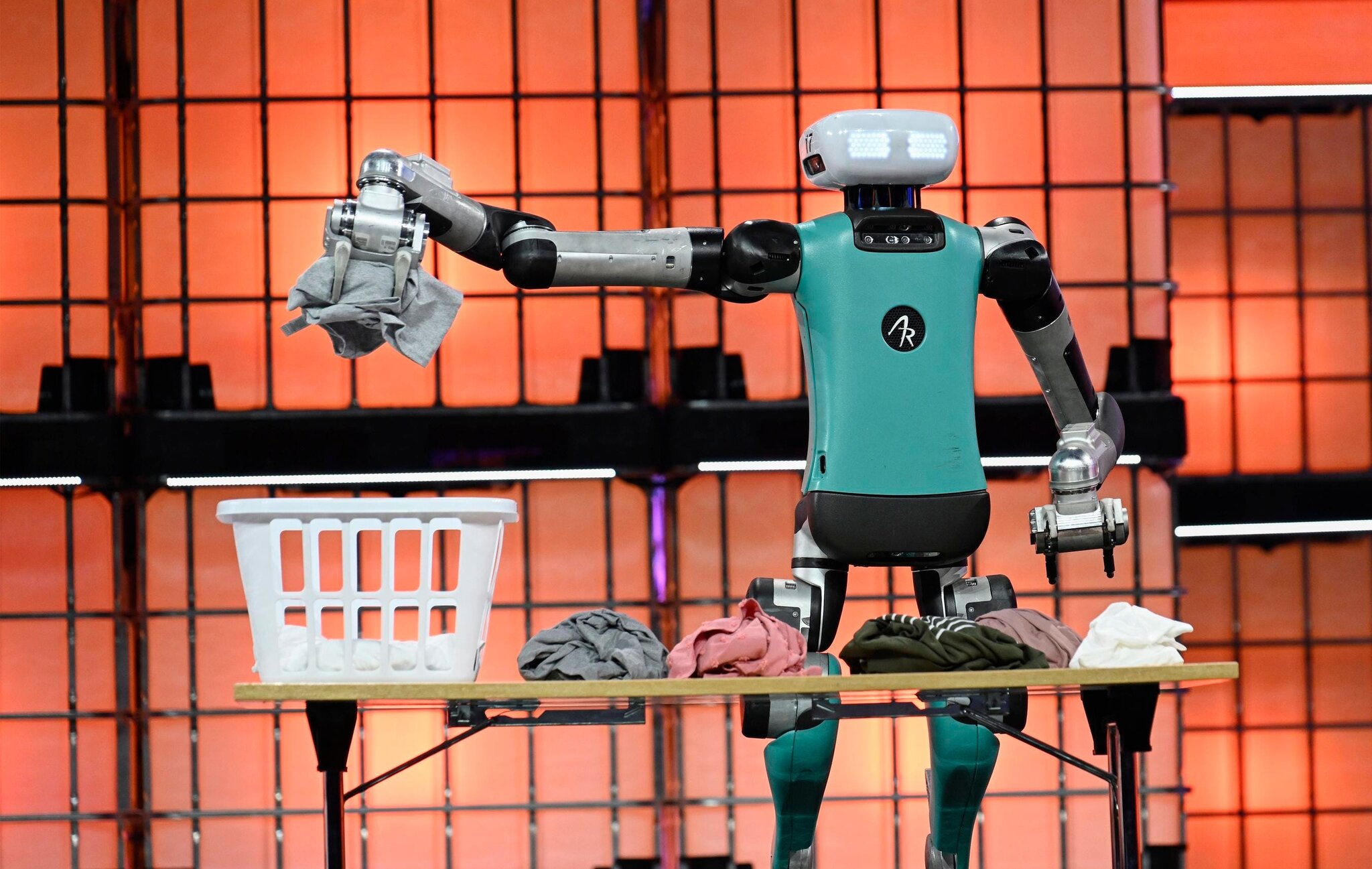
Consumer Tech Digit v5: First Humanoid Robot Out Of The Cage? By John Koetsier ,
Forbes contributors publish independent expert analyses and insights. Journalist, analyst, author, podcaster. Follow Author Aug 10, 2026, 01:23pm EDT Aug 10, 2026, 01:24pm EDT --:-- / --:-- This voice experience is generated by AI. Learn more . This voice experience is generated by AI. Learn more . Summary Agility Robotics is set to launch its Digit v5 humanoid robot in December, emphasizing its ability to work safely and cooperatively alongside humans without traditional safety fencing. This innovation tackles the biggest barrier to widespread humanoid deployment: operating outside restrictive cages. Digit v5 will offer 20-hour operational days and flexible manipulation through standardized, eventually self-swapping, end-effectors. The robot targets "dull, dirty, dangerous" bulk material handling jobs in warehouses and factories, addressing acute labor gaps. Agility is also going public via a $2.5 billion merger, backed by $300 million in booked revenue, aiming to set a new standard for commercially viable humanoid robotics.
Agility Robotics’ coming Digit v5 humanoid robot will work safely and cooperatively side-by-side with humans, Agility’s chief business officer Daniel Diez told me recently: no safety fencing required. It’ll also be able to work 20 hours a day and change hands – AKA end effectors – and eventually do that on its own.
The biggest challenges blocking humanoid robots from entering the workforce aren’t speed, agility, battery capacity, or dexterity, Diez says. It’s being a cobot: being able to work right in the mix of the warehouse or factory: no more being caged off for safety reasons.
"It’s probably the biggest misconception that what’s holding back these robots are skills or AI or batteries," Diez told me recently on the Humanoid Daily podcast . "The truth of the matter is what holds back large-scale deployments of humanoid robots is their inability to work outside of safety parameters or safety cages."
That is precisely the problem Agility says it is about to solve.
In December, the company plans to begin deploying Digit V5 to early customers. Digit v5 will be what Diez calls “the world’s first cooperatively safe robot, a robot capable of working in close proximity with people and ensuring their safety at the same time.” Few if any humanoid robots are currently working right beside humans. Figure, Apptronik, Boston Dynamics and Tesla have humanoids working in somewhat shared settings, reportedly, but not yet completely mixing in with human workers.
Digit v5 will be a significant upgrade in at least three ways:
The biggest deal here is Digit working with humans. Right now, pretty much every humanoid robot working in a warehouse or factory — Digit included — operates cordoned off behind safety fencing, physically separated from the humans around it. That’s essentially a deployment tax eating floor space, disrupting workflows and just completely kiboshing deals: many facilities simply don’t have the room.
"Opening up the safety cages, basically removing them, allows people to be able to walk by certain areas and the robots to be integrated more holistically into a working factory or a working warehouse," Diez says. He expects it to open up not just new use cases but entire verticals, including retail and pharmaceutical, where a fenced-off robot is a non-starter. "This will open up the ability to work with a great number of customers who we've had to say, wait for the next-generation robot."
Digit's sweet spot, for now, is deliberately narrow.
Agility chose bulk material handling — moving things around factories and warehouses — as its beachhead because that's where the labor gap is most acute across the US, Europe, Korea and Japan.
"Dull, dirty, dangerous jobs, injury-prone, high degree of absenteeism, high degree of turnover," Diez says. “These jobs are where Digit excels.”
I asked Diez about speed – we’ve all seen humanoid robots walk, and frankly some of them can’t outpace our grandparents. In response, Diez brought up Schaeffler’s plant in South Carolina, where Digit is working right now, loading greasy machine parts into an industrial washer. Today, Digit v4 already outpaces the washer’s ability to ingest parts. So speed, he says, isn’t always about being faster than a human.
“It isn’t always necessary to be faster than a human,” he says. "It’s ‘can I process more work in the same time period than the alternative?’"
And cost matters too: can you do that at a price below the fully burdened cost of a human doing the same job … "if they could even find that person," Diez adds.
Of course, all of this arrives as Agility steps into an unusually bright spotlight. The company is going public via a $2.5 billion merger with Churchill Capital Corp XI under the ticker AGLT. That will make it the first US pure-play humanoid robotics company to report real financials as a public company. The good news for the company: Agility says it’s sitting on roughly $300 million in booked revenue across some 1,000 robots and nine customer sites including Schaeffler, GXO, Toyota and Mercado Libre.
Diez frames the going-public transition as a chance to set a bar in a field awash with nine- and ten-figure valuations built largely on demo reels.
"You don’t see us pumping out marketing videos," he said. "This is what a humanoid robotics company looks like that is beginning to deploy commercially ... and is focused on delivering ROI."
Even more interesting will be the public launch of Digit v5. Then we’ll see if the next version of Agility’s humanoid robot can support – and grow – that $300 million. And if our next-gen humanoids can mix right in with humans.
Indexed and credited by AIPROPX. Originating outlet: Forbes. Open at source →
An original, deterministic readout — composed only from the computed coverage facts on this page. No interpretation, no rating; figures only.
AIPROPX has consolidated 1 report from 1 outlet into a single canonical entry on “Digit v5: First Humanoid Robot Out Of The Cage?.” Every covered outlet is based in US.
The only timestamped report came from Forbes (Aug 10, 2026, 17:23 UTC).
Comparing the wording across sources, the phrase recurring most across the coverage is “digit v5”.
2 statements are carried by only one outlet within this set and are not echoed by the others.
Every figure above is a direct count of real published articles. AIPROPX indexes and compares the original reporting — it never rewrites, rates, or editorializes — and each publisher’s full article is always one click away.
Generated by AIPROPX from the source counts above. AIPROPX indexes and resolves coverage; the original publishers are credited and linked at origin in every report.
Coverage from 1 independent outlet across 1 region — each view opens on its own page.
AIPROPX — “Digit v5: First Humanoid Robot Out Of The Cage?” · https://www.aipropx.com/story/0329fb34b161e6e36db9ee9295bc8028
Other events being covered across multiple sources right now.
Traffic to Trump’s Truth Social suffers double-digit decline over summer as rival sites see numbers climb
2 outletsUS emergency oil reserve falls below 300M barrels for first time since 1980s
2 outletsMurder investigation called off after 'body' turns out to be doll
2 outletsNew train service connects Finland and Sweden for first time in decades
2 outletsSpaceX retail investors sell $4.5 million in shares, first net outflow since IPO
2 outletsCanada: Octogenarian is first killed in British Columbia wildfire