
RESOLVING THE LEDGER
RESOLVING THE LEDGER
This is not a single article. It's every outletcovering this one event, gathered in one place — read AIPROPX's summary, see where the sources line up, then open any report at its origin.
By AIPROPX Editorial Desk · Published · Updated
Everything reported about this story, gathered from 3 sources. Read the summary below, then tap any source to open that report.

Salty water flowing through Antarctica's Blood Falls contains a distinct community of marine-specific microorganisms, providing evidence that the brine system beneath the glacier has a marine origin, according to a paper published in Nature Geoscience. The findings offer new insights into how microbial communities can persist through major environmental transitions.
Summary indexed by AIPROPX from Phys.org’s reporting — the full article is one click away. Open at source →
3 outlets are covering this. Resolve the ledger to read what they collectively report — the common thread, in plain terms.
Every report on this story — read the summary of each, then open any at its source. AIPROPX summarizes and links; it never reproduces the original.
Salty water flowing through Antarctica's Blood Falls contains a distinct community of marine-specific microorganisms, providing evidence that the brine system beneath the glacier has a marine origin, according to a paper published in Nature Geoscience. The findings offer new insights into how microbial communities can persist through major environmental transitions.
Read this report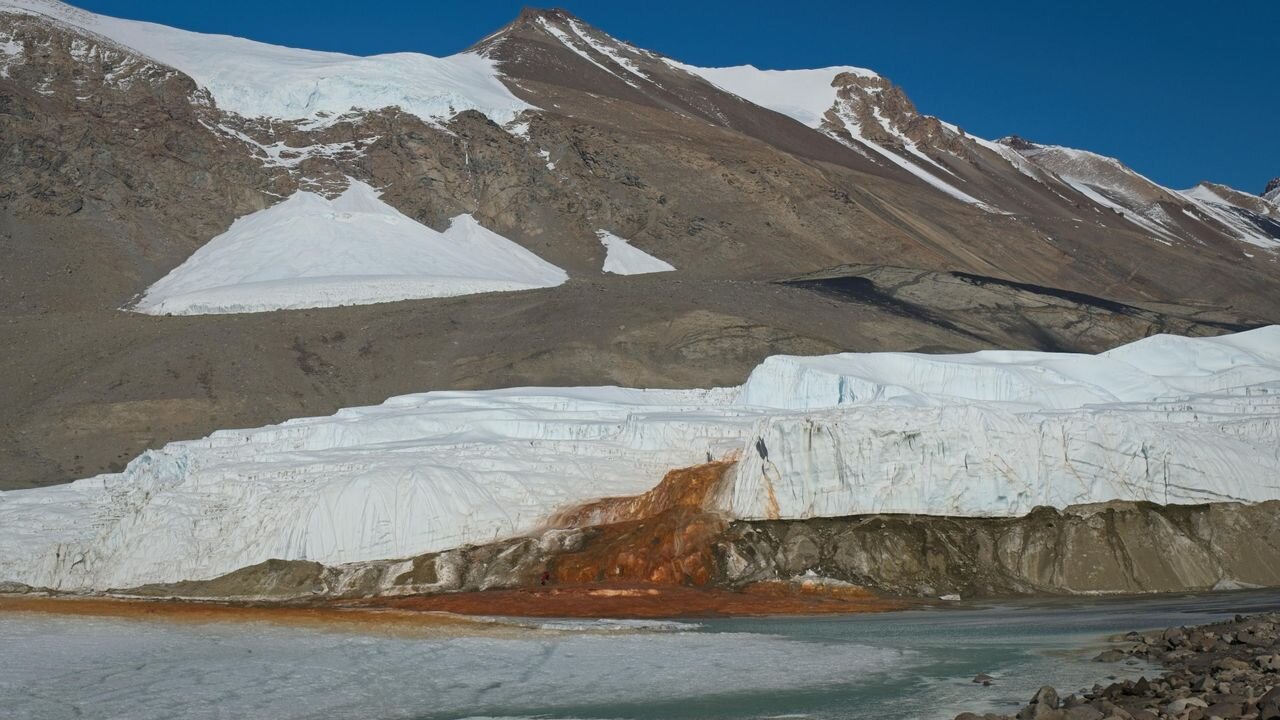
Brine that feeds the gruesome-looking Blood Falls in East Antarctica may have been emplaced when sea levels were higher than they are now, a new study says.
Read this reportThe bright, red-orange stain on Antarctica’s ice-covered landscape may trace back to ancient oceans
Read this reportAn original, deterministic readout — composed only from the computed coverage facts on this page. No interpretation, no rating; figures only.
AIPROPX has consolidated 4 reports from 3 outlets into a single canonical entry on “Marine microbes point to ancient seawater source beneath Antarctica's Blood Falls.” Every covered outlet is based in Other.
The earliest report in this entry came from Scientific American (Aug 3, 2026, 15:00 UTC); the most recent came from Phys.org (Aug 3, 2026, 21:00 UTC).
Comparing the wording across sources, 1 named entity is referenced by multiple outlets and the phrase recurring most across the coverage is “blood falls”.
5 statements are carried by only one outlet within this set and are not echoed by the others.
Every figure above is a direct count of real published articles. AIPROPX indexes and compares the original reporting — it never rewrites, rates, or editorializes — and each publisher’s full article is always one click away.
Generated by AIPROPX from the source counts above. AIPROPX indexes and resolves coverage; the original publishers are credited and linked at origin in every report.
Coverage from 3 independent outlets across 1 region — each view opens on its own page.
AIPROPX — “Marine microbes point to ancient seawater source beneath Antarctica's Blood Falls” · https://www.aipropx.com/story/03c78764f67a42e05f61803ed250a002
Other events being covered across multiple sources right now.
Hamby leads Los Angeles against Chicago after 23-point game
4 outletsRed Cross declares blood crisis, urges donations as nearly half of NH appointments sit empty
45 outletsEl Paso mid-year housing market review
25 outletsKevin Feige on the ‘Brand New Day’ Box Office and What’s Next for Spidey and Marvel
20 outletsUS states sue to block Trump tariffs impacting dozens of countries
16 outletsIran-US war latest: Tehran claims Trump could ignite World War III after making ‘last chance’ escalation threat