
RESOLVING THE LEDGER
RESOLVING THE LEDGER
Only one outlet has reported this event so far — you're reading it below, credited to its source. AIPROPX is tracking the web for more coverage; as additional outlets confirm it, this becomes a full multi-source story automatically.
By AIPROPX Editorial Desk · Published · Updated
One outlet is reporting this so far. AIPROPX is tracking it and will gather every additional source as it develops — the full multi-source comparison appears automatically once a second outlet confirms it.
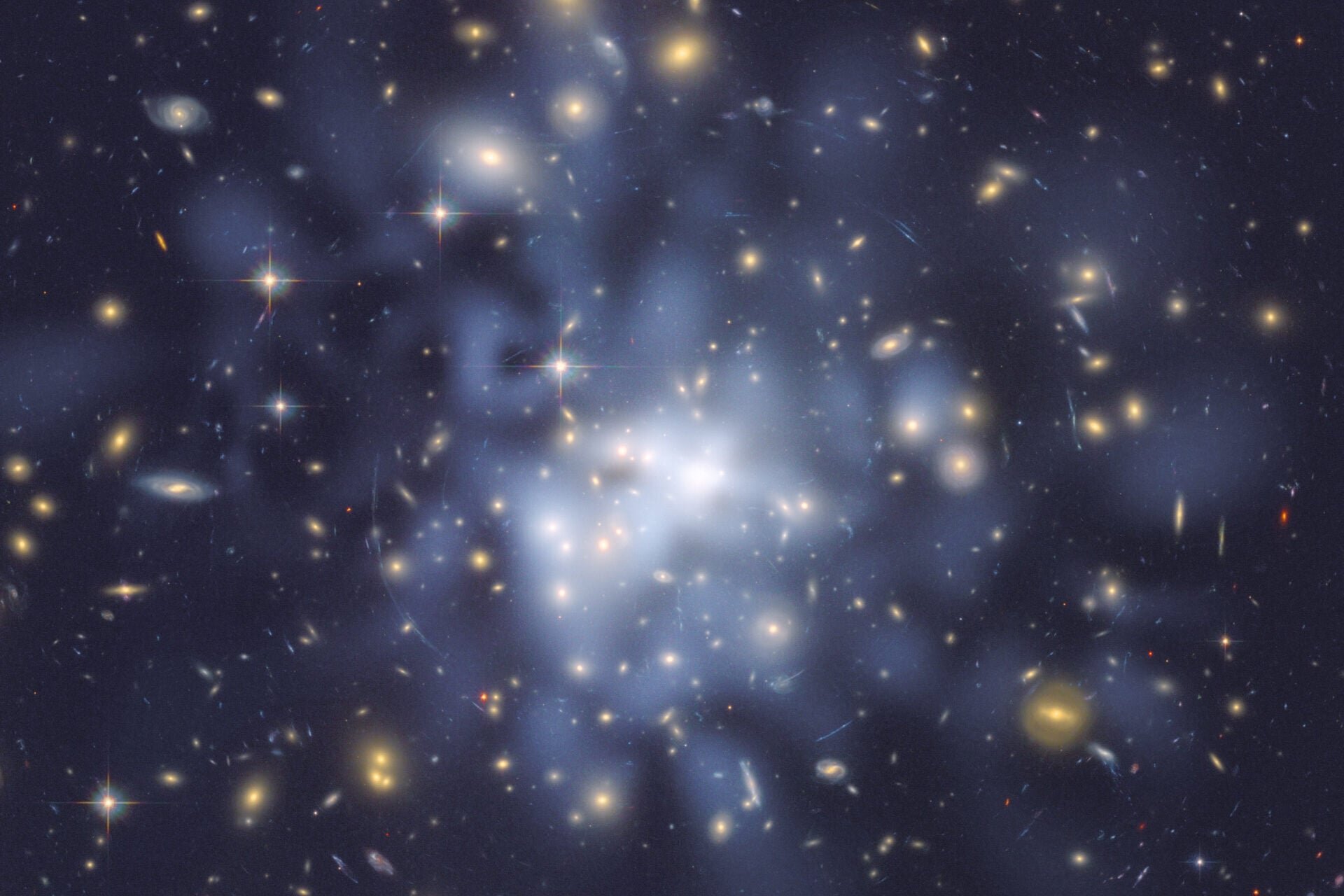
Dark matter, the elusive, invisible stuff that astronomers say constitutes roughly 85% of the universe’s mass, doesn’t interact with light. Scientists only suspect it's there because of the way the things we can see interacts with it. But now, one team in China says it’s found the most direct evidence for dark matter yet.
According to a recently published study in Physical Review Letters, astrophysicists with the Chinese Academy of Sciences found a “sharp” gamma-ray signal among 15.5 years' worth of data from the Fermi Gamma-ray Space Telescope (FGST). The signal, the paper argues, is observable support for the leading theory of dark matter, which posits that dark matter is composed of weakly interacting massive particles (WIMPs). This gamma-ray signal is what you would expect to see when those particles collide and annihilate each other.
“Discovering a sharp gamma-ray line would be the ultimate ‘smoking gun’ evidence proving the existence of dark-matter particles and revealing their properties in particle physics,” Yi-Zhong Fan, the study’s first author, told New Scientist .
Gamma rays are among the most powerful types of radiation in nature and a key area of interest in the search for dark matter, especially for scientists who support the WIMP theory. As per their name, WIMPs interact too weakly with the electromagnetic and nuclear forces to be observable via light or other particle interactions with normal matter.
On the other hand, WIMP-to-WIMP collisions should produce telltale gamma rays.
An intense gamma ray source with unknown origins is naturally going to leads some scientists to wonder if dark matter was responsible. At least, the latest study is far from being the first to do so. Last year, one team argued that the gamma glow at the Milky Way’s center was dark matter . Then one month later, another researcher claimed WIMPs were responsible for another odd gamma-ray signal , also from FGST data.
That said, gamma-ray “smoking guns” aren’t easy to prove. There have been times when purported dark matter signals of this nature were later proven to be just an instrument error. The study also observed a handful of galaxy clusters, so it’s always possible that this particular cluster was an anomaly.
However, the team argued in the paper that its calculations considering signal-to-noise ratios “disfavors an instrumental origin.” Either way, it seems worthwhile to investigate the signal’s physical origin, given its significantly sharp, clear nature, the researchers added in the study.
It’s also worth noting that, again, it’s not just this one team clocking some really unexplainable gamma-ray signals. The FGST is still active and will have doubled its dataset by 2040. International space agencies are also preparing to launch new gamma-ray telescopes in the next few years, so who knows? Perhaps gamma rays really will end up being humanity’s first contact with dark matter.
Indexed and credited by AIPROPX. Originating outlet: Gizmodo. Open at source →
An original, deterministic readout — composed only from the computed coverage facts on this page. No interpretation, no rating; figures only.
AIPROPX has consolidated 1 report from 1 outlet into a single canonical entry on “Astronomers Think They’ve Found the Best Evidence for Dark Matter Yet.” Every covered outlet is based in Other.
The only timestamped report came from Gizmodo (Aug 24, 2026, 19:30 UTC).
1 statement is carried by only one outlet within this set and is not echoed by the others.
Every figure above is a direct count of real published articles. AIPROPX indexes and compares the original reporting — it never rewrites, rates, or editorializes — and each publisher’s full article is always one click away.
Generated by AIPROPX from the source counts above. AIPROPX indexes and resolves coverage; the original publishers are credited and linked at origin in every report.
Coverage from 1 independent outlet across 1 region — each view opens on its own page.
AIPROPX — “Astronomers Think They’ve Found the Best Evidence for Dark Matter Yet” · https://www.aipropx.com/story/0a809b93eb2ced39b8c606ccbc0a4448
Other events being covered across multiple sources right now.
This modern Mexican kitchen was named one of America's best new restaurants by Bon Appétit
5 outletsInvestigation underway after Southwest Airlines flight attendant from Moore found dead in Hawaii
4 outlets5 people and multiple animals killed on rural Oregon property, with suspect found dead
3 outletsStudy highlights airports and airlines with the best flight deals
3 outletsBMW Exec Says Young People Prefer Voice and Screens Over Buttons Because ‘They Are Multitasking’: TDS
1 outletsWhen are the Europa and Conference League draws and how do they work?