
RESOLVING THE LEDGER
RESOLVING THE LEDGER
Only one outlet has reported this event so far — you're reading it below, credited to its source. AIPROPX is tracking the web for more coverage; as additional outlets confirm it, this becomes a full multi-source story automatically.
By AIPROPX Editorial Desk · Published · Updated
One outlet is reporting this so far. AIPROPX is tracking it and will gather every additional source as it develops — the full multi-source comparison appears automatically once a second outlet confirms it.
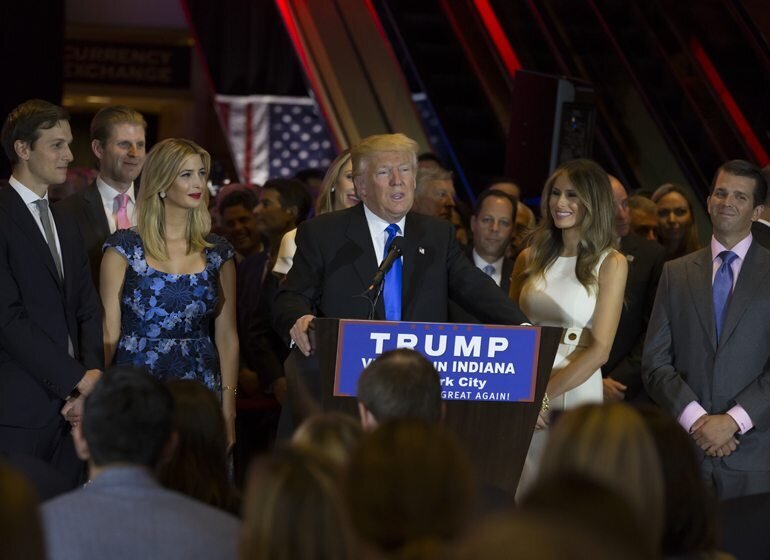
TEHRAN - Since Donald Trump returned to the White House for a second term, one of the most significant debates in American media has focused not only on his domestic and foreign policies, but also on the relationship between political power and the financial interests of his family.
Trump’s critics argue that during his second administration, the line between government decisions and the Trump family’s business activities has become increasingly blurred, with war, the defense industry, military technology and foreign policy becoming areas that could generate substantial financial benefits for the president’s family. From the perspective of these critics, war is not merely a matter of national security for Trump; rather, it has become a family business, one in which geopolitical tensions, rising defense budgets and the expansion of the defense sector can create new economic opportunities for those close to him while increasing political power at the same time.
Donald Trump was already a businessman long before he entered politics. His name became widely known in the 1980s through Trump Tower, construction projects, luxury hotels and the New York real estate market. However, the structure of the Trump family’s wealth has changed in recent years. While much of Trump’s wealth in previous decades was tied to real estate, during his second presidency investments in areas such as cryptocurrencies, media, technology and companies connected to the defense sector have become increasingly important. This shift has led critics to argue that the Trump family is no longer simply running a real estate empire, but rather a diversified holding structure that is influenced by political decisions, market movements and foreign policy developments.
One of the most significant reports on this issue was published by The Washington Post, focusing on investments made by Trump’s sons, Donald Trump Jr. and Eric Trump, in defense technology companies. According to the report, investment funds and firms linked to Trump’s sons invested, after his return to power, in a range of companies involved in military technology, drones, defense artificial intelligence and equipment used by the Pentagon. These companies have collectively received billions of dollars in government contracts or future financial commitments from the US government.
The Washington Post reported that investments connected to Trump Jr. and Eric Trump included companies such as SpaceX and Anduril, as well as several smaller firms operating in the drone and military technology sectors. Some of these companies secured additional contracts or expanded opportunities to work with the US government after investments linked to the Trump family. Representatives of these companies and the White House, however, have rejected the allegations, arguing that Pentagon contracts are awarded through official procedures based on technical capabilities and that there is no connection between these contracts and the president’s family.
Nevertheless, critics argue that the main issue is not simply proving the existence of a direct transaction, but rather the creation of a conflict-of-interest structure — one in which the president’s family invests in industries whose financial success depends heavily on government decisions, defense budgets and national security policies. According to these critics, when the US government prioritizes the development of military technologies, drones, defense AI and weapons industries, companies in which members of the president’s family have invested could also benefit from those policies.
The debate over the connection between war and the Trump family’s financial interests intensified after his administration placed greater emphasis on expanding the defense industry and increasing production of new military equipment. The wars in Ukraine and the Middle East have significantly expanded markets for drones, defense systems and military technologies. Companies involved in drones, military artificial intelligence and autonomous systems have become some of the major recipients of government investment and defense contracts. Trump’s critics argue that, under these circumstances, the president’s family investments in these sectors cannot be separated from the administration’s defense and military policies.
Within this context, the Trump sons’ investments in drone companies have attracted particular attention. Modern conflicts have demonstrated that low-cost drones and autonomous technologies can play a decisive role on the battlefield. The US government has also sought to increase domestic production capacity for these technologies. Donald Trump Jr. has previously spoken about the importance of expanding America’s drone industry and increasing domestic production of military equipment. Critics argue that when someone is involved on one side in shaping the political environment surrounding the defense industry while also investing in companies operating in that same sector, the risk of a conflict of interest increases.
These concerns have also been raised in the US Congress. During a hearing attended by Secretary of State Marco Rubio, Democratic Representative Johnny Olszewski accused the Trump administration of allowing the president’s family to use political power to increase their wealth. He pointed to the growth of Trump’s assets, his family’s financial activities and investments connected to cryptocurrencies and technology companies, questioning whether it is appropriate for relatives of political leaders to profit from government decisions and positions of power.
Olszewski also raised questions about Trump’s stock transactions and the timing of certain financial decisions, alleging that the president purchased shares in companies that could benefit from government actions or economic developments before those events occurred. Rubio rejected the accusations, saying that he had never seen evidence in foreign policy or national secur...
Indexed and credited by AIPROPX. Originating outlet: Tehran Times. Open at source →
An original, deterministic readout — composed only from the computed coverage facts on this page. No interpretation, no rating; figures only.
AIPROPX has consolidated 1 report from 1 outlet into a single canonical entry on “War as Trump’s family business.” Every covered outlet is based in Middle East.
The only timestamped report came from Tehran Times (Jul 28, 2026, 15:48 UTC).
1 statement is carried by only one outlet within this set and is not echoed by the others.
Every figure above is a direct count of real published articles. AIPROPX indexes and compares the original reporting — it never rewrites, rates, or editorializes — and each publisher’s full article is always one click away.
Generated by AIPROPX from the source counts above. AIPROPX indexes and resolves coverage; the original publishers are credited and linked at origin in every report.
Coverage from 1 independent outlet across 1 region — each view opens on its own page.
AIPROPX — “War as Trump’s family business” · https://www.aipropx.com/story/1228cbc86abde7d8e0661bcb1136a854
Other events being covered across multiple sources right now.
Iran-US war latest: Trump and Netanyahu hold ‘positive and productive’ talks in first visit since joint strikes began
23 outletsTrump Asks Supreme Court to Allow Restrictions on Mail-In Ballots Before Midterms
9 outletsNetanyahu and Zelenskyy meet Trump before Lindsey Graham funeral service
5 outletsMan facing charges after family members killed following barricade at Queens home
3 outletsNo closure': Great-grandmother cremated against her final wishes, family says
3 outletsTrump administration threatens Anne Arundel schools over gender identity policy