
RESOLVING THE LEDGER
RESOLVING THE LEDGER
Only one outlet has reported this event so far — you're reading it below, credited to its source. AIPROPX is tracking the web for more coverage; as additional outlets confirm it, this becomes a full multi-source story automatically.
By AIPROPX Editorial Desk · Published · Updated
One outlet is reporting this so far. AIPROPX is tracking it and will gather every additional source as it develops — the full multi-source comparison appears automatically once a second outlet confirms it.
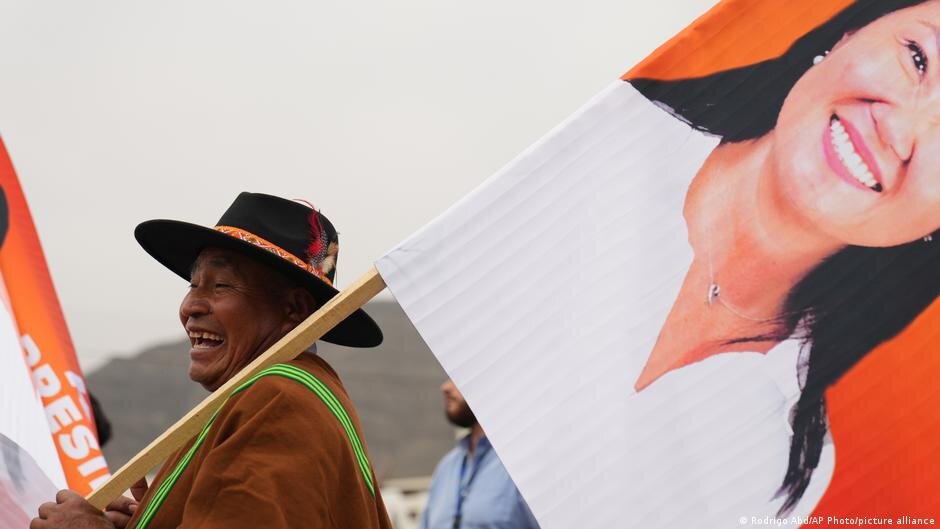
Peru's new president, Keiko Fujimori, has promised more security and investment. As she takes office, she'll have to find space for the South American nation amid Washington and Beijing's geopolitical rivalry.
https://p.dw.com/p/5Hk5K Advertisement When Keiko Fujimori steps into the presidential office on Tuesday, she'll bring back a political movement that hasn't been in power for more than a quarter century.
Fujimorism, a mix of neoliberalism, populism and strict government policies, characterized the 1990-2000 presidency of her father, the late Alberto Fujimori. Keiko Fujimori is stepping in amid a climate of social polarization, with promises to deliver more security, economic recovery and improvements in the health and education sectors.
But beyond those domestic projects, Fujimori is taking charge at a time of increased strategic importance for Peru . The country has become one of the key battlegrounds in the growing competition between the United States and China for political influence in South America.
Fujimori has already signaled that security will be the top priority for her government.
On the agenda: more video surveillance, a stronger police presence, tougher punishment for crimes and organized gangs, and command and control centers across the country. Part of the crackdown includes the construction of four mega-prisons, like those in El Salvador .
Eliana Carlin, a political science expert at the Pontifical Catholic University of Peru in Lima, is concerned by how Fujimori's plans will affect human rights .
"Behind [these measures] lie strong ideological positions intended to justify making the police and the armed forces solely subject to military jurisdiction," she said.
In addition to a stronger focus on security, Fujimori has said she intends to advance infrastructure projects, attract private investment, build new schools and hospitals and modernize the country with the help of technology and artificial intelligence .
But delivering on these pledges depends largely on whether the government can find the necessary funds. Infrastructure and essential services continue to face significant deficits. Added to that is the surging crime rate and the threat of the strengthening El Nino weather pattern , which could hit Peru with increased drought, extreme heat , flooding and other climate-related disruptions.
How a 'super El Nino' could change global weather To view this video please enable JavaScript, and consider upgrading to a web browser that supports HTML5 video
Foreign policy will also be a major challenge for Fujimori's administration. The opening of the Chancay port and logistics hub has turned Peru into a strategic player in regional trade — and made it a central focus in the geopolitical rivalry between Washington and Beijing.
The estimated $3.5 billion (€3 billion) project is part of China's world-spanning Belt and Road Initiative . Once fully operational, the port is expected to reduce the shipping time between Peru and China from around 40 to about 23 days, turning Chancay into a new gateway to Asia.
Thanks to the port and other investments, China has become Peru's most important trading partner. Bilateral trade between the two countries exceeded $40 billion in 2024, according to official figures. In second place is the US, with nearly $25 billion in trade.
Michael Shifter, an adjunct professor at Georgetown University in Washington teaching Latin American politics, said there's a lot at stake in Peru.
"Beijing has played a very important role in the Peruvian economy for many years, while at the same time the US is seeking to expand its influence. Nowhere is the competition between Beijing and Washington as evident as in Peru," he told DW.
Why is China's new megaport in Peru facing pushback? To view this video please enable JavaScript, and consider upgrading to a web browser that supports HTML5 video
For Shifter, the port at Chancay will be important for both Peru and its regional neighbors. "It will reduce transportation costs and facilitate trade with Asia, particularly with China," he said. "The project has enormous potential for the future of the South American economy."
Part of a planned "bioceanic" corridor between Brazil and Peru, the Pacific hub at Chancay will be connected via rail and road projects to the Atlantic Ocean, facilitating the export of products from all over South America to Asia.
Fujimori has also announced plans to expand her cooperation with the US, particularly in the areas of security and the fight against organized crime. For Shifter, the challenge will be to maintain the delicate balance between Washington and Beijing.
"Keiko wants to align herself with Washington and avoid tensions with the US. At the same time, China has been indispensable to the Peruvian economy for many years, and the port of Chancay enjoys broad support in Peru. Balancing this relationship will not be easy," he said.
To stay on the US president's good side, Peru's participation in the so-called "Shield of the Americas" will also be key. The alliance, initiated by Donald Trump to combat organized crime, has already welcomed the cooperation of, among others, the right-wing governments of Argentina, Chile, Ecuador and El Salvador.
According to Shifter, involvement in "the 'Shield of the Americas' would also serve to demonstrate a closeness to the Trump administration."
Fujimori's inauguration comes at a time when conservative forces have gained influence in several Latin American countries. For Shifter, however, Peru's case is unique.
"It's tempting to interpret her election victory as yet another shift to the right in Latin America . But Peru is more complex than that. Keiko Fujimori has shaped Peruvian politics for many years, and the country had already been pursuing a rather pragmatic course," he said.
Political scientist Carlin, however, fully expects a foreign policy shift.
"[Fujimori] has already made it clear that she wants to ali...
Indexed and credited by AIPROPX. Originating outlet: Deutsche Welle. Open at source →
An original, deterministic readout — composed only from the computed coverage facts on this page. No interpretation, no rating; figures only.
AIPROPX has consolidated 1 report from 1 outlet into a single canonical entry on “Fujimori takes charge in Peru amid China, US balancing act.” Every covered outlet is based in Europe.
The only timestamped report came from Deutsche Welle (Jul 27, 2026, 13:38 UTC).
2 statements are carried by only one outlet within this set and are not echoed by the others.
Every figure above is a direct count of real published articles. AIPROPX indexes and compares the original reporting — it never rewrites, rates, or editorializes — and each publisher’s full article is always one click away.
Generated by AIPROPX from the source counts above. AIPROPX indexes and resolves coverage; the original publishers are credited and linked at origin in every report.
Coverage from 1 independent outlet across 1 region — each view opens on its own page.
AIPROPX — “Fujimori takes charge in Peru amid China, US balancing act” · https://www.aipropx.com/story/16e3ee1f02e2989237d7440a68bad2bc
Other events being covered across multiple sources right now.
China’s CXMT Stock Soars 470% in Start of Trading, Amid A.I. Race
5 outletsJackson Koivun arrives in style, Lucas Glover takes off his shoes, and the greatest golf dad moment
4 outletsTrump presses Thune to keep Senate in session until SAVE America Act passes
3 outletsCommanders fire TE coach Ben Steele following DWI charge
17 outletsThree dead and several injured in shooting at food festival near Seattle's Space Needle
16 outletsHistoric wildfires in France and Spain have forced hundreds of thousands of people to evacuate. Here's what to know