
RESOLVING THE LEDGER
RESOLVING THE LEDGER
Only one outlet has reported this event so far — you're reading it below, credited to its source. AIPROPX is tracking the web for more coverage; as additional outlets confirm it, this becomes a full multi-source story automatically.
By AIPROPX Editorial Desk · Published · Updated
One outlet is reporting this so far. AIPROPX is tracking it and will gather every additional source as it develops — the full multi-source comparison appears automatically once a second outlet confirms it.
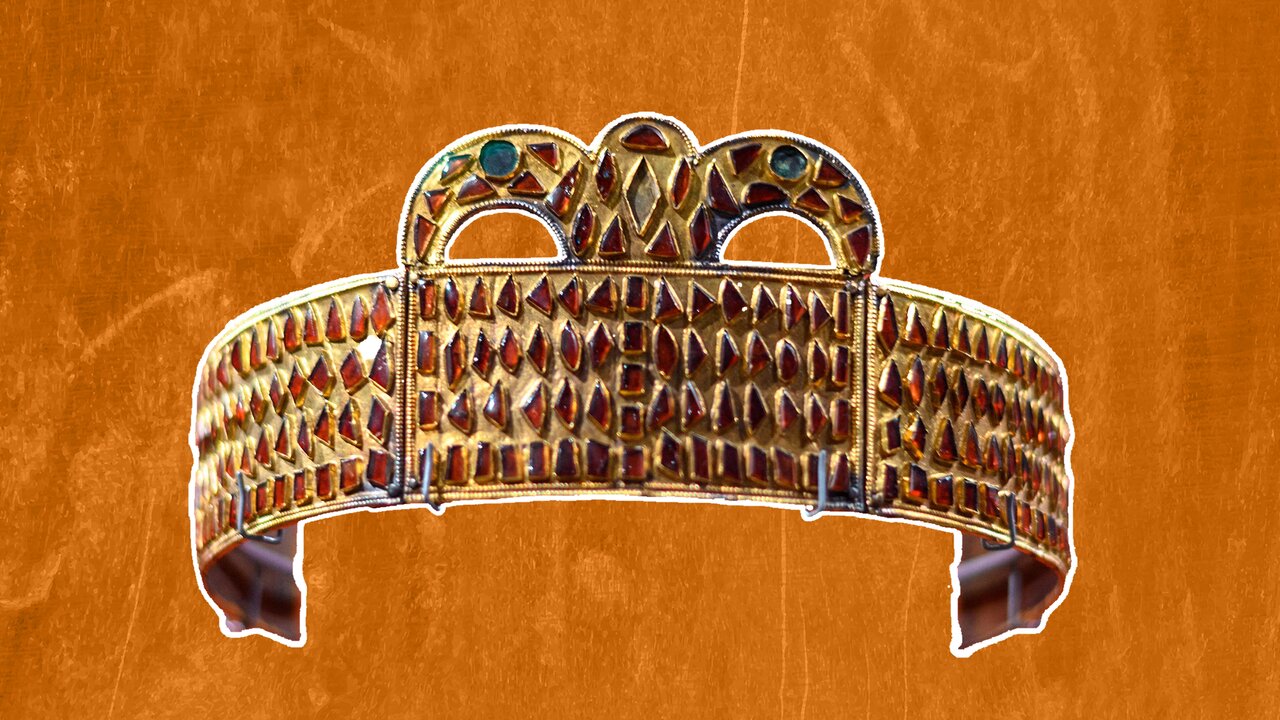
The Crown of Kerch was discovered in a high-status woman's grave in Crimea more than a century ago. (Image credit: Mirko Kuzmanovic/Alamy)
QUICK FACTS
Name: Crown of Kerch
What it is: A gold-and-garnet diadem
Where it is from: Kerch, Crimea
When it was made: Late fourth to early fifth centuries
At the beginning of the 20th century, a German art collector acquired dozens of artifacts from a Russian-led excavation of an ancient Hun settlement in Crimea. The most spectacular piece of the collection was the Crown of Kerch — a garnet-studded, gold diadem featuring stylized birds of prey.
The artifact, which is now on display at the Neues Museum in Berlin, is made up of three gold-covered, bronze plaques and more than 250 gem-studded cells. According to the museum, the crown was discovered in the grave of a high-status woman buried in the ancient city of Pantikapaion on what is now the Kerch Peninsula of Crimea.
The band of the rare gold diadem is roughly 1.7 inches (4.4 centimeters) tall and is associated with the fearsome nomadic warriors known as the Huns , who moved west from the Don River in what is now Russia in the late fourth century A.D.
Pantikapaion was founded as a Greek colony in the sixth century B.C. but was conquered by the Huns in the late fourth century A.D. A large necropolis with as many as 2,000 burials was excavated at Pantikapaion in the early 20th century, but only a handful of artifacts and skulls were saved from the excavation. Pantikapaion was incorporated into the Byzantine Empire in the sixth century by Emperor Justinian I.
The Crown of Kerch features two stylized heads of birds of prey, likely eagles, flanking a central floral motif. Round, green gems mark the birds' eyes. These birds likely represented power and authority among the Huns and other groups, according to the museum, and they were a popular symbol on jewelry and accessories of the time. Similar birds of prey have been found on Visigoth women's jewelry in Spain from the sixth century, for example.
German archaeologist Joachim Werner wrote in a 1956 study that the Crown of Kerch was found in a burial chamber near the skeleton of a woman with an artificially modified skull . Although the woman was buried with the diadem, Werner believed that these items were not just used for grave goods, and that high-status Hun women regularly wore the accessory during life, possibly with a cloth cap or veil attached.
Around two dozen examples of similar gold diadems have been discovered to date. This suggests that the Crown of Kerch is not technically the royal insignia of a queen but rather a diadem worn 1,600 years ago by a member of the ruling Hun elite.
For more stunning archaeological discoveries, check out our Astonishing Artifacts archives.
Fire Flame Vessel
Berlin Gold Hat
Neanderthal Crystal
Can you put together last week's Astonishing Artifact ?
Indexed and credited by AIPROPX. Originating outlet: Live Science. Open at source →
An original, deterministic readout — composed only from the computed coverage facts on this page. No interpretation, no rating; figures only.
AIPROPX has consolidated 1 report from 1 outlet into a single canonical entry on “Crown of Kerch: A 1,600-year-old gold, gem-studded diadem found in the grave of a Hun noblewoman.” Every covered outlet is based in Other.
The only timestamped report came from Live Science (Aug 31, 2026, 10:00 UTC).
2 statements are carried by only one outlet within this set and are not echoed by the others.
Every figure above is a direct count of real published articles. AIPROPX indexes and compares the original reporting — it never rewrites, rates, or editorializes — and each publisher’s full article is always one click away.
Generated by AIPROPX from the source counts above. AIPROPX indexes and resolves coverage; the original publishers are credited and linked at origin in every report.
Coverage from 1 independent outlet across 1 region — each view opens on its own page.
AIPROPX — “Crown of Kerch: A 1,600-year-old gold, gem-studded diadem found in the grave of a Hun noblewoman” · https://www.aipropx.com/story/1eea81e2c68eccc3572558751b4b2adf
Other events being covered across multiple sources right now.
Woman fatally stabbed in Fort Worth Sunday, 21-year-old man arrested: police
1 outletsToday on Sky Sports Racing: Two-year-old Trophy up for grabs at Ripon
2 outletsNaya Rivera’s 11-year-old son, Josey, makes acting debut 6 years after mom’s tragic death
1 outlets10-year-old shoot mom over VR headset
11 outletsMemorial held in Harlem for cab driver who was found dead in his vehicle during heat wave
7 outletsAaron Donald ends his 2 1/2-year retirement and returns to the Los Angeles Rams