
RESOLVING THE LEDGER
RESOLVING THE LEDGER
Only one outlet has reported this event so far — you're reading it below, credited to its source. AIPROPX is tracking the web for more coverage; as additional outlets confirm it, this becomes a full multi-source story automatically.
By AIPROPX Editorial Desk · Published · Updated
One outlet is reporting this so far. AIPROPX is tracking it and will gather every additional source as it develops — the full multi-source comparison appears automatically once a second outlet confirms it.
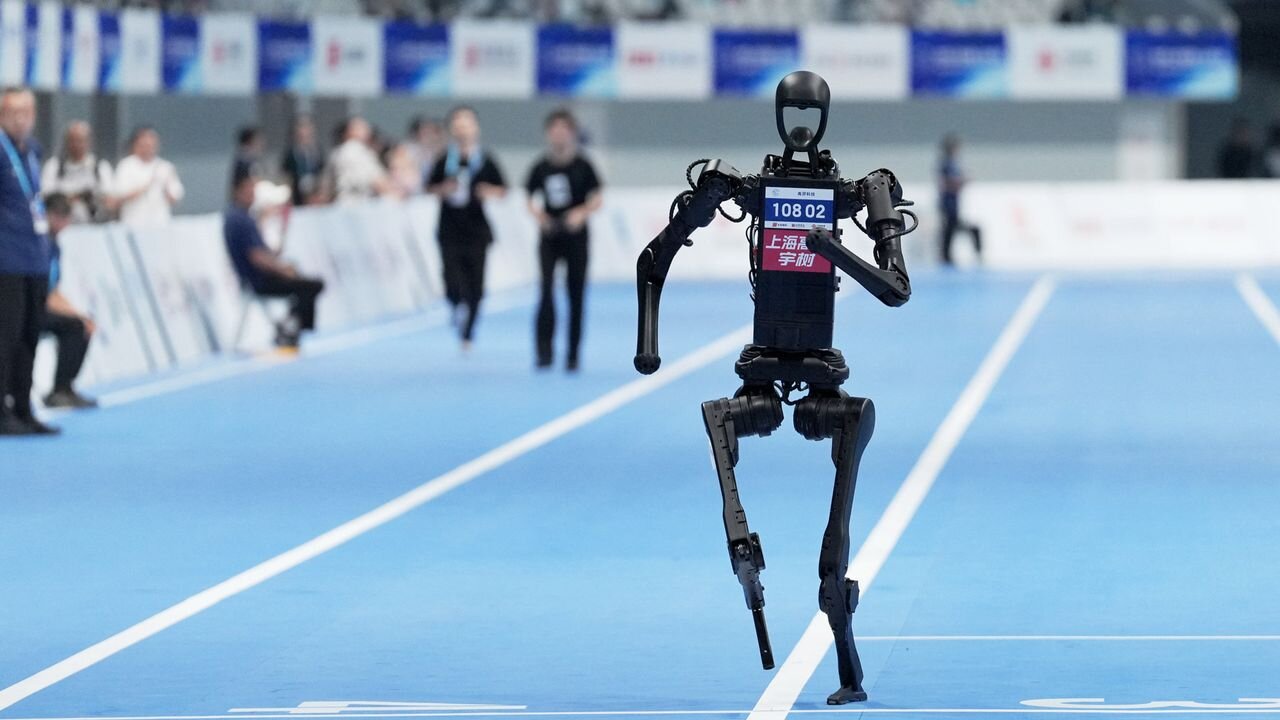
Despite mammoth advanced in artificial intelligence and computer vision, and a slew of humanoid robots either being piloted or hitting parts of the market, there’s still one major challenge that machines need to overcome.
It’s tactility, sensation, knowing how to hold an object. Picking up a strawberry, for example, a robot might not know how much pressure to apply, whether it’s secure, slipping, or about to be crushed. It’s something that we humans can feel through our skin, but it’s much harder to replicate on a machine level.
But it’s a work in progress, because there are companies out there like Touchlab who are working to give these skin-like characteristics to robots in a bid to make them more useful around the home, in care or in manufacturing. And it’s a lot more complex than we could ever imagine.
In Touchlab’s instance, it actually relies on quantum tunnelling technology to measure pressure, force and direction through a material that’s thinner than human skin, and with response times of less than a millisecond.
E-skin technology exists, but deployment is a challenge
Although the solution is laid out on the table, moving from pilot to production is a different ball game. Durability, reliability, affordability, adaptability… they’re all considerations that stand between theory and real-world use cases.
Touchlab is addressing some of these concerns with off-the-shelf components that already exist for established platforms, using bespoke engineering only where necessary.
It’s also seeking to reduce latency by bringing processing to the edge so that the robot only transmits the data necessary for the task, being that the e-skin can detect and collect huge amounts of micro-data.
With robots now rolling out across workplaces, care environments and, likely soon, homes, the ability to sense contact is becoming as important as the ability to see.
I speak with Touchlab’s team to understand how we can go from pilot to production in a realistic way.
Why do robots need the sense of touch, and how is Touchlab trying to achieve this?
Computer vision allows a robot to predict, but touch is what confirms. Without tactile feedback, robotics remains trapped in a classic paradox: a machine can calculate complex equations in milliseconds, yet struggle to pick up a strawberry, handle soft medical instruments, or turn a valve without either crushing the object or dropping it. Without tactile sensing, a robot is functionally numb.
Touchlab solves this by developing biomimetic electronic skin (e-skin) that is actually thinner than human skin. Powered by quantum tunneling technology, our e-skin measures 3D forces, direction, and pressure in real-time. Crucially, it detects incipient slip—meaning the robot senses that an object is beginning to slip before it actually drops, enabling instantaneous, sub-millisecond grip adjustments just like the human nervous system.
I tried the technology at Future Lab... I tried to control a robotic arm with haptic feedback and it felt a bit clunky with cables and restrictions. Why is it so hard to make it smoother?
Teleoperation is a classic engineering balancing act! First, there is a natural learning curve—controlling a high-degree-of-freedom robotic arm through a haptic glove isn't always intuitive on the very first attempt. It usually takes a bit of practice time and muscle memory to get the hang of the subtle force dynamics.
Second, running live demonstrations at high-traffic public events like Future Lab introduces specific hardware constraints. To ensure hundreds of visitors with completely different hand sizes can safely participate, setup requires universal-fit, heavy-duty tethered rigs and robust cabling.
Longer-term, our roadmap moves away from bulky, tethered operator suits entirely. By embedding our e-skin directly onto the robot and pairing it with onboard AI, the robot handles slip detection and dexterity autonomously—removing the need for an operator to wear restrictive physical gear.
Right now, the focus is on your proprietary robot fingertip tech. What's the plan going forward? Do you plan to license it or sell it as a finished product? How will you deal with various robotic architectures?
Every robot platform is unique—whether it’s a humanoid deployed into hazardous industrial environments or a cobot assisting nurses in hospital wards. Touchlab is uniquely positioned to design, develop, and manufacture bespoke tactile devices tailored to specific OEM architectures.
At the same time, we offer scalable, off-the-shelf tactile components that are pre-integrated (both electronically and mechanically) with a wide variety of popular robot end-effectors. We provide volume-based discounts alongside strategic hardware loan and collaboration programs for robotics companies aligned with our vision. Over the past seven years, we have become extremely adept at rapidly building reliable integrations to suit diverse customer requirements.
What are currently the biggest technological barriers Touchlab is encountering? What does the end game look like, and will we ever digitize our largest organ, the skin?
Our ultimate end game is for Touchlab’s tactile technology to become as ubiquitous as MEMS sensors— integrated into every commercial robot interacting with objects and humans. We envision full "finger-to-toe" tactile coverage powered by specialized edge computing and tactile orchestration software that mirrors the human somatosensory system.
Regarding barriers: the challenge isn't just technical; it's navigating western market adoption timelines for deeply transformative hardware. While digitizing human skin at scale presents manufacturing and durability hurdles, Touchlab can already deliver sensors matching or exceeding human-level spatial resolution, readout frequency, and sensitivity. The real task is packaging this capability into rugged, cost-effective formats ready for mass market deployment.
How is Touchlab designing the user interfac...
Indexed and credited by AIPROPX. Originating outlet: TechRadar. Open at source →
An original, deterministic readout — composed only from the computed coverage facts on this page. No interpretation, no rating; figures only.
AIPROPX has consolidated 1 report from 1 outlet into a single canonical entry on “Groundbreaking technology often enters the market at a premium before scaling’: Touch-sensitive e-skin could soon be commonplace….” Every covered outlet is based in Other.
The only timestamped report came from TechRadar (Aug 16, 2026, 09:00 UTC).
2 statements are carried by only one outlet within this set and are not echoed by the others.
Every figure above is a direct count of real published articles. AIPROPX indexes and compares the original reporting — it never rewrites, rates, or editorializes — and each publisher’s full article is always one click away.
Generated by AIPROPX from the source counts above. AIPROPX indexes and resolves coverage; the original publishers are credited and linked at origin in every report.
Coverage from 1 independent outlet across 1 region — each view opens on its own page.
AIPROPX — “Groundbreaking technology often enters the market at a premium before scaling’: Touch-sensitive e-skin could soon be commonplace…” · https://www.aipropx.com/story/222e8bdfd0037d1a4d2a4651d7451855
Other events being covered across multiple sources right now.
El Niño could reshape winter weather and dance with the polar vortex
3 outletsDowntown Laredo Farmers Market vendors now accepting SNAP/EBT
2 outletsVishal Garg, the CEO of Better Home & Finance who fired 900 people on Zoom just before Christmas wants his job back
2 outletsUkraine's own ballistic missiles could strike Russia within months, says former minister
1 outletsWater study could delay commercial construction
27 outletsHurricane Lala leaves one dead as ‘enormous storm’ brings powerful winds and heavy flooding to Hawaii