
RESOLVING THE LEDGER
RESOLVING THE LEDGER
Only one outlet has reported this event so far — you're reading it below, credited to its source. AIPROPX is tracking the web for more coverage; as additional outlets confirm it, this becomes a full multi-source story automatically.
By AIPROPX Editorial Desk · Published · Updated
One outlet is reporting this so far. AIPROPX is tracking it and will gather every additional source as it develops — the full multi-source comparison appears automatically once a second outlet confirms it.
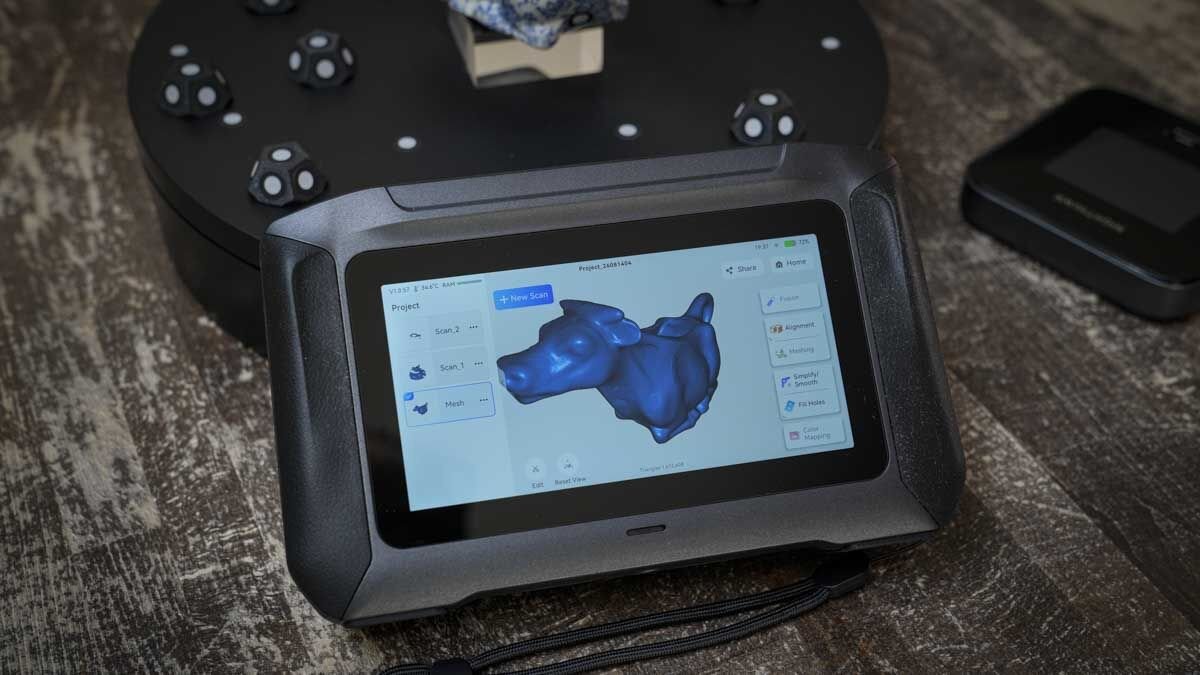
The Creality Sermoon P1 is a handheld 3D scanner and follows similar use lines to the superb Sermoon S1 that I looked at earlier in the year. However, unlike the S1, it can be used in isolation: no wires, no need for a computer; everything needed from the scan to the display is held within one small, portable box.
This includes the initial capture, point-cloud fusion, mesh creation, editing, and multi-scan merging, all of which can be handled on the device, which is impressive considering the amount of data being captured. Inside is an eight-core Qualcomm processor with 24GB of RAM and 256GB of storage, and the scans appear on a six-inch Full HD touchscreen.
The fact that everything is contained makes a difference to the user compared with wired models. When I reviewed the Sermon S1 earlier this year, the biggest limitation I had was the Y-cable connecting the S1 to the computer, especially when I knocked it mid-scan. As the P1 essentially has an onboard computer and no wires, this isn’t an issue.
Of course, this does mean that the P1 is heavier at 830g compared to the S1's 508g, but shaped a little like an oversized game controller, the shape and extra weight really aren’t an issue when you have that freedom to walk around an object without watching out for the cable catching.
Compared with the Sermon S1, the P1 is a complete device with a scanner and screen that lets you see the scanning process without needing to be constantly connected to a computer or a power source.
There are essentially two scanning modes: blue laser with lines that sweep across the object to be scanned and require markers to be stuck to the object, and then IR for objects where markers can’t be stuck; the scanning quality is also a small step up from the S1, although through the test I’d say they were actually pretty much on a par.
Physically, the large game-controller design of the handset, with its two substantial grips, makes it easy to handle, and at 830g, it’s thankfully not to weighty. As the device is completely standalone, it’s powered by a swappable 3,300mAh battery, with the kit including two; each charges to 80% in 50 minutes.
As you scan, everything is shown on the touchscreen, which is bright and responsive. While the screen is glossy and does show reflections, they weren’t too much and remained easy to see throughout scanning.
Like the Sermon S1, the scanning technique was still the sticking point; it was a test. Again, preparation is important to give yourself a good chance of a decent scan, and pumping light into the screen is also key.
Using the blue lasers to scan, after the initial calibration, marker placement, lighting, and placing marker cubes around the object helped with getting a successful scan. So did elevating on transparent blocks, all helped with the success of the scan.
While having everything in the handset is a step forward, the most significant feature here, as with all scanners, is a slow, methodical approach.
Creality Sermoon P1: Price and Availability
The Sermoon P1 is available direct from Creality in the US for $3299 , and in the UK, the Creality store has it in stock for £2799 .
You can also pick up the 3D scanner along with bundled items such as an automatic turntable and scanning markers. Depending on your use-case and workflow, they're well worth checking out.
Creality Sermoon P1: Design
(Image credit: Alastair Jennings)
The P1 features a compact, game controller-like body with a grip on either side and a large touchscreen. The weight is actually pretty modest at 830g, and it feels solid enough with its rubberised plastic exterior, which suggests it was designed for use out in the field as well as in the studio.
The six-inch touchscreen is where things really differ from the other handheld 3D scanners I’ve used, as it lets you control object scanning and editing without a computer connection. However, a data connection is still available if needed.
(Image credit: Alastair Jennings)
Handling the device around an object is easier than with the wired 3D scanner, and the grips make it easy to handle and manoeuvre, although I still find that using a turntable is the best solution.
One of the issues with a wireless handheld device is that the batteries will inevitably drain. Thankfully, Creality has designed this so the battery can be swapped out, with two pinch clips embedded in it that make it relatively easy to remove when needed. More importantly, they lock firmly into place so there is no possibility of the battery coming out at any point.
The feature that I was pleased to see, despite this being a handheld device, is the 1/-inch thread on the base. This means it will fit a rig if you have one and will actually make the whole scanning process far less painful for many objects. I also found that using a turntable is a must for higher-quality scans.
Design: 5/5
Creality Sermoon P1: Features
(Image credit: Alastair Jennings)
Specs
(Image credit: Alastair Jennings)
CPU: Qualcomm eight-core processor, up to 3.36GHz, with FPGA acceleration Graphics: Adreno 740 GPU RAM: 24GB LPDDR5X Storage: 256GB UFS 4.0 Left Ports: USB-C Connectivity: Wi-Fi 7, wired USB-C to PC, wireless PC scanning Audio: Integrated speaker for onboard guidance Camera: Four-lens scanning system with global-shutter RGB colour camera Size: 209 x 129 x 53mm Weight: 830g OS Installed: Creality onboard scanning and mesh-processing software; companion software for Windows and macOS Display: Six-inch Full HD touchscreen, 160-degree viewing angle Battery: Two hot-swappable 3,300mAh batteries, 65W PD 3.0, 80% in 50 minutes Scanning technologies: 22 cross blue laser lines, seven parallel lines, single blue line, dual NIR VCSEL Claimed accuracy: Up to 0.02mm laser, up to 0.075mm NIR Volumetric accuracy: 0.02mm + 0.06mm/m 3D resolution: 0.05- 2 mm blue laser, 0.1- 2 mm NIR Scan volume: 5 x 5 x 5mm up to 4,000 x 4,000 x 4,000mm Maximum speed: Up to 60fps standalone, 100fps connected to a PC
...
Indexed and credited by AIPROPX. Originating outlet: TechRadar. Open at source →
An original, deterministic readout — composed only from the computed coverage facts on this page. No interpretation, no rating; figures only.
AIPROPX has consolidated 1 report from 1 outlet into a single canonical entry on “Creality Sermoon P1 review: This ultraportable handheld 3D scanner let me scan almost any object I wanted.” Every covered outlet is based in Other.
The only timestamped report came from TechRadar (Aug 15, 2026, 06:10 UTC).
Comparing the wording across sources, the phrase recurring most across the coverage is “creality sermoon p1”.
2 statements are carried by only one outlet within this set and are not echoed by the others.
Every figure above is a direct count of real published articles. AIPROPX indexes and compares the original reporting — it never rewrites, rates, or editorializes — and each publisher’s full article is always one click away.
Generated by AIPROPX from the source counts above. AIPROPX indexes and resolves coverage; the original publishers are credited and linked at origin in every report.
Coverage from 1 independent outlet across 1 region — each view opens on its own page.
AIPROPX — “Creality Sermoon P1 review: This ultraportable handheld 3D scanner let me scan almost any object I wanted” · https://www.aipropx.com/story/2da20f1f3cf94411918e266adbbde91c
Other events being covered across multiple sources right now.
Review: 'The End of Oak Street' is a thrilling throwback to the original '90s blockbusters
4 outletsThe X-Files creator Chris Carter wanted to make a more horrific movie
3 outletsRally held outside Madison Square Garden over use of face recognition technology: 'Ban the scan
3 outletsI hope people say I was a good and decent man,' Tim Cook on his post-Apple legacy — and why for him I don't think any other…
3 outletsDell XPS 13 Review: Move Over, Neo
1 outletsAlmost 200 animals rescued from puppy mill