
RESOLVING THE LEDGER
RESOLVING THE LEDGER
Only one outlet has reported this event so far — you're reading it below, credited to its source. AIPROPX is tracking the web for more coverage; as additional outlets confirm it, this becomes a full multi-source story automatically.
By AIPROPX Editorial Desk · Published · Updated
One outlet is reporting this so far. AIPROPX is tracking it and will gather every additional source as it develops — the full multi-source comparison appears automatically once a second outlet confirms it.
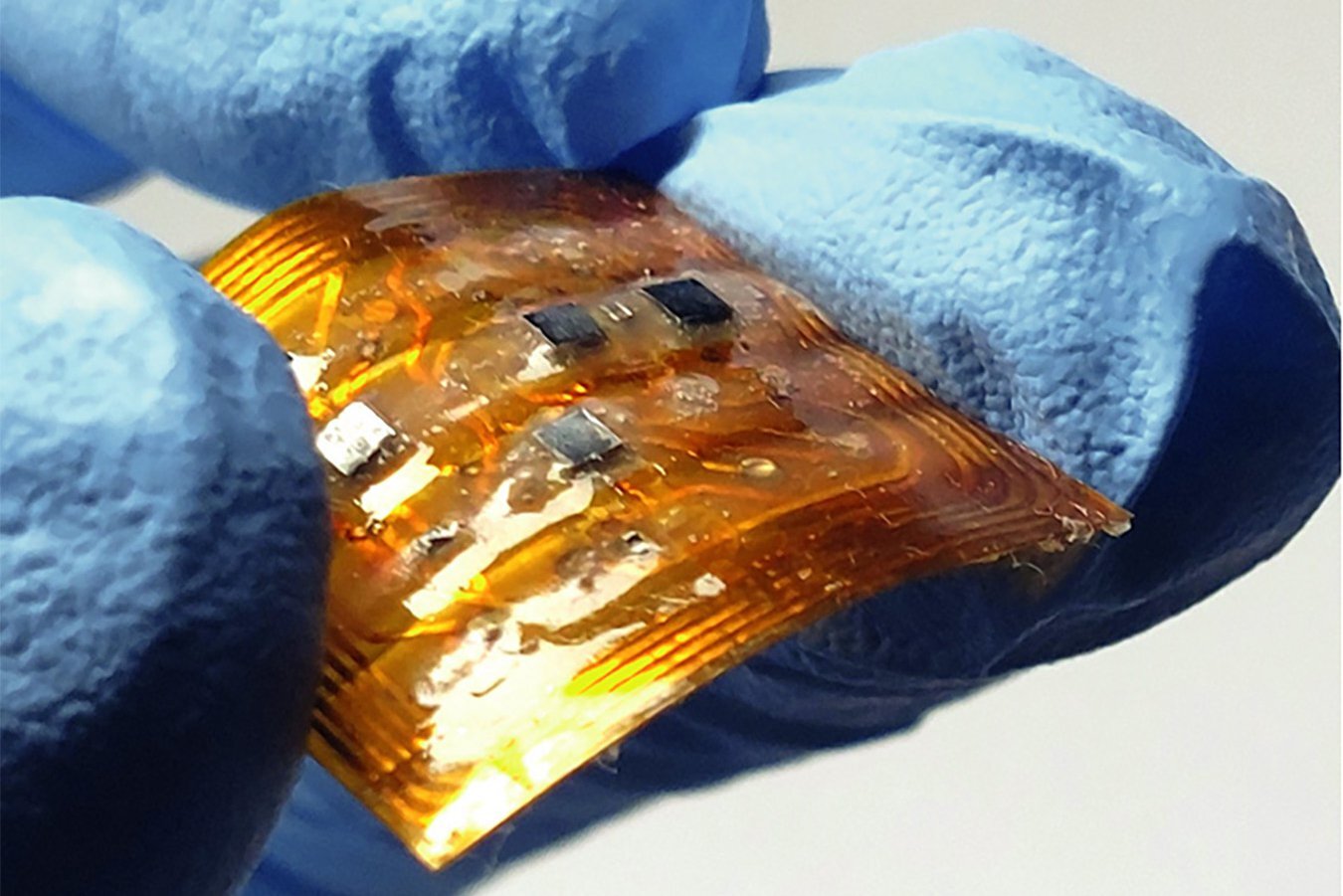
A body sensor inspired by origami could one day be implanted through a tiny incision to track our health in real time. In experiments on rats, the minimally invasive device unfolded beneath their skin to continuously monitor their heart and breathing rates, and scientists expect that a similarly sized implant could work in people.
Implantable sensors already exist, but face a trade-off between size and performance. A relatively large size is generally required to integrate the electronics for wireless power delivery and electrical or electrochemical monitoring. But the new sensor, called MiFi, is folded so it compresses during insertion and then expands beneath the skin into a 2.1 centimetre square that is 0.3 millimetres thick.
"Origami design principles were integral for the development of MiFi as it allowed us to solve one of the most critical optimisation problems within implantable design," says Selin Olenik at Imperial College London.
MiFi monitored the rats’ heart and breathing rates and their body temperature at a similar level of accuracy to a wearable monitor made up of sensors on the skin.
The implant is powered wirelessly via near-field communication, the same technology used for contactless payments, says Olenik. It is made up of different sensing devices, such as an accelerometer that detects tiny chest movements to calculate heart and breathing rates, she says. This information is then transmitted wirelessly to a computer. “This is the first foldable bioelectronic minimally invasive sensor,” says team member Fırat Güder, also at Imperial College London.
Although validated against wearable sensors, the implant outperformed them in terms of stability, says Olenik. “The wearable monitor would intermittently falter and produce non-realistic values."
MiFi also gives us access to interstitial fluid, she says, which is found in the spaces around cells. This contains biomarkers that closely correlate with those in the bloodstream but without the addition of blood-clotting coagulation factors, which can affect sensor performance, says Olenik. “For this reason, MiFi could be used in the future to enable real-time monitoring of chemical markers – e.g., metabolites, enzymes, drugs, antibiotics – that cannot reliably be detected from sweat, for example,” she says.
If eventually tested on people, the implant probably wouldn’t need to be made larger because “the scale of the device is not really determined by the size of the subject, but more by the capabilities of the device itself”, says Olenik.
"The novelty lies in the [device’s] folding and integration," says Ravinder Dahiya at Northeastern University in Massachusetts. It could one day be used to continuously track our health, without being scaled up, but we first need to be sure it works long-term and doesn’t cause harm in people, he says.
Olenik says the next step is longer-term animal studies. The rats in the current study had the device implanted for only about an hour, and while the procedure caused some inflammation, the negative effects of this were “minimal”, she says.
Indexed and credited by AIPROPX. Originating outlet: New Scientist. Open at source →
An original, deterministic readout — composed only from the computed coverage facts on this page. No interpretation, no rating; figures only.
AIPROPX has consolidated 1 report from 1 outlet into a single canonical entry on “Origami-inspired sensor could continuously monitor our vital signs.” Every covered outlet is based in Other.
The only timestamped report came from New Scientist (Jul 30, 2026, 14:01 UTC).
Comparing the wording across sources, the phrase recurring most across the coverage is “continuously monitor”.
1 statement is carried by only one outlet within this set and is not echoed by the others.
Every figure above is a direct count of real published articles. AIPROPX indexes and compares the original reporting — it never rewrites, rates, or editorializes — and each publisher’s full article is always one click away.
Generated by AIPROPX from the source counts above. AIPROPX indexes and resolves coverage; the original publishers are credited and linked at origin in every report.
Coverage from 1 independent outlet across 1 region — each view opens on its own page.
AIPROPX — “Origami-inspired sensor could continuously monitor our vital signs” · https://www.aipropx.com/story/39910f6c3eb3bf5b816af79a1a053f96
Other events being covered across multiple sources right now.
7 Indianapolis bars we wish could have made USA TODAY's Best of 2026
8 outletsJuly full moon delights skywatchers worldwide. Here are our favorite photos of the majestic Buck Moon
3 outlets2026 Love Our Schools CAFÉ Launch happening Friday, July 31
3 outletsUS signs $58.6bn mega deal for Patriot missiles as stock runs low amid Iran war
1 outletsWater study could delay commercial construction
1 outletsWhy this could be Joe Burrow's last year in Cincinnati