
RESOLVING THE LEDGER
RESOLVING THE LEDGER
Only one outlet has reported this event so far — you're reading it below, credited to its source. AIPROPX is tracking the web for more coverage; as additional outlets confirm it, this becomes a full multi-source story automatically.
By AIPROPX Editorial Desk · Published · Updated
One outlet is reporting this so far. AIPROPX is tracking it and will gather every additional source as it develops — the full multi-source comparison appears automatically once a second outlet confirms it.
Luke Tress is The Times of Israel's New York correspondent.
A Jewish legal group filed a brief with the US Supreme Court last week arguing that anti-Zionism can constitute discrimination against Jews, in a legal argument the authors hope will be used in other courts around the US.
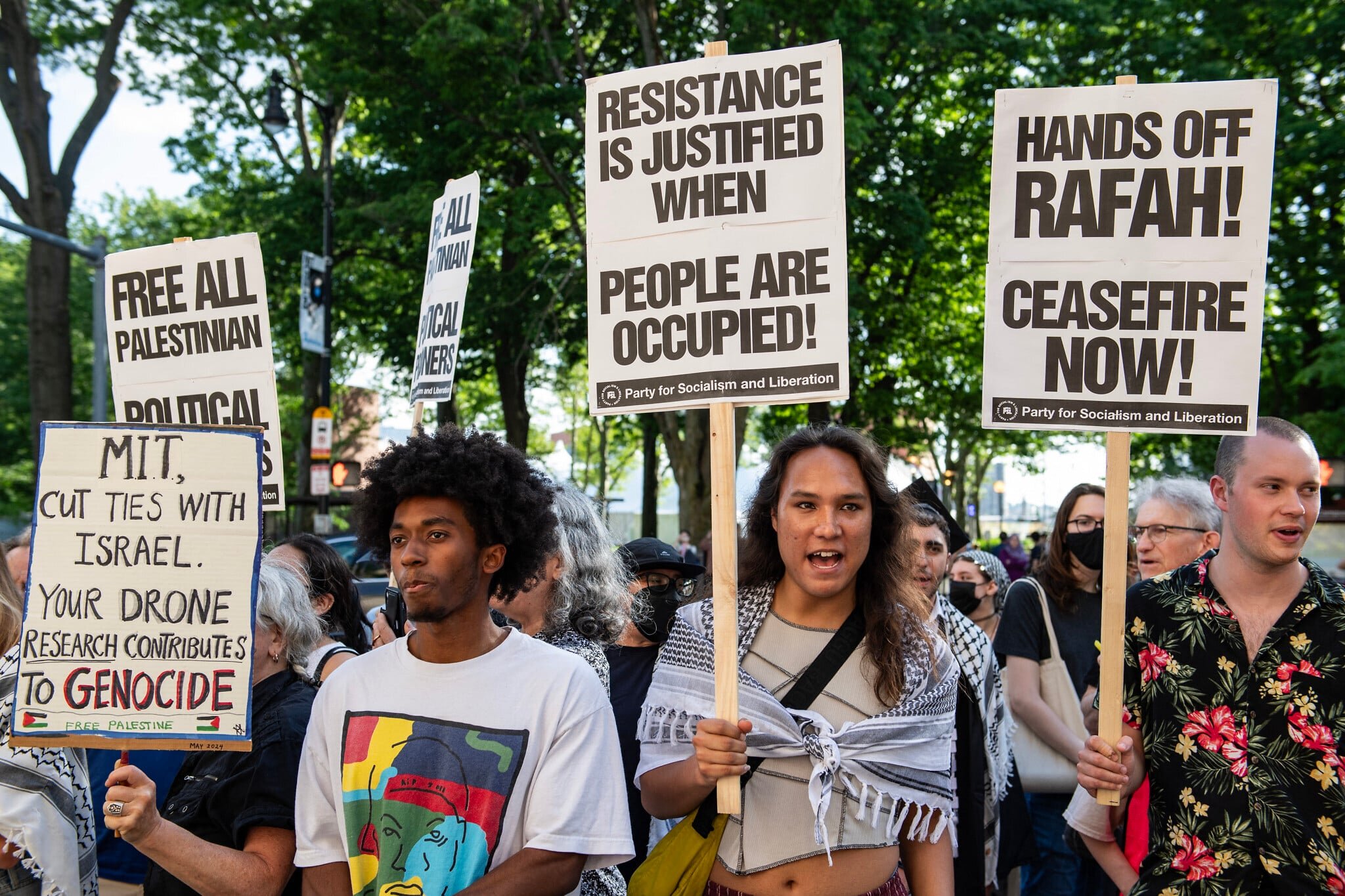
The brief is part of an ongoing legal battle surrounding alleged anti-Jewish discrimination at the Massachusetts Institute of Technology (MIT).
Jewish students, backed by the StandWithUs Center for Legal Justice, in 2024 filed a lawsuit accusing MIT of allowing a hostile educational environment. The case was dismissed later that year, and the federal First Circuit court of appeals upheld the dismissal.
While dismissing the case, the First Circuit court issued an opinion saying that anti-Zionism was not discrimination and that there was no consensus in the scholarship on the matter.
The circuit court said that the Jewish students were "entitled to their own interpretive lens equating anti-Zionism (as they define it) and antisemitism,” but cannot “insist that others must be bound" by their view.
The decision was a blow to Jewish legal groups that had argued anti-Zionism was discriminatory. Legal opponents of the Jewish groups cited the MIT dismissal in cases around the country.
The Center for Jewish Legal Studies, an advocacy group established this year by law professors Rona Kaufman and Andrea J. Martin, filed the amicus brief last Wednesday as part of an appeal against that dismissal.
Cases filed by Jewish groups in recent years have argued that anti-Zionism was discriminatory based on the IHRA definition of antisemitism, or that anti-Zionism was discriminatory because an attachment to Israel is a core value for most Jews. The strategies have met with mixed success.
The Supreme Court brief took a different approach, arguing that anti-Zionism can be direct discrimination due to historical context, citing anti-Zionism's ideological history and anti-Zionist violence.
The brief argued that the circuit court had not accounted for scholarship indicating anti-Zionist movements “have repeatedly served as vehicles for anti-Jewish discrimination and violence" and must be understood within that historical context.
The argument cited past legal decisions regarding discrimination against Black Americans, such as a 2003 Supreme Court case involving the Ku Klux Klan in which justices ruled that burning a cross was not inherently an illegal act of intimidation.
A cross burned on private property before willing participants could be protected expression, but a cross burned on a Black family's lawn could be prosecuted as intimidation, the court said.
The MIT brief argued that, just as cross burnings could be illegal because of "the symbol’s historical association with racial terror," anti-Zionism could be discrimination based on historical context.
Rona Kaufman of the Center for Jewish Legal Studies pointed to anti-Zionist protesters at MIT targeting Jewish students who were mourning shortly after the October 7, 2023, Hamas invasion of Israel.
She said that, if anti-Zionists gathered on their own and "they sing, 'Free Palestine,' they're not committing any crime. They're not bothering anyone."
"But to show up at a Jewish vigil and chant, 'Globalize the intifada,' now we're talking about something else," Kaufman told The Times of Israel. "There are these legal precedents that say context determines whether something is discriminatory, and this argues that the history of this [anti-Zionist] language creates that context, which makes it discriminatory."
While some listeners may interpret the term "intifada" by the word's literal definition, "uprising," for Jews who are familiar with the Second Intifada's mass terrorism will understand the term as threatening, the brief said.
The brief listed a series of violent incidents against Jews that were related to anti-Zionist ideology, such as the deadly firebombing of a rally for Israeli hostages in Colorado last year, saying Jewish MIT students had reason to fear the campus rhetoric.
The Colorado firebomber shouted , "End Zionists," during the attack, and afterward told investigators that he wanted to "kill all Zionist people."
The brief stated that definitions of anti-Zionism vary, that criticism of the Israeli government and Zionism are not necessarily antisemitic, and that not every person who endorses anti-Zionism discriminates against Jews.
The argument defined anti-Zionism and cited scholarship into its origins, arguing its influences include Islamist, Nazi and Soviet ideologies that have resulted in historical persecution against Jews.
The definition leaned on a growing academic movement to study anti-Zionism and to treat the ideology as a form of hatred against Jews.
Anti-Zionists, including Jews, say the ideology is motivated by concern for Palestinians and is purely political, and therefore not discriminatory. Civil rights protections in the US cover protected groups based on national origin, religion, race, and sex, but do not cover political views.
The legal brief is part of an evolving legal struggle, waged by both pro- and anti-Israel advocacy groups, in courtrooms across the US over alleged discrimination at universities, workplaces, and public venues.
It is unclear whether the Supreme Court will decide to hear the case, and if it does, the court will not issue a statement declaring that anti-Zionism is discrimination. The authors hope, though, that the court will take the argument into consideration and that it will be used elsewhere in the US, Kaufman said.
"The hope is that this legal argument will become a dominant legal argument in civil rights litigation across the country," she said.
The war with Iran has been draining for all of us in Israel. But when I heard about a high casualty incident – ballistic missile impacts in Arad and Dimona that left nearly 200 people wounded – I drank a cup of coffee, packed a bag, and headed south.
There,...
Indexed and credited by AIPROPX. Originating outlet: The Times of Israel. Open at source →
An original, deterministic readout — composed only from the computed coverage facts on this page. No interpretation, no rating; figures only.
AIPROPX has consolidated 1 report from 1 outlet into a single canonical entry on “Legal brief asks US Supreme Court to consider anti-Zionism potential discrimination.” Every covered outlet is based in Middle East.
The only timestamped report came from The Times of Israel (Jul 27, 2026, 18:42 UTC).
Comparing the wording across sources, the phrase recurring most across the coverage is “consider anti zionism potential discrimination”.
1 statement is carried by only one outlet within this set and is not echoed by the others.
Every figure above is a direct count of real published articles. AIPROPX indexes and compares the original reporting — it never rewrites, rates, or editorializes — and each publisher’s full article is always one click away.
Generated by AIPROPX from the source counts above. AIPROPX indexes and resolves coverage; the original publishers are credited and linked at origin in every report.
Coverage from 1 independent outlet across 1 region — each view opens on its own page.
AIPROPX — “Legal brief asks US Supreme Court to consider anti-Zionism potential discrimination” · https://www.aipropx.com/story/3d2684a44b548be4f0f828d80276f98e
Other events being covered across multiple sources right now.
Trump asks Supreme Court to step into dispute over mail-in ballot executive order
3 outletsCourt rules Shekarchi can serve on state Supreme Court
5 outletsOutside Tate brothers’ court hearing
4 outletsD4vd murder case: Court says Celeste Rivas allegedly threatened singer
4 outletsTrump suffers another loss in US appeals court fight over federal voter list
3 outletsFinal texts from 14-year-old girl to singer D4vd shown in court at hearing on her killing