
RESOLVING THE LEDGER
RESOLVING THE LEDGER
Only one outlet has reported this event so far — you're reading it below, credited to its source. AIPROPX is tracking the web for more coverage; as additional outlets confirm it, this becomes a full multi-source story automatically.
By AIPROPX Editorial Desk · Published · Updated
One outlet is reporting this so far. AIPROPX is tracking it and will gather every additional source as it develops — the full multi-source comparison appears automatically once a second outlet confirms it.
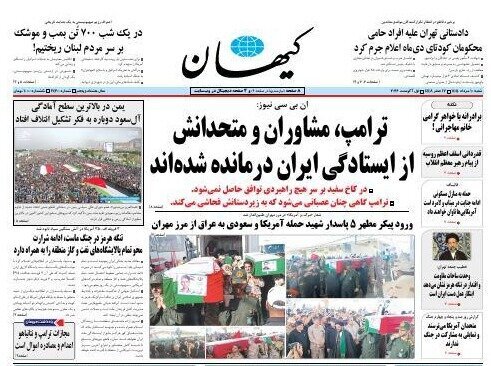
Kayhan analyzed Iran’s surprise attack on Jordan. According to Kayhan, Iran’s pre‑emptive strike on US military logistics in Jordan completely surprised Washington and Tel Aviv’s think tanks, forcing Trump to admit that “Iran’s attack was unexpected.” Kayhan describes the strike as a smart blow that once again showcased Iran’s superior position and battlefield initiative to the world.
In global politics, events are always shaped by the real balance of power on the ground. For years, the United States—relying on its media empire and the hollow prestige of its military machine—tried to shape regional dynamics through threats, sanctions, and unilateral attacks. But Iran’s pre‑emptive strike on US forces in Jordan, Kayhan argues, marked the end of this imposed doctrine and disrupted Washington and Tel Aviv’s strategic calculations. The attack, they claim, proved that battlefield initiative lies with the courageous commanders of Iran’s armed forces.
The Iran newspaper wrote that the foreign minister’s intensive consultations with his counterparts in both East and West show Tehran’s simultaneous effort to contain the crisis on the battlefield while managing it through diplomacy. On one side, mediators are trying to revive implementation of the Iran–US memorandum of understanding; on the other, Tehran and Muscat are negotiating a joint mechanism to manage traffic in the Strait of Hormuz. Despite accelerated diplomatic efforts, diplomacy has not yet prevented the crisis from returning to the battlefield, and even as diplomatic contacts continue, the scope of clashes has expanded again. Tehran’s condition for reopening Hormuz has become the central issue among all the files simultaneously on the diplomatic and military tables. As exchanges of fire continue, competition over designing a mechanism to manage this strategic waterway has entered a new phase and become the main focus of talks between Tehran and Muscat.
In an interview with Etemad, international affairs expert Majid Mohammad‑Sharifi assessed Netanyahu’s trip to Washington and the regional outlook. He argues that Netanyahu is trying to convince Trump that the previous war did not eliminate Iran’s nuclear program and that a new attack is necessary. Meanwhile, Trump’s short‑term goal is reopening the Strait of Hormuz, and he seeks to force Iran to do so through a mix of military threats and economic pressure. Netanyahu believes he can still persuade Trump to launch a new strike on Iran—provided he can present a convincing picture of Iran’s nuclear threat. How Trump connects the goal of reopening Hormuz with Iran’s nuclear program depends on the US military posture in the region and the outcome of possible negotiations with Iran and Oman. According to Mohammad‑Sharifi, the current US posture signals preparation for a large‑scale military action, though a temporary agreement on Hormuz could, at least in the short term, prevent such an operation.
Ettelaat: Is a limited war with America better for Iran, or a fragile peace?
Ettelaat analyzed the reasons behind Iran’s missile strike on the US base in Jordan. At first glance, explaining Iran’s surprise attack seemed difficult. The strike effectively ended the fragile pause in direct US –Iran confrontation and prompted Washington to resume attacks inside Iran. It appears Iran is trying to reshape the diplomatic debate. Instead of accepting unrestricted freedom of navigation, Tehran has repeatedly stated that shipping must operate under rules agreed with Iran or administered by Iran. If this interpretation is correct, Tehran’s goal may be to ensure that any future reopening of the Strait of Hormuz reflects Iranian influence—not a return to pre‑war conditions. A limited, ongoing confrontation allows Iran to maintain pressure toward this goal. From Tehran’s perspective, keeping the crisis alive below the threshold of full‑scale war may be preferable to accepting a ceasefire that leaves sanctions, blockade, and economic isolation largely unchanged.
Farhikhtegan: Saudi Arabia’s escape — from Hormuz to the Bab al‑Mandab dead end
Farhikhtegan evaluated the closure of the Bab al‑Mandab Strait to Saudi Arabia by the Houthis. They argue that shutting Bab al‑Mandab to Saudi shipping affects the global oil market in two ways: is Ansarullah targeting the Yanbu port, or the Bab al‑Mandab route itself? In reality, Ansarullah has the tools and capability for both scenarios, either of which could push the global oil market into a period of reduced supply—lasting until alternative routes are found or the market adapts. The global market is now facing a situation with no precedent: simultaneous disruption in both the Strait of Hormuz and Bab al‑Mandab, while China’s behavior remains uncertain. From a timing perspective, such an event is strategically more favorable for Iran now than two or three months ago, because today’s global oil market is more vulnerable to supply and transport shocks.
Indexed and credited by AIPROPX. Originating outlet: Tehran Times. Open at source →
An original, deterministic readout — composed only from the computed coverage facts on this page. No interpretation, no rating; figures only.
AIPROPX has consolidated 1 report from 1 outlet into a single canonical entry on “America was caught off guard.” Every covered outlet is based in Middle East.
The only timestamped report came from Tehran Times (Aug 1, 2026, 17:53 UTC).
1 statement is carried by only one outlet within this set and is not echoed by the others.
Every figure above is a direct count of real published articles. AIPROPX indexes and compares the original reporting — it never rewrites, rates, or editorializes — and each publisher’s full article is always one click away.
Generated by AIPROPX from the source counts above. AIPROPX indexes and resolves coverage; the original publishers are credited and linked at origin in every report.
Coverage from 1 independent outlet across 1 region — each view opens on its own page.
AIPROPX — “America was caught off guard” · https://www.aipropx.com/story/41f5e92f4e40bb1f2966f311f8866f60
Other events being covered across multiple sources right now.
Who says girls can't play baseball?': America's pastime goes pro for women
3 outletsFlorida Evangelist Kicked Off Alaska Airlines Flight for Preaching During Delay
3 outletsNew York building collapse caught on camera
3 outletsSound Off: July 31, 2026
1 outletsMother fends off raccoon from daughter
1 outletsDrake Baldwin leads off again, facing the righty Miles Mikolas