
RESOLVING THE LEDGER
RESOLVING THE LEDGER
Only one outlet has reported this event so far — you're reading it below, credited to its source. AIPROPX is tracking the web for more coverage; as additional outlets confirm it, this becomes a full multi-source story automatically.
By AIPROPX Editorial Desk · Published · Updated
One outlet is reporting this so far. AIPROPX is tracking it and will gather every additional source as it develops — the full multi-source comparison appears automatically once a second outlet confirms it.
A non-profit newsroom, powered by WNYC. Gothamist Listen Live Donate News What is the real cost of NYC's Second Avenue subway extension? Depends who you ask. By Clayton Guse Published Aug 21, 2026 at 11:25 a.m. ET
Twitter Reddit Email Never miss a story Email address By submitting your information, you're agreeing to receive communications from New York Public Radio in accordance with our Terms . By Clayton Guse Published Aug 21, 2026 at 11:25 a.m. ET
Twitter Reddit Email We rely on your support to make local news available to all Make your contribution now and help Gothamist thrive in 2026. Donate today
Gothamist is funded by sponsors and member donations
This column originally appeared in On The Way, a weekly newsletter covering everything you need to know about NYC-area transportation.
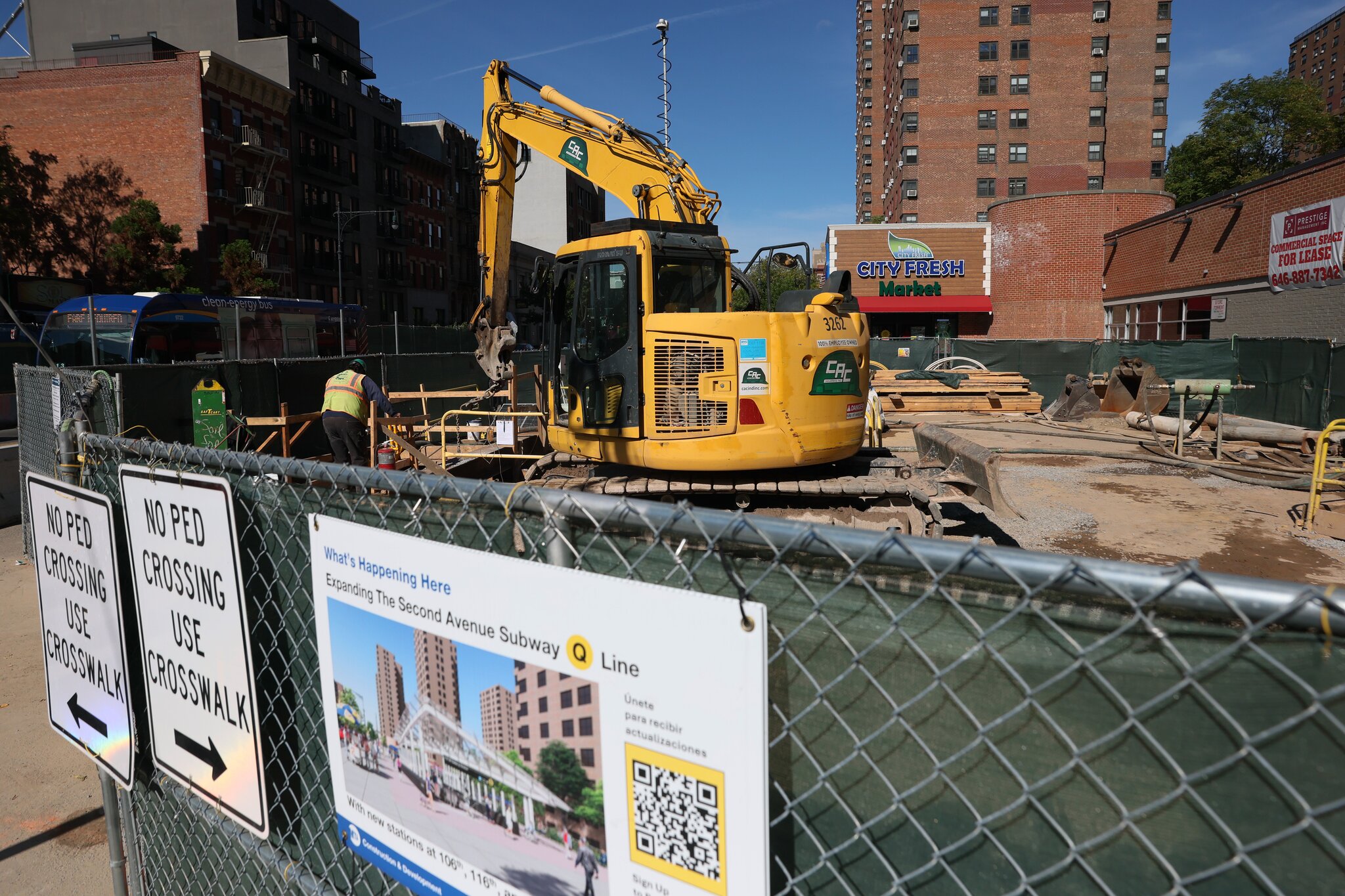
The Second Avenue subway extension is slated to be one of the most expensive projects of its kind in the history of the world — but exactly how much it’s expected to cost has been a source of confusion among eagle-eyed followers of mass transit in New York.
In press releases , the MTA states it’ll cost $6.9 billion. But in federal reporting documents, the U.S. Department of Transportation puts it at $7.7 billion — a number this newsroom and other media outlets have reported .
The discrepancy is worth interrogating. Doing so helps taxpayers and transit riders understand exactly how their money is used to fund some of New York’s biggest public works projects.
Records show the difference is $731 million in financing costs the MTA estimates it will pay as part of the project. The agency plans to take on debt by issuing bonds to cover part of the cost. The financing charges, which are still paid by the taxpayers, cover the interest and fees paid to the banks and bondholders that lend the agency capital.
Ultimately, 10% of the $7.7 billion in taxpayer money earmarked for the project will go to banks and bondholders.
MTA leaders insist they're being transparent about the true cost of the Second Avenue subway by not including the financing charges in their price tag.
“That’s like buying a car for $23,000 and telling friends that you own a $32,000 vehicle because you add in the cost of payments on a six-year car loan,” MTA spokesperson Tim Minton wrote in a statement.
Eric Goldwyn, a researcher at NYU who studies the cost of transit construction around the world, said the public ought to be aware that the MTA expects to spend $731 million in financing fees in order to build the Second Avenue subway extension. He also said the MTA should try to avoid taking on debt for its projects in general.
“You talk to any sort of responsible fiduciary they’re going to say, ‘Hey, don’t take on credit card debt,’” said Goldwyn.
The accounting for the project is complicated. The $6.9 billion price the MTA reports for the Second Avenue subway is what the agency pays out of its long-term capital budget. The remaining $731 million in financing fees is paid out of the MTA’s yearly operating budget. Both are still covered by the public. (Roughly $3.2 billion — or 14% — of the agency's $22.8 billion operating budget for 2026 is used to pay debt service.)
The feds, which have agreed to cover $3.4 billion of the project’s cost, said they don’t really care which of the two numbers is used to report the project’s costs.
Even though the MTA doesn’t consider the financing charges as part of the project’s overall costs, the agency still cited the $7.7 billion price tag in a financial disclosure document published last month. “The revised FTA (Federal Transit Administration) cost estimate also includes $731 million in finance costs that are not part of the capital cost of the project and are paid out of the MTA’s operating budget. As such, the full FTA cost estimate for Second Avenue subway Phase 2, between capital and operating, is $7.699 billion,” the agency wrote.
Minton, the MTA spokesperson, said there’s no guarantee the agency will actually end up paying that much in financing fees.
Unlike the Second Avenue subway extension, the price tags of other megaprojects touted by New York officials do include financing costs. Gov. Kathy Hochul has reported the cost of the Gateway project — which is building a set of new rail tunnels beneath the Hudson River — at $16 billion. That figure includes an estimated $1.4 billion in financing costs, according to federal documents .
Minton said that’s not a fair comparison because the Gateway project doesn’t have a separate annual operating budget from which it can pay financing fees.
The MTA continues to charge ahead with the subway extension.
The agency’s board has approved three of the four major construction contracts planned for the work, and is preparing to launch a massive boring machine in East Harlem with the goal of opening service to the three new Q line stations in 2032.
The MTA reports the work is on time, and on budget.
The federal government has a more skeptical view.
The independent firm overseeing the project for the feds in August noted delays in early work to relocate utilities for the subway extension could increase the project’s cost “primarily due to price escalation.”
The springs between subway cars. While they’re designed to keep visually impaired riders from falling onto the tracks, they keep injuring transit workers, according to an internal MTA memo. When train sets are decoupled at subway yards, crews have to remove and reconnect the supersized coils — and sometimes they snap back in a scene that resembles something out of “Looney Tunes.”
Where are the electric buses? A new audit by state Comptroller Thomas DiNapoli says the MTA’s plan to convert its fleet of 5,700 buses to electric vehicles by 2040 has already fizzled .
East River tunnel rehab. Amtrak this week wrapped up a 15-month rehabilitation of one of its East River train tunnels, completing the first phase of a project that’s drawn criticism from MTA officials because of its effect on Long...
Indexed and credited by AIPROPX. Originating outlet: Gothamist. Open at source →
An original, deterministic readout — composed only from the computed coverage facts on this page. No interpretation, no rating; figures only.
AIPROPX has consolidated 1 report from 1 outlet into a single canonical entry on “What is the real cost of NYC's Second Avenue subway extension? Depends who you ask..” Every covered outlet is based in Other.
The only timestamped report came from Gothamist (Aug 21, 2026, 15:25 UTC).
2 statements are carried by only one outlet within this set and are not echoed by the others.
Every figure above is a direct count of real published articles. AIPROPX indexes and compares the original reporting — it never rewrites, rates, or editorializes — and each publisher’s full article is always one click away.
Generated by AIPROPX from the source counts above. AIPROPX indexes and resolves coverage; the original publishers are credited and linked at origin in every report.
Coverage from 1 independent outlet across 1 region — each view opens on its own page.
AIPROPX — “What is the real cost of NYC's Second Avenue subway extension? Depends who you ask.” · https://www.aipropx.com/story/4c671e1e5e7626b672f7c02c4674ec36
Other events being covered across multiple sources right now.
Can you use a satellite dish as a free TV antenna? It depends where you live
4 outletsNvidia Earnings Preview: What's Needed To Drive Nvidia Stock Higher?
4 outletsTexas cities among 2026 best US real estate markets
4 outletsUS Army confirms it's offering 4 days to play GTA 6 to soldiers who reenlist for at least 2 years
3 outletsWhat time does The Duskbloods network test start in your time zone?
3 outletsWhat’s Happening to the WNBA Isn’t Normal