
RESOLVING THE LEDGER
RESOLVING THE LEDGER
Only one outlet has reported this event so far — you're reading it below, credited to its source. AIPROPX is tracking the web for more coverage; as additional outlets confirm it, this becomes a full multi-source story automatically.
By AIPROPX Editorial Desk · Published · Updated
One outlet is reporting this so far. AIPROPX is tracking it and will gather every additional source as it develops — the full multi-source comparison appears automatically once a second outlet confirms it.
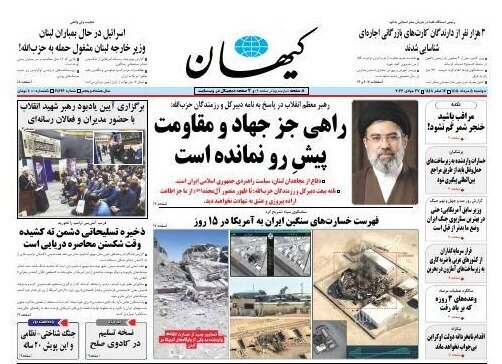
Kayhan published an article assessing Iran’s high level of resilience and power since the start of the war. The paper writes that none of the enemy’s objectives have been achieved. Not only has there been no political, military, economic, or social collapse, but—according to Kayhan—an unprecedented defeat in eighty years has been imposed on the United States.
The article says many Western analysts now describe Iran as the world’s fourth superpower—not merely the leading power of the region. Kayhan acknowledges Iran’s internal problems, saying they cannot be ignored and must be resolved, yet argues that despite foreign sanctions and domestic self‑imposed restrictions, Iran has endured the “hybrid war” and inflicted a major defeat on its adversaries. The paper emphasizes the decisive role of Iran’s armed forces, but adds that military strength alone would not have been enough without the resilience and support of other sectors. It asks whether the military could have resisted on its own to the point that the enemy is now requesting a ceasefire and an end to the war.
Siasat-e-Rooz: There is no second Strait of Hormuz
In its editorial, Siasat-e-Rooz highlights the vital strategic importance of the Strait of Hormuz and Iran’s control over it. The paper argues that the United States seeks dominance in the Persian Gulf, but there is no alternative to the Strait of Hormuz—the only entry and exit point for this critical waterway, which lies under Iran’s authority. Losing control of the Strait, it says, would be extremely costly for Iran. According to the editorial, Washington launched the war hoping to seize control of the strait, but Iran’s armed forces disrupted all US and Israeli calculations and prevented them from achieving their goals. The paper warns that if the Strait is reopened solely through diplomacy and Iran loses oversight or authority over it, the United States would emerge as the winner.
Javan: Iran does not trust the United States
Javan analyzes the halt in US attacks after thirteen days. According to the paper, the US ambassador to the UN said the pause is meant to give diplomacy a chance to reach an agreement on how the situation should be managed. American sources, Javan reports, have revealed that declining US air‑defense stockpiles prompted senior military officials to warn Donald Trump about continuing or escalating confrontation with Iran. Axios reported Saturday night that Trump ordered the military to pause new strikes until it becomes clear whether diplomatic progress is possible. Whether negotiations will succeed remains uncertain. After nearly five months of war, tension, and confrontation—and after a fragile agreement that was implemented briefly and then halted—Tehran has become deeply distrustful of Washington’s intentions regarding the ceasefire and diplomatic processes.
Donya‑e‑Eqtesad: Bab al‑Mandab in the deterrence equation
Donya‑e‑Eqtesad examines the closure of Bab al‑Mandab as the second link in a chain of pressure. With the Iran–US war turning the Strait of Hormuz into the epicenter of an energy and maritime‑security crisis, Bab al‑Mandab is now emerging as another geopolitical pressure point. Foreign Policy recently analyzed the Houthis’ declaration of a naval blockade on Saudi Arabia, calling it a new stress point for global energy markets—already strained by disruptions in Hormuz. The significance of the analysis, the paper notes, is that it views the Bab al‑Mandab threat not as an independent crisis but as an extension of the Hormuz crisis. If Hormuz is the eastern chokepoint for energy exports, Bab al‑Mandab could become the second link in the same chain.
Sazandegi: We must use the capacity of diplomacy
Sazandegi, in a commentary, discussed the importance of continuing negotiations and diplomacy in this unstable environment in order to reach a more stable situation. According to the paper, although direct clashes have decreased in recent weeks—and countries such as Pakistan, China, Qatar, and others are trying to revive dialogue between Tehran and Washington—there is no guarantee that this fragile calm will not escalate into a larger crisis. This reality, the paper argues, makes preserving diplomatic channels even more essential. Today, more than ever, Iran needs active, realistic, and forward‑looking diplomacy. The greatest lesson of the forty‑day war, Sazandegi writes, may be that military power and diplomacy are not rivals but complements. A country capable of defending itself can negotiate with greater confidence. Now is the time, the paper argues, to use this capacity in service of peace, economic reconstruction, and rebuilding social trust. Iran’s future will be shaped less by continued confrontation and more by its ability to convert deterrent power into diplomatic and economic opportunities.
Indexed and credited by AIPROPX. Originating outlet: Tehran Times. Open at source →
An original, deterministic readout — composed only from the computed coverage facts on this page. No interpretation, no rating; figures only.
AIPROPX has consolidated 1 report from 1 outlet into a single canonical entry on “Iran’s power has brought the enemy to its knees.” Every covered outlet is based in Middle East.
The only timestamped report came from Tehran Times (Jul 27, 2026, 17:37 UTC).
2 statements are carried by only one outlet within this set and are not echoed by the others.
Every figure above is a direct count of real published articles. AIPROPX indexes and compares the original reporting — it never rewrites, rates, or editorializes — and each publisher’s full article is always one click away.
Generated by AIPROPX from the source counts above. AIPROPX indexes and resolves coverage; the original publishers are credited and linked at origin in every report.
Coverage from 1 independent outlet across 1 region — each view opens on its own page.
AIPROPX — “Iran’s power has brought the enemy to its knees” · https://www.aipropx.com/story/711fd6990b0835766e3a387fe9b5912d
Other events being covered across multiple sources right now.
How the Iran-Backed Houthis Cornered Saudi Arabia Into a New Conflict
5 outletsHas AI reached the singularity? What smart people are saying about Sam Altman's claim
3 outletsWar on Iran: Phase II: Day 16
3 outletsNetanyahu says Iran is top of agenda in meeting with Trump
10 outletsOil Prices Sink After U.S. and Iran Pause Fighting a Second Day
4 outletsPentagon Changes How It Reports Casualties in Iran War