
RESOLVING THE LEDGER
RESOLVING THE LEDGER
Only one outlet has reported this event so far — you're reading it below, credited to its source. AIPROPX is tracking the web for more coverage; as additional outlets confirm it, this becomes a full multi-source story automatically.
By AIPROPX Editorial Desk · Published · Updated
One outlet is reporting this so far. AIPROPX is tracking it and will gather every additional source as it develops — the full multi-source comparison appears automatically once a second outlet confirms it.
Imagine a world where the most powerful weapon isn't a missile, but a software update. In less than 72 hours, a software engineer can patch a drone on the front line and turn an enemy's multi-million-dollar electronic warfare system into little more than expensive scrap.
This isn't science fiction but an everyday reality inside Ukraine’s real-time military tech pipeline. Driven by the necessity of national survival, a decentralized network of coders, startup founders, and makers has bypassed decades of slow defense bureaucracy.
At the heart of this transformation is Brave1 , Ukraine's defense innovation engine, where software developers, startups, soldiers, and investors collaborate at startup speed to solve battlefield problems. In the newly launched Brave1 Market , an ecommerce-style procurement catalog, combat success earns digital "ePoints," public rankings fuel competition, and rewards are reinvested into even more powerful technology.
It’s no surprise that Brave1’s success has attracted global attention, with aerospace giant Airbus partnering with the platform to connect aerospace expertise with this next-gen defense ecosystem. Also backed by big-data titan Palantir , the new Brave1 Dataroom acts as a secure data pipeline, streaming raw battlefield video and thermal imagery directly to developers training AI targeting models.
Now, we can forget all about old-school defense programs and endless procurement cycles. The future of warfare is open source, software-defined, and moving at the warp speed of a Silicon Valley startup.
Why traditional military tech procurement is failing
The traditional model of military procurement is running on outdated code. For over half a century, the Western defense industry has been building bigger, better, and increasingly expensive "exquisite beasts" - fighter jets, aircraft carriers, and heavy armor, each taking a decade to design and deploy.
Under this system, the pipeline is painfully slow. Governments can spend years defining specifications, years selecting contractors, and years more building the hardware.
By the time it reaches the battlefield, the software inside is often two decades out of date and locked behind proprietary code that can't be modified without years of legal renegotiations. As The Wall Street Journal recently reported, traditional defense structures struggle to absorb the rapid pace of software and startup-led innovation.
This peacetime bureaucracy is breaking under the speed of modern warfare. Today's battlefield is defined less by firepower than software, where an overnight update can render even the most sophisticated missile system obsolete. Legacy defense structures simply can’t cut it for software-speed innovation. They prioritize caution and consensus, while modern defense tech is designed for speed and to survive battlefield surprises.
At its core, the old defense playbook presumes weapons are built once and fielded for decades later. But when a new battlefield threat emerges, waiting a year or two for a budget committee to approve a software patch is a recipe for defeat.
Modern warfare demands systems that can evolve every day. By decoupling software from hardware, these defense ecosystems empower thousands of developers to adapt faster than any centralized procurement committee ever could. At the forefront of this transformation is Brave1, Ukraine's open source tech cluster.
What is Brave1?
If traditional defense procurement is a labyrinth of government departments and endless paperwork, Brave1 is the system built to bypass it. Co-founded by multiple Ukrainian ministries, including Digital Transformation, Defense, and Strategic Industries, this platform gives anyone with a laptop and a promising idea a path to the battlefield. It brings developers, startups, investors, and soldiers into a continuous deployment cycle.
In the old-school defense world, getting a new, innovative idea in front of the right people takes months. Brave1 acts as a secure, digitized buffer zone where developers upload their designs or code, pass automated and expert reviews, and connect directly to the problems facing Ukraine’s military.
Once a project clears Brave1’s gateway, it receives an official security rating, gets access to the centralized technology registry, and can scale research and development (R&D) grants reaching up to eight million UAH to fast-track production.
However, this high-speed model comes with its own set of challenges. When hundreds of teams are sprinting to solve battlefield problems, some will run along parallel paths, spreading funding and talent across versions of similar technology. The result is a risk of fragmented resources spread across an ecosystem built for speed and experimentation.
Still, by swapping endless military paperwork for the automated Brave1 Market, the platform ensures that promising ideas don't get stuck in red tape.
Inside Brave1’s expanding innovation network
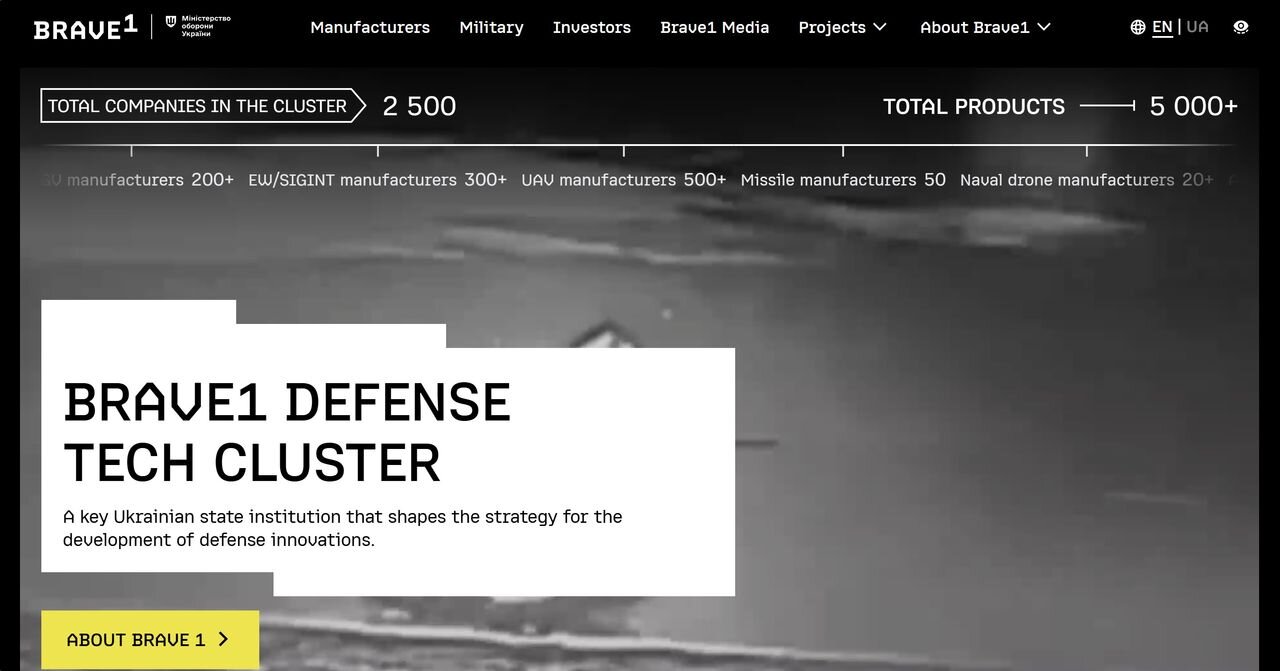
The speed at which Brave1 has grown turns traditional defense economics entirely on its head. What started as a bold innovation hub has evolved into a full-scale defense technology engine. Today, Brave1 brings together more than 3,200 registered companies and actively tracks over 4,500 products moving through its secure development pipeline.
Yet innovations don't win wars unless they can be implemented. Rather than relying on sluggish defense grant cycles, Brave1 has awarded 500 direct innovation grants totaling over $11 million, putting funding directly into the hands of frontline engineers and hardware startups. This pipeline is designed to bridge the notorious hardware "valley of death," where many promising technologies traditionally run out of money.
(Image credit: Brave1)
The technology verticals that are reshaping the front line
Instead of focusing on billion-dollar missiles or heavy armored vehicles, Brave1 targets technologies that are reshaping modern warfare. Its product catalog spans a wide scope of...
Indexed and credited by AIPROPX. Originating outlet: TechRadar. Open at source →
An original, deterministic readout — composed only from the computed coverage facts on this page. No interpretation, no rating; figures only.
AIPROPX has consolidated 1 report from 1 outlet into a single canonical entry on “Brave1 and the open source future of war.” Every covered outlet is based in Other.
The only timestamped report came from TechRadar (Jul 28, 2026, 17:05 UTC).
Comparing the wording across sources, the phrase recurring most across the coverage is “open source”.
2 statements are carried by only one outlet within this set and are not echoed by the others.
Every figure above is a direct count of real published articles. AIPROPX indexes and compares the original reporting — it never rewrites, rates, or editorializes — and each publisher’s full article is always one click away.
Generated by AIPROPX from the source counts above. AIPROPX indexes and resolves coverage; the original publishers are credited and linked at origin in every report.
Coverage from 1 independent outlet across 1 region — each view opens on its own page.
AIPROPX — “Brave1 and the open source future of war” · https://www.aipropx.com/story/764e28268407da56447e4138e0a89e23
Other events being covered across multiple sources right now.
Ukraine-Russia war latest: Zelensky hails ‘good meeting’ with Trump as presidents discuss Patriot missile production
3 outletsNvidia launches Open Secure AI Alliance — but there's no room for OpenAI, Anthropic or Google
1 outletsBrandon McGinley: What city gardens teach us about life, land and the future
1 outletsGod Of War Laufey Actor Says The Love Between Kratos And Fey Is Like ‘A Soul Finding Its Own Reflection In Another
1 outletsBiological War’ TV Adaptation in the Works at Universal Global Television and Patrick Macmanus’ Littleton Road Productions…
21 outletsWatch Live: Trump calls Graham "beloved friend" and "American original" in eulogy