
RESOLVING THE LEDGER
RESOLVING THE LEDGER
Only one outlet has reported this event so far — you're reading it below, credited to its source. AIPROPX is tracking the web for more coverage; as additional outlets confirm it, this becomes a full multi-source story automatically.
By AIPROPX Editorial Desk · Published · Updated
One outlet is reporting this so far. AIPROPX is tracking it and will gather every additional source as it develops — the full multi-source comparison appears automatically once a second outlet confirms it.
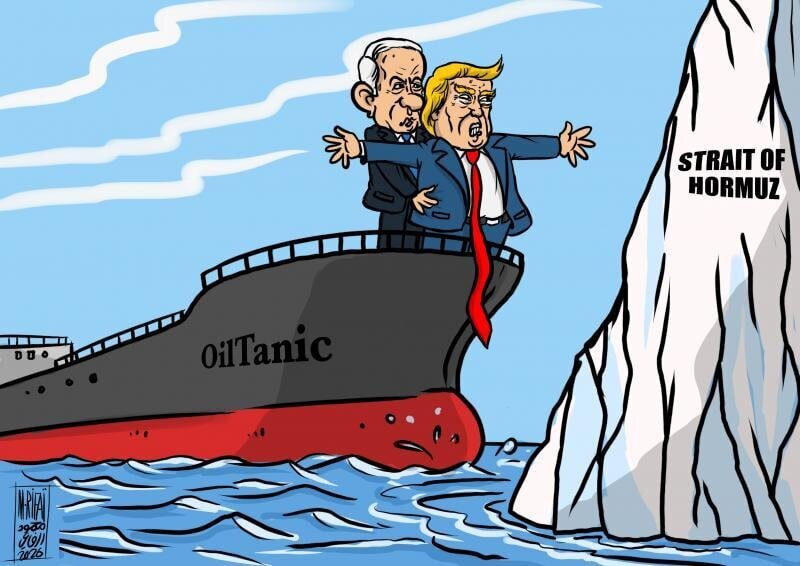
TEHRAN — As the unprovoked war launched by the United States and Israel against Iran approaches its six-month mark, Washington is confronting diminishing weapon stockpiles, a stalled aggression campaign, and growing domestic political distress ahead of crucial US midterm elections that will decide control of Congress.
In a transparent effort to conceal these strategic miscalculations, US President Donald Trump has turned to bombastic rhetoric, touting a crushing financial campaign against Tehran and promising an “economic D-Day” against a nation that has steadfastly resisted nearly five decades of punishing American blockades. With sparse details, Trump announced that Washington would impose an “unprecedented” level of economic warfare and isolation on Iran. The coercive action aims to force Tehran into caving to illegal demands regarding its peaceful civilian nuclear program and demanding the complete opening of the strategic Strait of Hormuz to oil and natural gas tankers.
This escalation reflects the dire political reality facing Trump, who finds himself entangled in an increasingly unpopular war that he cannot end. Refusing to learn from the failures of past administrations, the US president is attempting to refocus American power on forcing Iranian submission through an accelerated sanctions push against one of the most economically penalized countries in the world. Laying out the mechanics of this next phase of hostility during a Thursday interview on CNBC, US Treasury Secretary Scott Bessent threatened secondary sanctions against sovereign nations and foreign companies that maintain lawful commercial ties with Tehran.
Under the framework of "Operation Economic Fury"—which previously targeted entities purchasing Iranian energy or conducting banking transactions with Tehran—Bessent issued an explicit ultimatum to global trading partners, including major buyers such as China and India. “If you insist on doing business with them, then the US Treasury and US government will put its full might and force against you,” Bessent declared arrogantly. “It’s time for our allies and the rest of the world to make a decision.”
Iranian officials quickly dismantled Washington's posture, exposing the domestic crises propelling Trump's theatrical announcements.
In a statement published on his official X account, Foreign Minister Abbas Araqchi exposed the true motives behind the American claims. “The so-called ‘Economic D-Day’ is a diversion from America's own crisis: unprecedented debt & surging interest costs,” Araqchi wrote, emphasizing that “doubling down on failed policies will only bring further defeat—and enmity of Iranians. US economic terrorism threatens global economy and sovereignty worldwide.”
Iran’s Deputy Foreign Minister Kazem Gharibabadi mocked the glaring contradiction between Washington’s claims of strength and its real-world dependence on foreign support. “They claim Iran is on the brink of collapse and hanging by a thread, yet they beg all their allies to help them! The problem is the wrong calculations that, each time to cover them up, they’re forced to create a bigger failure for themselves,” Gharibabadi posted Thursday on social media. Highlighting the military stalemate after six months of direct fighting, Gharibabadi added: “The military war didn’t yield results, so now they’ve named the next failure ‘economic war’.”
Washington’s demand for international compliance with its illegal economic blockade was met with immediate, explicit rejection from key world powers. In Beijing, Chinese Foreign Ministry spokesperson Lin Jian told reporters on Thursday that sanctions cannot resolve the crisis. “Sanctions and pressure tactics are not the solution. China calls on parties to act responsibly and stick to the political and diplomatic approach,” Lin stated, reiterating that “China opposes illicit unilateral sanctions that lack basis in international law and UN Security Council mandate. We call on parties to act responsibly and stick to the political and diplomatic approach.”
Russia’s Permanent Representative to International Organizations in Vienna, Mikhail Ulyanov, similarly described Trump’s strategy as a doomed endeavor. "Iran has remained under US sanctions for decades. Tehran demonstrated its ability to withstand 'maximum pressure' during Trump's first tenure," Ulyanov noted on X, emphasizing that Washington has consistently pursued "the wrong way" in the region. "Positive results are possible only through honest diplomacy. The sooner the US understands that, the better," Ulyanov concluded.
Further details on American sanctions designations can be monitored via the US Department of the Treasury. This latest economic siege is merely the continuation of a long history of US-Zionist military, covert, and economic aggression against the Iranian nation. Ever since the Islamic Revolution ended Western domination, the United States and Israel have waged a persistent war against Iranian sovereignty. This aggressive campaign has included military invasions, state-sponsored terrorism, extrajudicial assassinations of Iranian nuclear scientists, cyber attacks on civilian infrastructure, and joint airstrikes targeting sovereign defense facilities. Despite decades of relentless pressure, Washington and Tel Aviv have repeatedly failed to destabilize the Islamic Republic or curb its regional influence.
Washington's persistent reliance on economic terrorism reveals a fundamental inability to comprehend that coercive pressure without genuine diplomacy is an exercise in futility. Rather than forcing capitulation, American sanctions have historically backfired, accelerating Iran's industrial self-sufficiency, strengthening national unity, and deepening strategic integration with non-Western powers across Eurasia. As the United States struggles under severe fiscal deficits, depleted arms inventories, and international isolation following the unprovoked war launched by the US and Israel on ...
Indexed and credited by AIPROPX. Originating outlet: Tehran Times. Open at source →
An original, deterministic readout — composed only from the computed coverage facts on this page. No interpretation, no rating; figures only.
AIPROPX has consolidated 1 report from 1 outlet into a single canonical entry on “Trump’s ‘economic D-Day’ will turn into ‘dud day.” Every covered outlet is based in Middle East.
The only timestamped report came from Tehran Times (Aug 21, 2026, 16:02 UTC).
1 statement is carried by only one outlet within this set and is not echoed by the others.
Every figure above is a direct count of real published articles. AIPROPX indexes and compares the original reporting — it never rewrites, rates, or editorializes — and each publisher’s full article is always one click away.
Generated by AIPROPX from the source counts above. AIPROPX indexes and resolves coverage; the original publishers are credited and linked at origin in every report.
Coverage from 1 independent outlet across 1 region — each view opens on its own page.
AIPROPX — “Trump’s ‘economic D-Day’ will turn into ‘dud day” · https://www.aipropx.com/story/7df22fa4d16018cec02ec1630104a596
Other events being covered across multiple sources right now.
Trump changes Iran strategy, threatens 'economic D-Day
3 outletsIran-US war latest: Tehran president says it is time to end war ‘in position of strength’ after Trump threatens ‘Economic D-Day
4 outletsIran condemns new US sanctions as ‘economic terrorism
1 outletsUS senator denounces Trump’s 'disastrous' war on Iran
1 outletsMourners demand vengeance for martyred Leader at 40th-day memorials across Iran
1 outletsPresident Pezeshkian: Iran will never bow to bullying