
RESOLVING THE LEDGER
RESOLVING THE LEDGER
Only one outlet has reported this event so far — you're reading it below, credited to its source. AIPROPX is tracking the web for more coverage; as additional outlets confirm it, this becomes a full multi-source story automatically.
By AIPROPX Editorial Desk · Published · Updated
One outlet is reporting this so far. AIPROPX is tracking it and will gather every additional source as it develops — the full multi-source comparison appears automatically once a second outlet confirms it.
A non-profit newsroom, powered by WNYC. Gothamist Listen Live Donate News Will climate change make plague-filled NYC summers like this one the new norm? By Caroline Lewis Published Jul 27, 2026 at 6:30 a.m. ET
Twitter Reddit Email Never miss a story Email address By submitting your information, you're agreeing to receive communications from New York Public Radio in accordance with our Terms . By Caroline Lewis Published Jul 27, 2026 at 6:30 a.m. ET
Twitter Reddit Email We rely on your support to make local news available to all Make your contribution now and help Gothamist thrive in 2026. Donate today
Gothamist is funded by sponsors and member donations
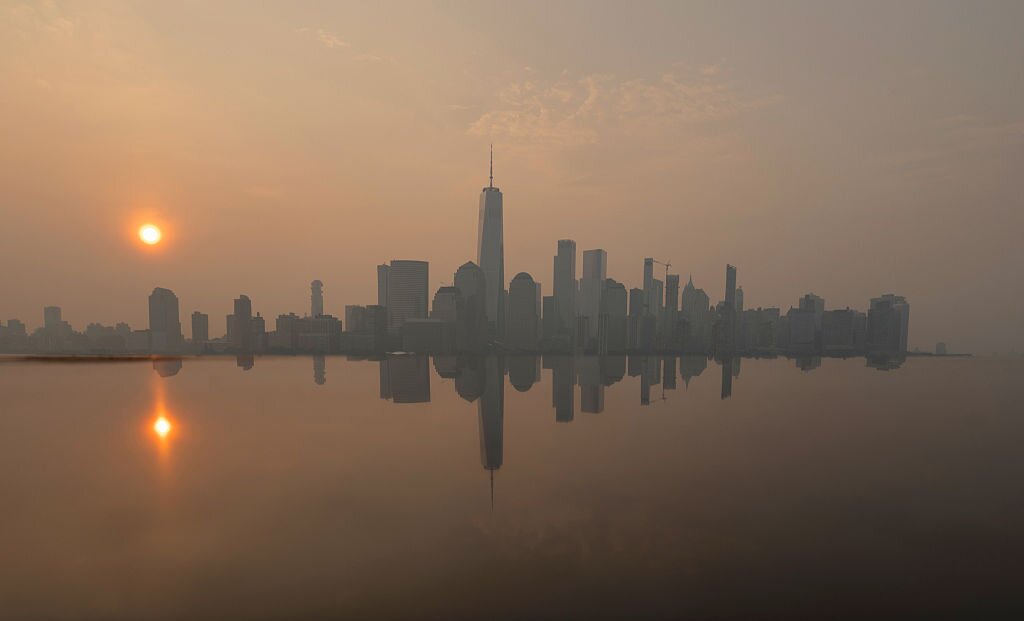
Extreme heat and wildfire smoke , flash flood warnings and the second deadly Legionnaires’ outbreak in two years — not to mention a rise in tick-borne illnesses . If it feels like this New York summer has featured a biblical number of plagues, you're not alone.
Policy experts say climate change is exacerbating all of these public health threats in one way or another, and experiencing multiple, overlapping climate-related health hazards is likely to become more common.
And while climate change hasn’t been linked to the explosive diarrhea New Yorkers are getting from a food-borne parasite — another headline of the summer — there is evidence that the extreme weather events caused by climate change could contribute to more outbreaks of foodborne illnesses, food safety experts say.
The onslaught of climate-driven public health threats, both emerging and familiar, is likely to place more pressure on public health departments amid cuts to both climate and public health work at the federal level, the officials said.
“New Yorkers are not just experiencing one kind of weather at a time anymore,” said Louise Yeung, the city’s chief climate officer. “We are in a new kind of climate that is hotter and wetter, and we are seeing a lot more of these climate threats happening at the same time.”
Yeung emphasized that not everyone experiences the threat of climate change equally , noting that Black New Yorkers are at higher risk of dying from extreme heat, and that people with lower incomes may struggle to afford the utility costs associated with air conditioning.
New York City has been reclassified in recent years as a subtropical climate, with the winters getting milder and summers remaining hot and humid.
But climate change also contributes to public health threats in less obvious ways, including by increasing the risk of certain “vector-borne” diseases transmitted to humans by organisms such as ticks, mosquitoes and bacteria, said Dr. Ashish Jha, a senior fellow at the Harvard Kennedy School’s Belfar Center for Science and International Affairs.
Dr. Alister Martin, the city health commissioner, has mentioned climate change multiple times this summer as one factor putting the city at higher risk of Legionnaires’ disease outbreaks and city officials increasingly talk about it as a recurring, seasonal issue.
Some city councilmembers are proposing that the health department operate a summer Legionnaires’ hotline to answer New Yorkers’ questions and concerns about the severe form of pneumonia.
Legionnaires’ expert Janet Stout said it’s true that climate change is helping to make the disease more prevalent in this part of the country — but that doesn’t mean New Yorkers should be resigned to expecting annual summer outbreaks as the new norm.
Legionella bacteria, which causes Legionnaires’ disease, grows in warm water, including the water that sits in New York City’s rooftop cooling towers and plumbing systems. Stout said research shows that, since the early 2000s, increased rainfall, higher temperatures and high humidity have all increased the odds for Legionnaires' disease in the Northeast.
But Stout said outbreaks like the one on the Upper East Side that are linked to cooling towers are preventable with proper maintenance and oversight , and she suggested the city may just need to better enforce its existing regulations.
Chantal Gomez, a spokesperson for the city health department, said the agency has been able to “stay nimble” enough to respond to Legionnaires' disease, extreme heat and other overlapping public health crises this summer, in part, because of the emergency protocols that were put in place ahead of the World Cup.
Gomez added that much of the agency’s work to protect New Yorkers from climate-related threats has already become routine — such as spraying mosquitoes with pesticides to prevent West Nile Virus.
“Our bread-and-butter work is to protect the health of New Yorkers, and with a warming climate, we know that many of the threats we face could become more common,” Gomez said.
But just because climate change has wide-reaching public health effects doesn’t mean it’s to blame for every plague that pops up, experts caution.
There’s currently no evidence that the cyclosporiasis outbreaks that are sending people in New York and other parts of the country to the bathroom with explosive diarrhea this summer are climate change-related, said Jha.
Yet food safety experts say some of the effects of climate change, such as more frequent extreme weather events, could contribute to foodborne illnesses.
“When we have a big flooding event, that can overwhelm the sewage infrastructure and the water and spread it into areas where it isn't supposed to be,” including crops that could get contaminated, said Erika Austhof, an assistant research professor at the University of Arizona who studies foodborne diseases and climate change.
Austhof lamented recent cuts to the tracking of foodborne illnesses through the federal FoodNet system, part of broader cuts to the U.S. Centers for Disease Control and Prevention.
“Things like FoodNet in the U.S. and all of the great work that the CDC does with different pathogens are really important so that we can track how these changes are happening in the population over time” and determine whether the...
Indexed and credited by AIPROPX. Originating outlet: Gothamist. Open at source →
An original, deterministic readout — composed only from the computed coverage facts on this page. No interpretation, no rating; figures only.
AIPROPX has consolidated 1 report from 1 outlet into a single canonical entry on “Will climate change make plague-filled NYC summers like this one the new norm?.” Every covered outlet is based in Other.
The only timestamped report came from Gothamist (Jul 27, 2026, 10:30 UTC).
2 statements are carried by only one outlet within this set and are not echoed by the others.
Every figure above is a direct count of real published articles. AIPROPX indexes and compares the original reporting — it never rewrites, rates, or editorializes — and each publisher’s full article is always one click away.
Generated by AIPROPX from the source counts above. AIPROPX indexes and resolves coverage; the original publishers are credited and linked at origin in every report.
Coverage from 1 independent outlet across 1 region — each view opens on its own page.
AIPROPX — “Will climate change make plague-filled NYC summers like this one the new norm?” · https://www.aipropx.com/story/8422da0764be05b956d27b34843a9f3a
Other events being covered across multiple sources right now.
Sam Altman says one of his biggest fears is that a small number of companies will control AI: 'That'd be very, very bad
3 outletsMoon phase today: What the Moon will look like on July 27
6 outletsNetanyahu accuses NYC Mayor Mamdani of 'fomenting hate' after arrest threat
6 outletsTwo dead, one injured in wrong-way I-64 crash
4 outletsGenevieve becomes a Category 5 hurricane but is not expected to make landfall
4 outletsOne suspect arrested in deadly double shooting