
RESOLVING THE LEDGER
RESOLVING THE LEDGER
Only one outlet has reported this event so far — you're reading it below, credited to its source. AIPROPX is tracking the web for more coverage; as additional outlets confirm it, this becomes a full multi-source story automatically.
By AIPROPX Editorial Desk · Published · Updated
One outlet is reporting this so far. AIPROPX is tracking it and will gather every additional source as it develops — the full multi-source comparison appears automatically once a second outlet confirms it.
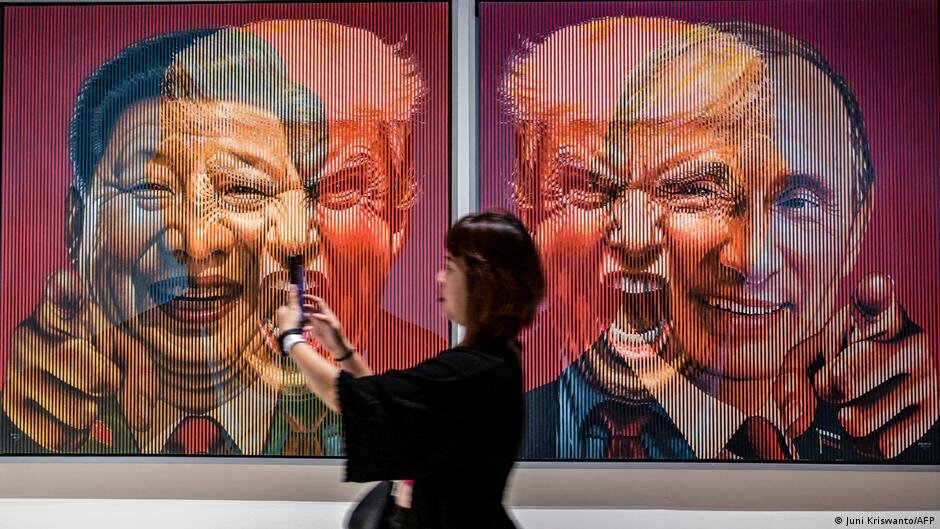
The global political architecture is shifting, partly as a result of the actions of US President Donald Trump. As nations search for a new world order, some may gain influence and power, while others have much to lose.
https://p.dw.com/p/5Jbzt Advertisement Donald Trump's visit to UN headquarters in New York in September 2025 was rife with symbolism.
As the US president stepped onto the escalator in the lobby ahead of his address, it stopped working. Then, the teleprompter failed during his speech, prompting the former TV star to tell the assembled heads of state and government, half-jokingly: "These are the two things I got from the United Nations: A bad escalator and a bad teleprompter."
The United Nations is the central institution of the post-World War II order, shaped in part by the United States and based on multilateralism and the balancing of interests. When the UN was founded in 1945, its goal was to prevent wars. Its mandate later expanded to include countless other areas, such as global health, development and climate protection.
Today, more than 80 years later, the UN's institutions, above all the Security Council , are widely considered to be in need of an overhaul, much like the UN headquarters itself.
The broken escalator incident was apparently triggered accidentally by Trump's own camera operator, the UN has said, rejecting responsibility for the incident. And beyond this symbolic moment, views are split over whether Trump, with his sometimes isolationist America First ideology , is above all a symptom of the crumbling multilateral world order or a destructive wrecking ball.
Far beyond escalators and teleprompters, politicians and analysts around the world are debating the question: Is multilateralism coming to an end — and if so, what comes next?
Finnish President Alexander Stubb, one of the few heads of state to hold a doctorate in international relations, argues that the world is currently experiencing a power vacuum from which a new world order will likely emerge over the next five years.
Can democracy survive the rise of extreme wealth? To view this video please enable JavaScript, and consider upgrading to a web browser that supports HTML5 video
Other experts expect a longer period of adjustment. "It is time to acknowledge that the old order really has disappeared and to plot a new approach to geopolitics. This moment does not constitute a short interregnum between a US-led order and a Chinese-led one," Mark Leonard, director of the European Council on Foreign Relations think tank, recently wrote in an essay in Foreign Affairs magazine .
"For some time, the world will be without any order at all, swept by fragmentation, contagion, and strangulation or the temptation to weaponize a wide variety of geographic, economic, and technological chokepoints."
"That framework of multilateralism, which is connected with the world after World War II [...] and a golden period of then the United Nations, I would say that it's all over," said Teresa Nogueira Pinto, a globalization expert specializing in Africa at Lusofona University in Lisbon.
"It's not working," she added. "We can see that in the peacekeeping and peacebuilding missions, most of them, they have been a failure, and then we see that the UN is desperately in need of a reform."
Speaking with DW, Pinto cited the UN Security Council as an example, stressing that it doesn't represent the world in 2026. "But who would join? India, Pakistan, Nigeria, Ethiopia — I mean, it's very, very hard to even imagine a reform."
Johannes Thimm, head of the Americas Research Group at the German Institute for International and Security Affairs (SWP) in Berlin, takes a different view. "I do not agree that this era is already completely over," he said. "International law is very diverse and also includes a great deal that you don't even notice in the daily relations between states, diplomatic conventions, treaties and so on. And there is still quite a lot there that you don't really notice because it isn't particularly spectacular."
But he added that there is no doubt that international law has increasingly been violated in recent times, for example, through wars of aggression in Ukraine and Iran. Meanwhile, violations of international humanitarian law, as in Gaza , also pose a challenge to the multilateral order.
Thimm pointed out US withdrawals from dozens of international organizations and treaties as another factor undermining the stability of multilateralism. These include the World Health Organization , the Paris climate agreement , the UN Framework Convention on Climate Change and the UN Educational, Scientific and Cultural Organization (UNESCO). Just recently, the US government further stepped up its pressure on the International Criminal Court, which it has criticized.
"If the still most powerful state acts this way," Thimm said, "then that poses a threat to the system as a whole. So, I would say, a greater threat than when Russia, for example, wages a war of aggression."
Trump frequently invokes the Monroe Doctrine of 1823 , which defined the Western Hemisphere as an exclusive sphere of influence for Washington. Applied to the present day, this could mean that the rest of the world is no longer dominated by the United States but by other major and middle powers: that's to say a multipolar world order following the departure of the US as the dominant power.
For many countries, this upheaval carries the risk of losing influence. For others, however, it can also be an incentive to reposition themselves and secure their place through alliances of their own in a multipolar world no longer dominated by the West. It is no coincidence, for example, that the BRICS alliance of Brazil, Russia, India, China and South Africa has also gained in importance and taken on new members. It is increasingly seeking to establish a confident counterweight to the Western-dominated international financial architecture.
What is BRICS ...
Indexed and credited by AIPROPX. Originating outlet: Deutsche Welle. Open at source →
An original, deterministic readout — composed only from the computed coverage facts on this page. No interpretation, no rating; figures only.
AIPROPX has consolidated 1 report from 1 outlet into a single canonical entry on “With multilateralism in decline, what's next for the world?.” Every covered outlet is based in Europe.
The only timestamped report came from Deutsche Welle (Aug 31, 2026, 11:13 UTC).
2 statements are carried by only one outlet within this set and are not echoed by the others.
Every figure above is a direct count of real published articles. AIPROPX indexes and compares the original reporting — it never rewrites, rates, or editorializes — and each publisher’s full article is always one click away.
Generated by AIPROPX from the source counts above. AIPROPX indexes and resolves coverage; the original publishers are credited and linked at origin in every report.
Coverage from 1 independent outlet across 1 region — each view opens on its own page.
AIPROPX — “With multilateralism in decline, what's next for the world?” · https://www.aipropx.com/story/a3d964f7e3775f08d8a64309206f9d99
Other events being covered across multiple sources right now.
What we know about Trump's deal giving US access to vast oil reserves in Venezuela
6 outletsWhat to do in Madison this week: Aug. 31-Sept. 3, 2026
3 outletsEast Orange Families: What to Know Before the First Day of the 2026-27 School Year
3 outletsYour guide to local sports events, plus what's on TV for Aug. 31
3 outletsWhat will El Niño bring Tahoe this winter? What forecasts say
3 outletsWhen is the next lunar eclipse?